It is tempting to talk about the Northeast Tennessee–Southwest Virginia housing market as though it were one thing. The numbers suggest otherwise.
Looking at single-family sales over the past 12 months by ZIP-area population reveals a series of distinct submarkets—urban, suburban, small-town and rural.
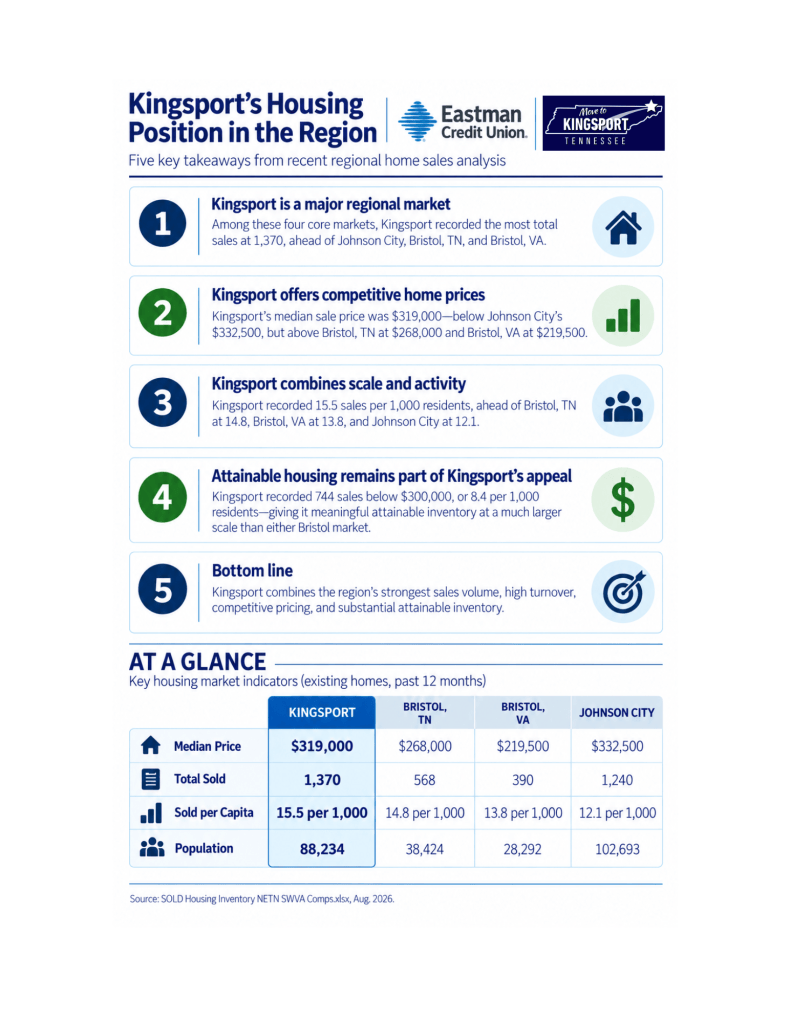
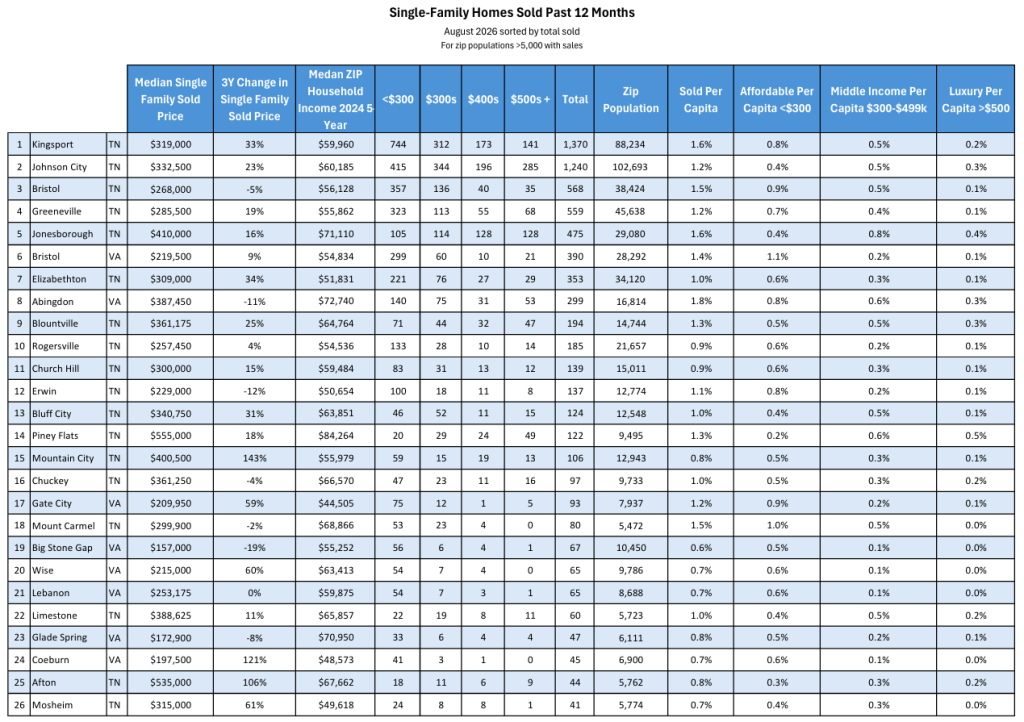
Kingsport and Johnson City naturally lead in total activity, but their sales mix differs. Kingsport records about 15.5 sales per 1,000 residents, compared with 12.1 in Johnson City. Kingsport also produces 8.4 sales below $300,000 per 1,000 residents—more than twice Johnson City’s 4.0—while Johnson City has more middle- and upper-price activity.
The more interesting story is spatial.
A higher-price suburban and exurban corridor is visible from Jonesborough through Johnson City’s northern suburbs, Piney Flats and Blountville toward Kingsport.
Jonesborough records 16.3 total sales per 1,000 residents, including 4.4 above $500,000. Piney Flats is the clearest example: its median sale price is $555,000, and 49 of 122 sales exceeded $500,000. Blountville, Afton and Limestone also show relatively strong middle- and upper-price activity for their size.
Hawkins County illustrates how the market changes as distance from an urban center increases. Mount Carmel, closest to Kingsport, combines household income of nearly $69,000 with 14.6 sales per 1,000 residents and 9.7 sub-$300,000 sales—an unusually favorable combination of income, activity and attainable inventory. Church Hill occupies a middle position. Farther west, Rogersville has a lower median price but fewer sales per capita and much less upper-end activity. The pattern suggests a transition from a Kingsport-influenced suburban market toward a more independent small-town and rural market.
Other affordable submarkets include Bristol on both sides of the state line, Greeneville, Erwin, Gate City and much of far Southwest Virginia. Bristol, Virginia, records 10.6 sub-$300,000 sales per 1,000 residents. Wise, Big Stone Gap, Lebanon and Coeburn remain inexpensive but have fewer transactions and very little activity above $400,000. Abingdon is the major exception, behaving more like an upper-tier Tri-Cities submarket.
The Tennessee–Virginia split is therefore useful context, but not the main story. Northeast Tennessee has more sales per capita and more middle- and upper-price activity; Southwest Virginia has a larger share of sales below $300,000. The stronger dividing line may be urban/suburban versus rural rather than Tennessee versus Virginia.
Income adds another dimension. Nationally, the median single-family home price was about five times median household income in 2024. Kingsport is about 5.3 times income, Johnson City 5.5, Jonesborough 5.8 and Piney Flats 6.6. Bristol, Virginia, is about 4.0, Wise 3.4 and Big Stone Gap 2.8.
Three-year price changes explain part of the pressure. Kingsport’s median sale price rose nearly 33%, Johnson City 23%, Elizabethton 34% and Blountville 25%. Smaller markets sometimes show much larger swings, but those percentages can be heavily influenced by the types of homes sold; a rising median does not mean every house appreciated by that amount.
The region remains inexpensive in absolute dollars compared with many parts of America, but affordability is increasingly uneven. It depends not just on price, but on income, the number of homes available at attainable prices, and where those homes are located.
One region, certainly—but increasingly, several different housing markets.


Leave a comment