Move To Kingsport Quarterly Report April-June, 2026
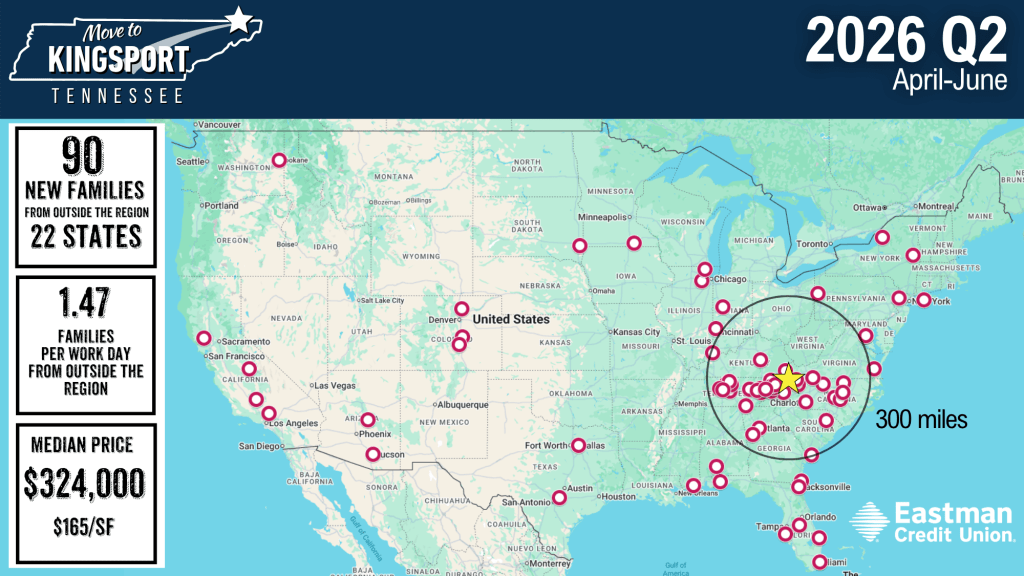
Kingsport continues to welcome new families from across the country, though at a slower pace than last year. From April to June, 90 families moved to Kingsport from outside the region, representing 22 states. That works out to about 1.47 new families per workday.
This report does not consider every home sale or every move in to or out of Kingsport. It focuses only on newcomers moving here from outside the region. It does not include people moving from one Kingsport neighborhood to another or families relocating from nearby Tri-Cities communities.
That focus is intentional. The Move to Kingsport program is designed to grow Kingsport’s economic base by attracting new households, income, and investment from outside the area. Local moves are important, too, but they mostly shift people and dollars already within the regional economy.
The comparison with last year shows a clear slowdown. During the same three-month period in 2025, 198 families moved here from 39 states. This year’s total of 90 families is down by a little more than half. That does not mean interest in Kingsport has disappeared. It means the fast-moving relocation wave that followed the pandemic has cooled. People are still coming, but the pace has settled down.
The map tells an important part of the story. New residents came from the West Coast, Florida, Texas, Colorado, the Midwest, the Northeast, and many parts of the Southeast. Since 2020, the Move to Kingsport data has tracked 4,704 families moving here from 52 states or postal areas. Over that longer period, the top sources have included Tennessee, Florida, North Carolina, California, Virginia, Texas, New York, Georgia, South Carolina, and Kentucky.
From April through June of this year, Tennessee was by far the largest source of new families. Thirty-seven of the 90 families came from within Tennessee, or about 41 percent. North Carolina and Florida followed with eight families each. Several other states and Washington, D.C., also appeared among the leading sources.
Most newcomers come from places within a half-day drive. Some already know the region. Some have family nearby. Others are looking for a smaller city with good quality of life, lower costs, outdoor recreation, and access to larger regional markets when needed.
The housing numbers are also worth noting. The typical home purchased by these outside-the-region newcomers had a median price of $324,000, or about $165 per square foot. That was slightly lower than the same period last year, when the median price was $330,000, or about $168 per square foot. While the number of families relocated dropped sharply, home prices did not. The typical purchase price was only down about 1.8 percent from last year.
Since 2020, the median purchase price has been $287,875, or about $143 per square foot. The April-through-June median of $324,000 is about 12.5 percent higher than the since-2020 median. Nearly half of the homes purchased by these newcomers were below $300,000, compared with about 38 percent during the same period last year.
This is where the idea of grounded growth comes in. Kingsport benefits when enough new families move here from outside the region to add income, investment, volunteers, workers, customers, and future taxpayers. But the goal should not be growth at any cost. Grounded growth means welcoming outside interest while protecting the ability of local families, first-time buyers, retirees, teachers, public safety employees, service workers, and young adults to buy homes and remain here.
That is the balance Kingsport needs: not too hot, not too cold, but just right. The relocation surge has slowed, but Kingsport is still attracting new families, still drawing from a wide area, and still offering strong value. The challenge now is to keep telling the Kingsport story while protecting what makes the city attractive in the first place.


Leave a Reply