In retirement, I’ve spent a lot of time working on the landscaping around my 55-year-old house. The house sits beneath towering oaks that were there long before the first footing was poured. They give the place shade, structure, and character. The foundation plantings came later, when the house was built. Over time, some of them became overgrown, leggy, and tired — not beyond repair, but in need of thoughtful renewal through pruning, shaping, clearer edges, stronger borders, and a few well-placed new plantings.
A city is not so different.
Move to Kingsport is not about tearing out what gives this community its character. It is about respecting the deep roots already here — the people, neighborhoods, churches, schools, industries, volunteers, and civic memory that give Kingsport its strength — while thoughtfully adding the new energy, investment, and life needed for the next generation.
Before we begin, I want to offer a special thank-you to Eastman Credit Union for sponsoring. ECU has long been more than a financial institution in our community. They are a true community partner — investing in people, supporting local organizations, strengthening families, and helping make our region a better place to live, work, and raise a family.
Our work is about more than attracting new residents. It is about helping people see the full value of this community — our quality of life, our neighborhoods, our schools, our affordability, our outdoor assets, and the people and institutions that make this place feel like home.
Eastman Credit Union understands that story because they have helped build it. Their support allows us to continue telling our story in a thoughtful, credible way and to connect with people who are looking for exactly what this community has to offer.
I recently shared this update at an in-person event at the Chamber of Commerce. It spans the 20-year history of the Move to Kingsport program. We usually share information every month, but rarely look back at the longer trends. I realize that data and metrics can cause many to glaze over, but this one is especially important to understand the direction our city is moving. It consists of 3 topics and 5 slides that put it all together.
INTRODUCTION
The foundation of traditional economic development is jobs, wages, employers, retail, etc. That is the most important work.
Move to Kingsport is a supplemental economic development strategy. What began in 2006 as a response to industries’ downsizing and employees leaving is still just as relevant today.
Traditional economic development focuses on the employment side of the economy.
Move to Kingsport focuses on the household side: who is choosing to live here, where they are moving from, what income or assets they bring, and how their spending supports local businesses.
A simple way to think about Move to Kingsport is through three demographic measures: volume, income, and age.
Volume tells us whether people are still choosing Kingsport.
Are households moving here? Are they coming from nearby, or from outside the region? Are we seeing enough household inflow to support organic growth now that annexation of existing neighborhoods has effectively ended?
Income tells us whether that growth strengthens the economy.
Newcomers may bring wages, retirement income, pensions, Social Security, investment income, savings, remote-work income, business income, or home-sale proceeds from another market. Those dollars support local businesses, nonprofits, churches, services, and the tax base.
Age tells us what kind of community growth is happening.
Are we adding young families, retirees, empty nesters, remote workers, singles, or households without school-age children? That matters because population growth, school enrollment, housing demand, and neighborhood turnover don’t move one-for-one.
This is especially important because less than half of Kingsport residents are employed. That does not mean the rest are unemployed.
“Unemployed” means someone is looking for work but does not have a job.
“Not in the labor force” includes retirees, students, stay-at-home parents, caregivers, people with disabilities, and others not actively seeking work.
But people outside the labor force still participate in the economy. They buy groceries, eat in restaurants, hire contractors, support churches and nonprofits, use services, pay taxes directly or indirectly, volunteer, and contribute to community life.
So, jobs and wages are the foundation. Move to Kingsport supplements that foundation by attracting households, outside income, and balanced demographic growth.
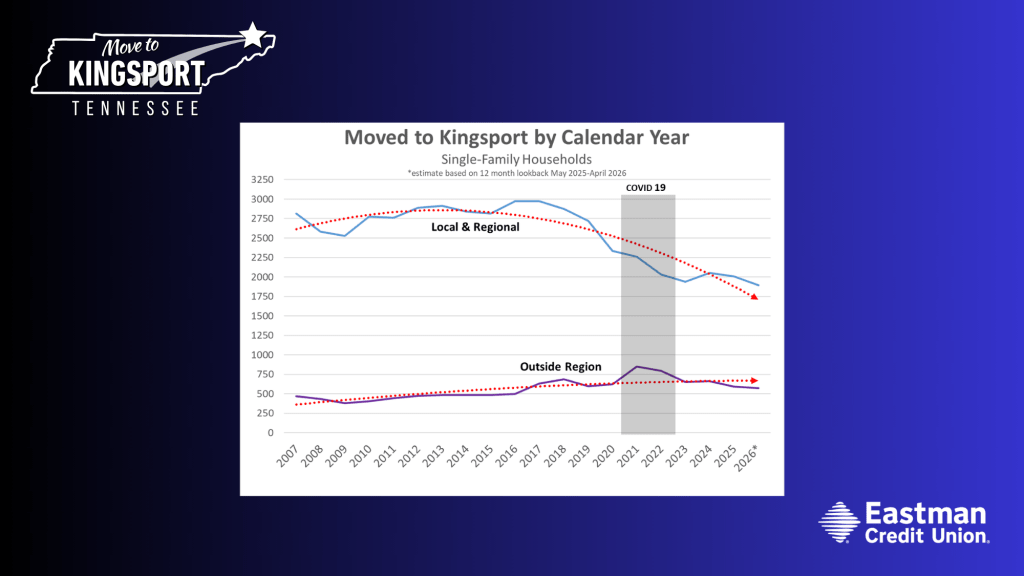
This first chart is about volume — how many households are moving into single-family homes served by the Kingsport water, and where they are coming from.
It is important to define the data carefully. This chart shows new single-family water account occupants in Kingsport’s water service area. It is not a city-limits population count, and it is not just homeowners. Renters in single-family homes can be included. Apartments, multi-family buildings with shared meters, and senior housing are not fully captured.
The blue line shows moves from less than 35 miles away. Those local and regional moves have declined from earlier levels.
The purple line shows moves from more than 35 miles away. That number is smaller, but it has been comparatively steady, peaked in 2021, and is now closer to pre-COVID levels.
That combination is important.
If both lines were rising sharply, Kingsport would look more like a hypergrowth market — the kind of fast-growing Nashville suburb where local movement and outside demand are both accelerating, often putting major pressure on roads, schools, infrastructure, and housing prices.
If both lines were falling, we would look more like a Rust Belt or Appalachian community where local movement is weakening, outside demand is also disappearing, and the economy is struggling.
But that is not what the chart shows.
Kingsport is in the middle. Local turnover has slowed, but longer-distance moves have remained comparatively steady. That points to a tighter housing market, not a collapsing one — and it makes out-of-region newcomers more important to economic stability.
“Churn” simply means turnover — the normal life cycle of homes and neighborhoods. Young families become empty nesters. Empty nesters become older residents. Eventually homes turn over, and another household moves in.
When that cycle slows, housing feels tight. Fewer homes become available. Local families have fewer choices. Empty nesters who might downsize may not have good options. Homeowners with low mortgage rates may stay put.
But turnover is only one side of the supply story. New construction is the other.
Existing-home turnover is about homes already in the market. New construction is the pressure release when those homes are not turning over. When both are limited — fewer existing homes cycling through the market and not enough new housing to fill the gap — inventory gets tight and prices rise.
That is partly a national issue. After the 2008 housing crash, homebuilding slowed across the country. Builders pulled back, lending became tighter, labor became harder to find, development costs rose, and many communities spent years underbuilding.
Kingsport has its own local version of that problem: not just how many units are built, but what kind, where, and at what price point.
So the issue is not mainly “too many newcomers.” The issue is too few homes turning over, and not enough new construction across the full housing ladder to offset that slowdown.
Newcomers may add pressure at the margin, especially if they bring outside income or home equity. But if out-of-region newcomers stopped arriving tomorrow, Kingsport would still have limited inventory, mortgage lock-in, aging in place, higher construction costs, and too few housing choices.
What would disappear is the new income and spending those newcomers bring.
Takeway:
Kingsport is not hypergrowth, and it is not decline. It is grounded growth — but grounded growth still needs newcomers, housing turnover, and new construction across the full ladder.
Growth after annexation has to be organic
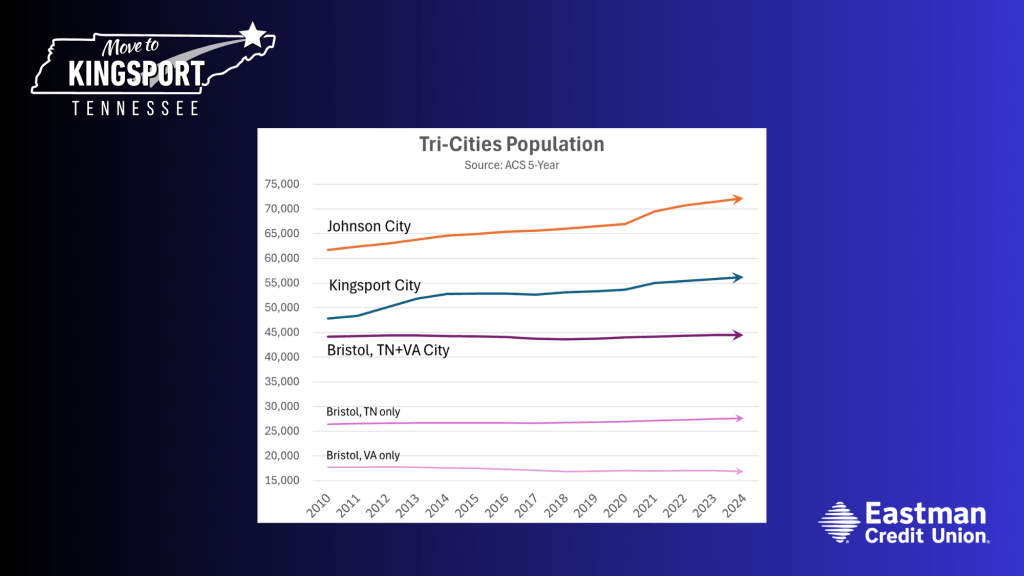
This chart continues the volume story, but at the citywide population level.
Johnson City has grown the fastest. Bristol, TN, has grown slightly, Bristol, VA, has declined, and combined, Bristol is relatively flat. Kingsport is in the middle: growing steadily but not exploding.
Middle is good. I call it the Goldilocks principle: not too hot, not too cold, but just right.
If you travel north of Kingsport on U.S. 23, you’d have to drive more than 5 hours to find the next place with a positive population growth. We stand on the precipice. What keeps us from crossing that line? Newcomers.
Maintaining positive population growth matters because annexation of existing neighborhoods effectively ended in 2015. Before then, some population growth could come from adding already-developed neighborhoods.
That makes out-of-region newcomers more important, not less. In a post-annexation city, attracting households is part of organic economic development. We are no longer growing by simply adding developed neighborhoods. Growth has to come from people choosing Kingsport. That’s the reason it’s so important for the city to invest in quality of life initiatives like parks, recreation, seniors, and education.
Takeaway: After Tennessee’s annexation laws changed, Kingsport’s growth had to be earned rather than acquired, and we’re still slowly growing organically 11 years later.
Life Stage Explains Turnover and School Enrollment
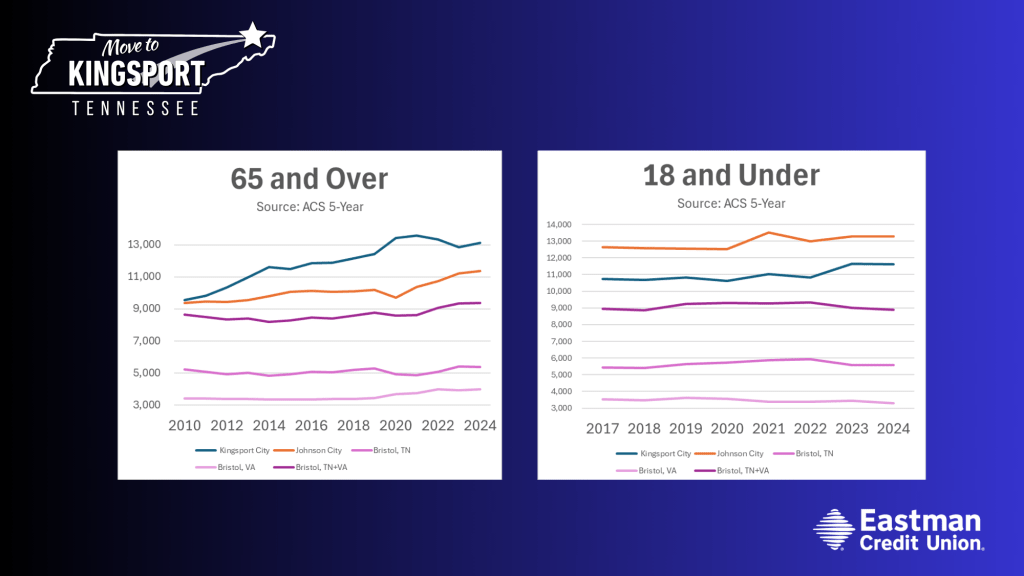
These charts shift from volume to age. They show why population growth, school enrollment, and housing turnover don’t move one-for-one.
Kingsport has the largest 65-and-over population among the cities shown. That matters because older residents often age in place. They are more likely to own their homes outright, have low housing costs, love their neighborhood, and want to stay near family, church, doctors, and friends.
That stability is good. Older residents are community anchors. But it also slows the normal life cycle of housing. A home that once might have turned over every 10 or 15 years may stay with the same household for 25, 35, or 50 years.
That means fewer single-family homes become available for younger families, local move-up buyers, or newcomers.
The under-18 chart shows the other side, and this includes kids that are not yet in the school system. Kingsport’s child population is relatively stable to modestly higher, but it is not surging. That helps explain why population can grow while school enrollment remains relatively stable.
So, a new resident is not always a new student. Kingsport can add retirees, empty nesters, and singles or couples without children. We can look at our circle of friends and see many who fit that category. They count in population and support the economy, but may add no K-12 students.
The new school construction in Kingsport is not to accommodate rapidly increasing enrollment from newcomers; it’s to consolidate and right-size classrooms into a single school while closing older facilities. It’s about efficiency with a built-in capacity in case it is needed for the future.
Housing balance is the goal. Kingsport needs options for every stage of life: starter homes, apartments, townhomes, patio homes, senior-friendly housing, and move-up homes.
This is where new construction matters again. If older residents want to downsize but can’t find the right next home, they stay where they are or leave the community altogether. The same applies to growing families or higher-income households who want to move up but cannot find the right next home. If they don’t move up, they don’t create space for others to move into the spaces they’re currently occupying.
Takeaway: Houses stay; the people inside them move through life stages. That is why population and school enrollment are not a one-to-one match.
Income Pressure and Balance
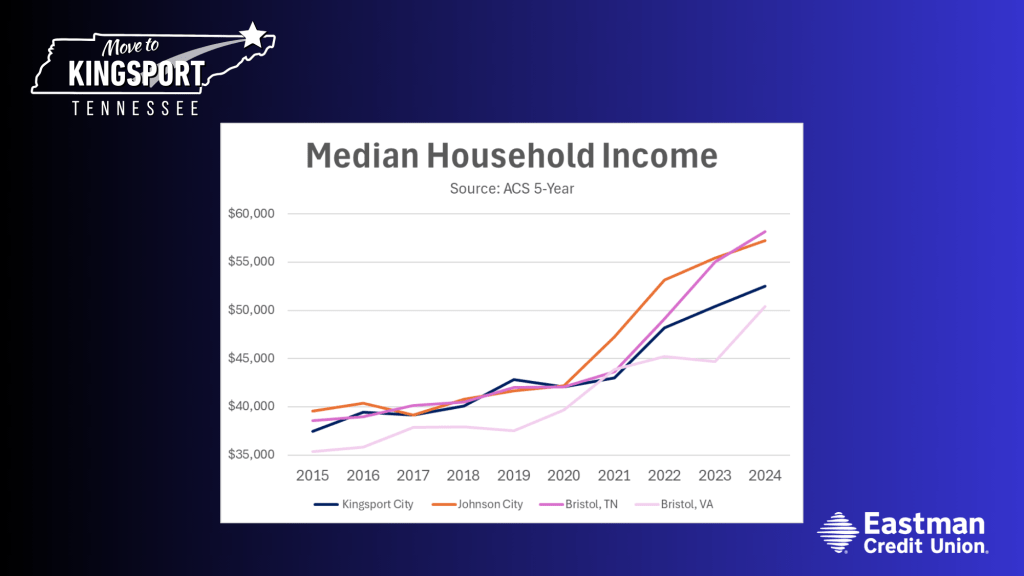
This slide begins the income part of the story.
Median income is the midpoint: half of households are above it and half are below it. It tells us about the typical household.
Kingsport’s median income is lower than Bristol, TN and Johnson City. That matters because affordability is usually felt at the median. A household near the median may struggle with today’s home prices, rents, mortgage rates, insurance, utilities, and everyday costs.
But the larger point is balance.
Kingsport appears to have a wider income spread. In plain English, Kingsport may have both realities at once: more households under financial pressure, and enough higher-income or asset-backed households to pull the average upward.
Kingsport has always been a benevolent community. But benevolence requires capacity. Churches, nonprofits, civic clubs, foundations, volunteer boards, local fundraising, and social-service support all depend on a healthy mix of households across the income spectrum.
If higher-capacity households age out, move away, or choose other communities, the need for help doesn’t go away. The base that can support that help gets thinner.
So the goal is not to become exclusive or unaffordable. The goal is balance: enough attainable housing for households under pressure, and enough higher-income and asset-backed households to sustain the community’s ability to help.
Bristol, TN helps illustrate the difference between median and mean. Its higher median suggests a stronger middle. But because it falls behind Kingsport and Johnson City in mean income, it may have fewer very high-income households pulling the average upward.
Kingsport appears to have more income spread: more pressure at the lower end, but also more upper-end purchasing power.
Takeaway: Kingsport’s median income shows affordability pressure. The larger question is whether we can maintain enough balance to remain the benevolent community we have always been.
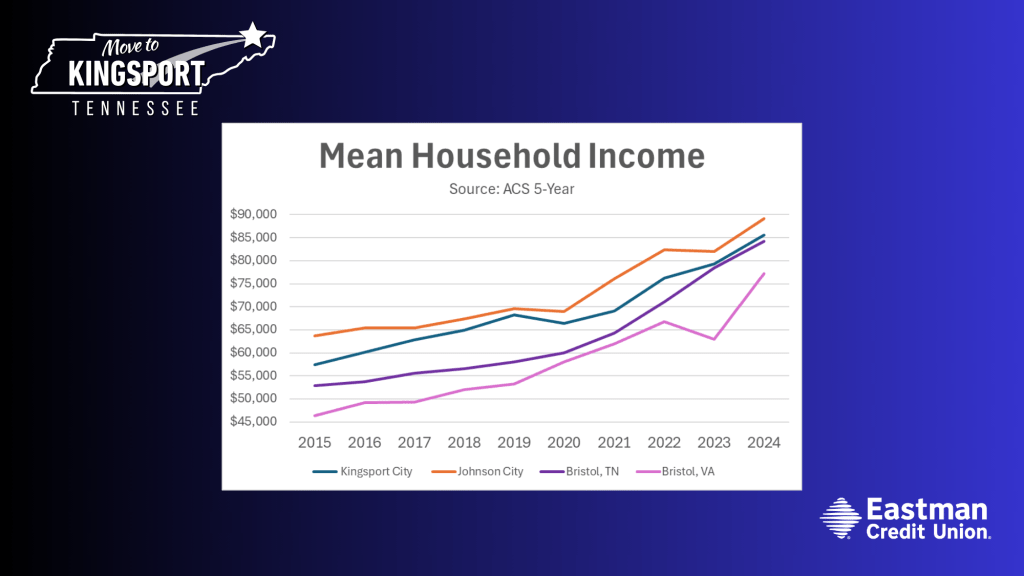
Mean income is the average. It can be pulled upward by higher-income households, so it helps reveal purchasing power that the median income does not fully show.
Kingsport’s mean household income is second among the cities shown. That suggests Kingsport has more purchasing power than the median alone would indicate.
Some of that purchasing power comes from wages, but much of it may come from assets: paid-off homes, retirement savings, pensions, investment accounts, home equity, remote-work income, business income, or proceeds from selling a home in another market.
This is where Move to Kingsport fits.
A newcomer’s value is not limited to whether they take a local job or add a student to the school system. A retiree, remote worker, empty nester, or asset-backed household may bring income that was earned or accumulated elsewhere and then spend it here.
That outside income supports local restaurants, contractors, retail, personal services, churches, nonprofits, professional services, and local tax revenues.
This also connects directly to housing supply. Kingsport needs housing that captures that purchasing power without forcing higher-capacity buyers into the middle of the market.
That means move-up housing matters — including homes in the $500,000-plus range.
I double-checked Zillow this morning. There are twice as many new homes in the $500,000 plus range in Washington County as in Sullivan County. If someone moves to the region, they’re going to have twice as many choices there as here.
A healthy housing market works like a ladder. If a household can afford a $600,000 home but cannot find one in Kingsport, they may stay in a $350,000 or $400,000 home. That keeps the home from the next buyer. Then the next buyer stays put, too. The pressure rolls downhill.
So upper-end housing is not just a luxury issue. It is part of market mobility. It gives higher-capacity households somewhere to go, helps retain and attract them, and can reduce pressure on the middle of the market.
New construction is part of that strategy. The answer is not only more housing units. It is the right mix of housing units: starter homes, rentals, apartments, patio homes, townhomes, senior-friendly housing, infill, and $500,000-plus move-up homes. If the market only builds one or two parts of the ladder, the rest stays stuck.
And I don’t mean taking the same house you could buy in a neighboring county for less and pricing it above $500,000 in Kingsport. At that level, the product has to compete regionally. It needs the amenities, design features, finishes, location, and overall advantages that make buyers say, “This is worth choosing Kingsport.”
Takeaway: Mean income shows Kingsport has purchasing power. The strategy is to capture it here — through newcomer attraction, new construction, and move-up housing — so it strengthens the whole community.
CONCLUSION
County Mayor-Elect Zane Vanover coined the term “grounded growth”, which summarizes where we are today.
Kingsport’s story is not runaway growth, and it is not stagnation. It is steady renewal in a post-annexation city.
We are a legacy manufacturing city, and that history is still very visible in our core neighborhoods. We drive by smokestacks every day. But that doesn’t have to be a limitation. Other legacy communities, like Oak Ridge, have also become stronger residential destinations because people see value, schools, parks, trails, lakes, and quality of life.
Traditional economic development remains the foundation: jobs, wages, employers, retail, restaurants, and investment.
Move to Kingsport supplements that foundation by focusing on the household side of growth: volume, income, and age.
That makes Move to Kingsport a non-traditional economic-development strategy, much like tourism. Tourism brings outside dollars into the community through visitors. They come here, eat in our restaurants, stay in our hotels, shop locally, attend events, visit attractions, and experience our parks and trails.
Move to Kingsport builds on that same idea, but with a longer-term result. Tourism introduces people to Kingsport. Relocation gives them a reason to stay. That is why Visit Kingsport and Move to Kingsport work so well together: both are about bringing outside dollars into the local economy, first through visitors and then through permanent households.
Volume: Are people still choosing Kingsport? Yes — but local single-family turnover has slowed, making longer-distance newcomers more important.
Income: Are residents and newcomers bringing economic capacity? Yes — but Kingsport needs balance: attainable housing for households under pressure, and enough higher-capacity households to sustain local giving, churches, nonprofits, businesses, and services.
Age: Where are residents in the life cycle? Kingsport has a large older-adult population and a stable child population, which helps explain why population growth, school enrollment, and housing demand do not move one-for-one.
The housing challenge is not locals versus newcomers. Kingsport needs both. Locals provide continuity, leadership, memory, neighborhoods, churches, volunteerism, and civic strength. Newcomers bring outside income, new spending, fresh energy, and renewed demand.
Discouraging newcomers would not fix affordability. It would only reduce the new dollars coming into Kingsport. The larger housing issue is a stuck ladder: too few existing homes turning over, and not enough new construction across every rung of the market to relieve pressure.
That is why the better answer is grounded growth: steady household inflow, more housing variety, and a market that lets people move through life stages without leaving the community. That means starter homes, apartments, townhomes, patio homes, senior-friendly housing, infill housing, and true move-up housing — including $500,000-plus homes that are regionally competitive in location, amenities, design, finishes, and overall value.
Closing takeaway: Tourism brings people here to experience Kingsport. Move to Kingsport helps convert that interest into households, income, spending, and long-term community investment. Newcomers are not the reason housing is tight; they are one reason Kingsport’s economy remains resilient despite a tighter housing market.


Leave a Reply