Move To Kingsport Quarterly Report | July–September 2026
Kingsport continues to attract new families from outside the region, but the third-quarter numbers make one thing increasingly clear: the post-pandemic relocation surge has moved into a much quieter phase.
From July through September, 63 families moved to Kingsport from outside the region, representing 18 states based on the current data. That works out to about one new family per workday.
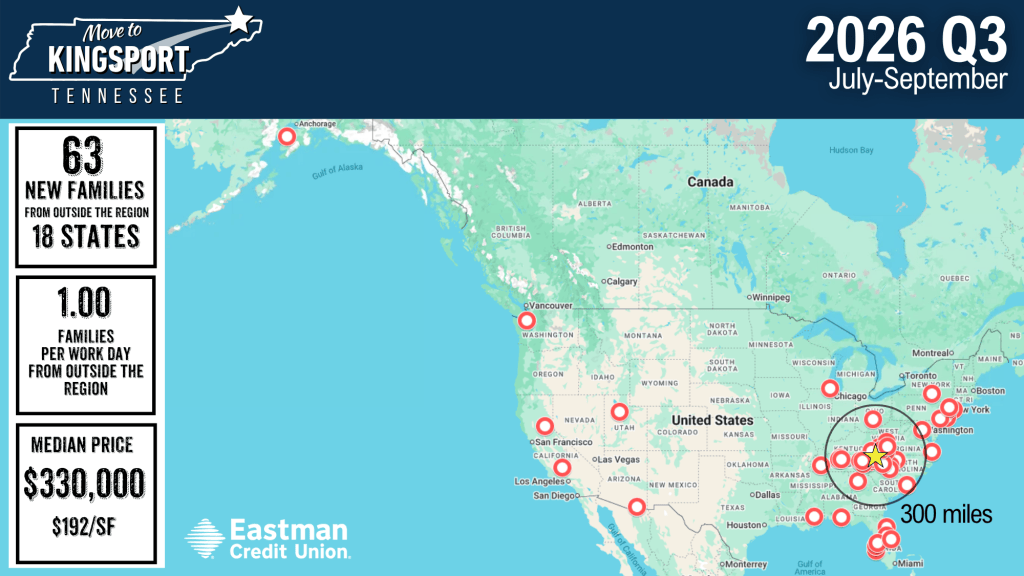
That is down from 90 families during the second quarter, when Kingsport averaged 1.47 new families per workday. In other words, quarterly newcomer volume fell about 30 percent from April–June to July–September.
That is a meaningful slowdown.
But it is also important to remember what these numbers measure.
This report does not include every home sale or every person moving within Kingsport. It focuses on households relocating here from outside the Tri-Cities region—generally more than 35 miles away. Someone moving from Johnson City to Kingsport, or from one Kingsport neighborhood to another, is not part of this report.
That distinction is intentional. Move to Kingsport is an economic development program designed to attract new households, income, and investment from outside the regional economy.
The Map is Becoming More Regional
Kingsport still has national reach, but Q3 continued a shift toward nearby states.
Tennessee accounted for 24 of the 63 newcomer households, or 38 percent. Florida followed with seven, Virginia with six, North Carolina with five, and New Jersey with four.
Tennessee, Virginia and North Carolina together accounted for 35 moves—56 percent of the quarter’s total.
Even so, the map still stretches from the West Coast to the Northeast and South Florida. The pattern is increasingly clear: national reach, but growing regional strength.
Since 2020, Move to Kingsport has tracked approximately 4,767 families relocating here from outside the region. The pandemic-era spike has subsided, but the flow of newcomers remains significant.
Home Prices Steady, But Homes Were Smaller
The median newcomer home purchase in Q3 was $330,000, up just 2 percent from Q2’s $324,000 and about 1.5 percent below Q3 2025’s $335,000.
At first glance, that suggests remarkable price stability.
But the typical home purchased this quarter was smaller.
The Q3 median was approximately 1,720 square feet, compared with 2,027 square feet during the same quarter last year. The typical home had three bedrooms, two baths and was built around 1972.
The median price per square foot was about $193, compared with roughly $165 in Q3 2025.
So, while the median purchase price was essentially flat, newcomers were buying less house for roughly the same money.
Since 2020, the median newcomer purchase has been about $289,000 and 2,014 square feet. Q3’s $330,000 median is about 14 percent higher than that longer-term benchmark, while the median home size was about 15 percent smaller.
Affordability Remains Part of the Story
Forty percent of newcomer purchases in Q3 were below $300,000. That is lower than Q2, when nearly half were below that mark, but slightly better than the roughly 38 percent recorded in Q3 2025.
Sixty percent of Q3 purchases were below $350,000.
That matters because newcomers and local residents compete for many of the same homes. Growth that strengthens the economy but prices local families out of the market is not healthy.
That is why our goal is not simply more newcomers. It is grounded growth: enough new households to help offset natural population decline, add outside income, support businesses and strengthen the tax base, while preserving the affordability and quality of life that make Kingsport attractive in the first place.
At one new out-of-region family per workday, Q3 does not look overheated.
The pandemic sprint is over. What remains may be more sustainable: a smaller, steadier stream of families choosing Kingsport because the numbers—and the quality of life—still make sense.


Leave a comment