Recent Census Bureau data tell an important story about where America is headed — and where Kingsport may be headed with it.
Between 2020 and 2025, the South grew 6%, almost twice the national rate. More important, it was the only region to gain population in every major age group. Children under 18 increased 1.1%. Ages 18 to 24 grew 5%. Ages 25 to 44 jumped 9%. And, as the Baby Boom generation continues moving into retirement, the population 65 and older grew 17.5%. Elsewhere, the picture is different.
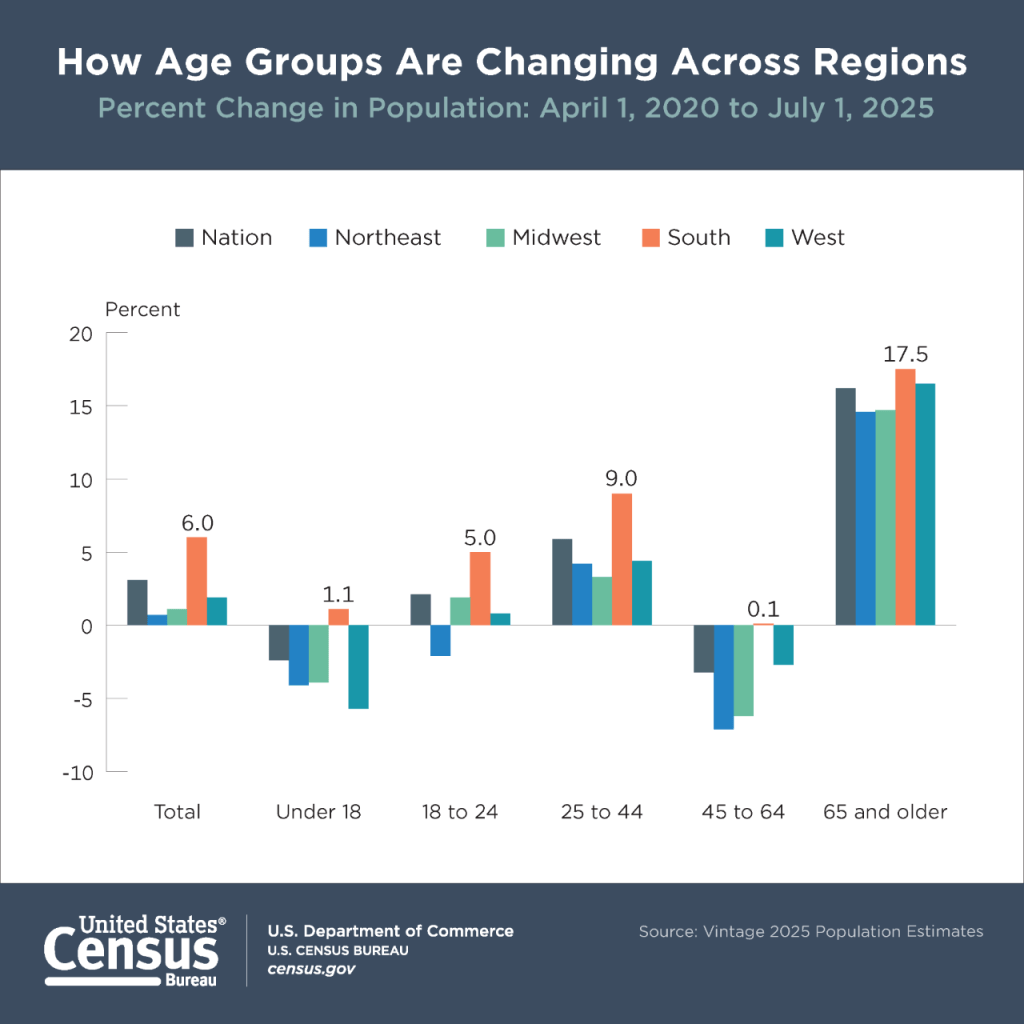
The Northeast lost children under 18, lost college age (18-24), and lost workforce (45-64), but gained dramatically in the 65+ category. The Midwest and West both lost children under 18 and workforce (45-64). Seniors increased rapidly in every region. The Baby Boomers have arrived.
Those shifts will ripple through just about everything.
Fewer children eventually mean fewer students in public schools and colleges. Fewer middle-aged adults can create workforce and leadership succession problems. More seniors mean greater demand for health care, transportation, housing and long-term care.
The South has an important advantage: while it is aging, it is also adding younger adults and families.
So where does Kingsport fit?
The Census Bureau estimates Kingsport reached about 57,500 residents in 2025, up roughly 3.6% since 2020. But total population tells only part of the story.
Kingsport remains an older community. The latest American Community Survey estimates about 23% of city residents are 65 or older, compared with about 21% under age 18 — roughly 13,100 seniors and 11,600 children.
But there is another side to the story: Kingsport is getting somewhat younger.
Comparing the Census Bureau’s 2017-2021 and 2020-2024 five-year estimates, residents ages 25 to 44 increased about 9% — almost exactly the growth rate for that age group across the South.
Ages 18 to 24 appear to have grown even faster, by about 11%.
And children grew, too. Kingsport’s under-18 population increased from roughly 11,000 to 11,600, or about 5%. School-age children ages 5 through 17 increased from about 8,100 to 8,500. Children under 5 increased from roughly 2,900 to 3,100.
That is particularly important for Kingsport City Schools. Many communities elsewhere are wrestling with declining enrollment simply because there are fewer children coming along behind the students already in their classrooms. Kingsport’s demographic trend is more encouraging.
It matters economically as well. People in their 20s, 30s and early 40s are working, buying homes, raising children and spending money locally. They are also the generation that will increasingly replace retiring Baby Boomers in our businesses, schools, hospitals and local institutions.
At the same time, nearly one in four Kingsport residents is already 65 or older. That means continued demand for physicians, home health, senior housing, transportation and services such as Meals on Wheels.
Housing has to respond to both trends. Younger adults and families need apartments, starter homes and family-sized housing. Older residents increasingly need smaller homes, one-level living and opportunities to remain in their communities as they age.
The data should be viewed as evidence of a trend than precise counts. But the direction is worth watching.
America is aging everywhere, but the regions are aging differently.
Kingsport appears to be sharing in one of the South’s most important advantages: we are not simply adding population. We appear to be adding younger adults, working-age families and children at the same time our senior population remains substantial.
Population growth matters, but the goal isn’t boom or bust. It’s balance — and Kingsport seems to be getting the math right.
 Kingsport Spirit
Leave a comment