Last night, while waiting through the delayed start of the Florida State–SMU football game, I kept hearing the announcers refer to Doak Campbell Stadium.
I’d heard the name for years but never really thought about it. Was Doak-Campbell hyphenated? A place? A person?
So, naturally, I looked it up.
That’s how these stories often start.
It’s football season, and I’m all in for the Tennessee Volunteers. But as a history buff, I keep discovering how often the names we hear on Saturdays lead back to Northeast Tennessee and Southwest Virginia.
I previously wrote about Gen. Edmund Pendleton Gaines, who grew up near present-day Kingsport and whose family is tied locally to Exchange Place (Gaines-Preston Farm). Gaines became one of the young United States’ prominent Army officers, serving in the War of 1812 and later confronting the Seminoles in Florida.
Gainesville—home of the Florida Gators—was named for him.
And Gaines wasn’t the only Tennessean leaving his name on Florida. During the First Seminole War, his efforts became intertwined with those of Andrew Jackson, who led American forces into Spanish Florida. When a town was established there in 1822, it was named Jacksonville for Jackson, who had served as Florida’s first military governor.
Gainesville. Jacksonville. Seminoles. Tennessee keeps turning up.
Then there’s Texas. George Campbell Childress, whose family had roots in our region, became the principal author of the Texas Declaration of Independence. Later, thousands of Tennesseans and Virginians gathered at Long Island in Kingsport to support the Polk-Dallas ticket and annexation of Texas.
Longhorns, Aggies, Gators—and now Seminoles.
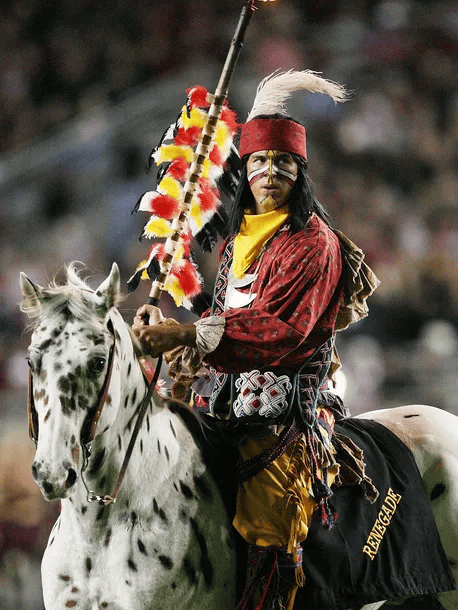
Florida State adopted the Seminoles name in 1947, the same year the former Florida State College for Women became coeducational Florida State University. Today, FSU uses the name and related traditions with the formal support of the Seminole Tribe of Florida.
Even Tennessee isn’t hard to find in Tallahassee. East Tennessee Street and West Tennessee Street are the names of U.S. 90 that bisects the city just a few blocks north of Florida’s Capitol.
And the Seminoles play at Doak S. Campbell Stadium.
Doak Sheridan Campbell wasn’t a coach or football star. He was the university president who guided Florida State through its transformation and helped develop its athletic program.
Then I started digging into Campbell.
Born in Arkansas in 1888, his Campbell roots lead directly to Southwest Virginia. His paternal grandparents, Emmett T. Campbell and Mary A. Caudle, were married at Hillsville in Carroll County in 1853—the same small Virginia community associated with two towering figures in Kingsport’s development, George L. Carter and J. Fred Johnson.
Then there’s his unusual first name: Doak.
Published biographies say Campbell was named for an uncle, Samuel Doak, while family histories connect the name to the family of Rev. Samuel Doak, one of early Northeast Tennessee’s best-known ministers and educators.
Rev. Doak preached around Abingdon before moving into Sullivan County, Tennessee, in the 1770s. Most famously, he stood before the Overmountain Men at Sycamore Shoals in September 1780.
More than 1,000 militiamen from the Watauga and Holston settlements and Southwest Virginia volunteered to cross the mountains in pursuit of British Major Patrick Ferguson. Before they departed, Doak preached and prayed over them.
They rode away and, on October 7, 1780, won the pivotal Battle of Kings Mountain.
Tennessee’s Volunteer State nickname came later, during the War of 1812, but the volunteer spirit was already evident here decades earlier.
And here’s my favorite coincidence.
The first football game played at Doak Campbell Stadium was on October 7, 1950—exactly 170 years to the day after Kings Mountain.
But from Volunteers to Seminoles, Gators, Longhorns and Aggies, it’s remarkable how often the trail leads back home.


Leave a Reply