Full disclosure: I’m down a rabbit hole researching a trip to the Tennessee at Texas A&M game this November. You know me, I can’t just enjoy a football weekend. I have to seize the opportunity to explore the surrounding area.
That led me to a suggested side trip to Washington-on-the-Brazos, where delegates adopted the Texas Declaration of Independence in March 1836. Its principal author was George Campbell Childress.
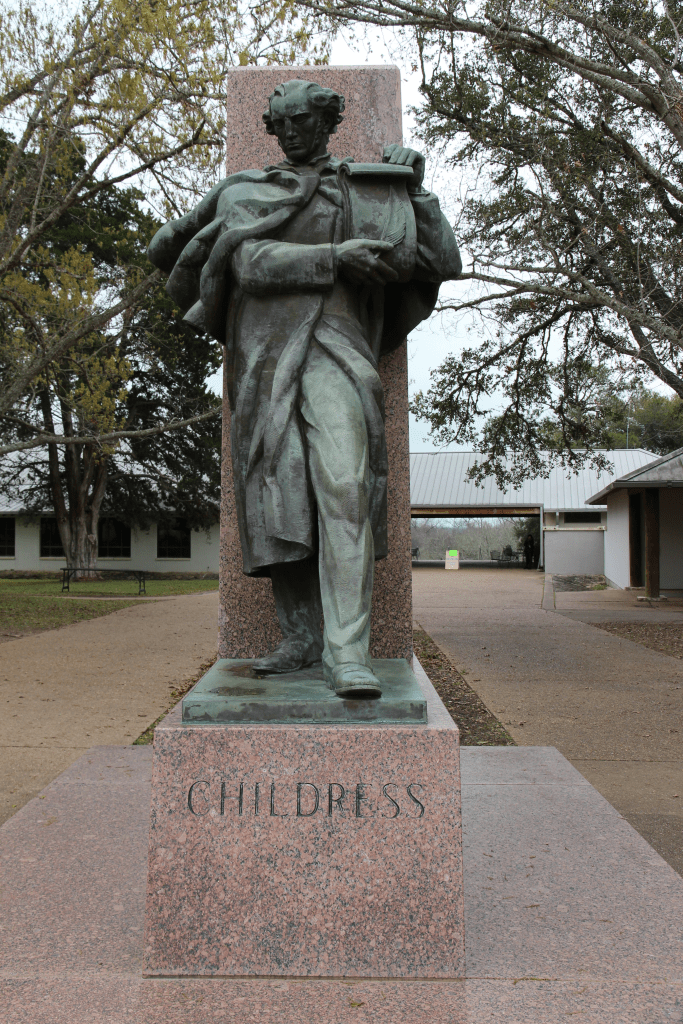
That name sounded familiar to this Northeast Tennessean. There are Childress family members and footprints all over the Kingsport area.
Could the man who helped create the Republic of Texas have roots here?
George Childress was born in Nashville in 1804, the son of John and Elizabeth Robertson Childress. He became a lawyer before joining the movement for Texas independence.
His mother’s brother was Sterling Clack Robertson, a Tennessee land promoter who led an effort to settle a vast section of Mexican Texas. The Nashville-based enterprise became Robertson’s Colony and included the land where Texas A&M is located. It covered parts of about 30 counties and included Nashville-on-the-Brazos.
Childress first visited Texas in 1834. Back in Tennessee, he raised money and recruited volunteers, then returned in 1835. Robertson’s Colony elected Childress and his uncle to the convention.
When it opened on March 1, 1836, Childress introduced a resolution for independence and chaired the committee assigned to write the declaration.
But the story reaches farther east than Nashville, all the way to our neck of the woods.
Elizabeth Robertson Childress and Sterling Robertson were children of Elijah Robertson and Sarah Maclin Robertson. Elijah was the brother of James Robertson, a Watauga leader often called the Father of Middle Tennessee.
James helped lead the Watauga Association, defended the frontier settlements, and later guided settlers to the Cumberland River, helping establish Nashville. Robertson County, Tennessee, bears his name. In fact, the Tennessee State Capitol is surrounded by James Robertson Parkway.
Elijah Robertson’s name appears on the 1776 petition from the Washington District—now Northeast Tennessee—seeking North Carolina’s recognition of the government settlers had organized along the Watauga and Nolichucky. This frontier society later produced the Overmountain Men.
Elijah also participated in the dispute that helped produce the State of Franklin. By 1784, he represented Davidson County and the Cumberland settlements in the North Carolina legislature. He opposed North Carolina’s proposed cession of its western lands, one issue that prompted East Tennessee settlers to organize Franklin.
He was not a known officer of Franklin’s government and continued representing Davidson County in North Carolina. Even so, his role placed him within the struggle for Tennessee’s statehood.
George Childress was therefore the grandson of a Watauga settler and the grandnephew of James Robertson.
The progression is striking: from Watauga and the upper Holston to Nashville and Middle Tennessee, then to Robertson’s Colony and Washington-on-the-Brazos.
Texas remained central to Tennessee history.
I previously wrote on KingsportSpirit.com about the 1844 “Great Mass Meeting” held at Kingsport for another Tennessean, James K. Polk less than 5 miles from the Childress property on Horse Creek. Contemporary reports claimed 40,000 people and more than 1,000 wagons and carriages gathered on Long Island for the Polk-Dallas ticket.
Polk made Texas annexation central to his campaign. His narrow election helped clear the way for Texas to enter the Union in 1845. War with Mexico followed, and when Tennessee’s governor called for 2,800 volunteers, more than 30,000 reportedly answered.
That response reinforced Tennessee’s identity as the Volunteer State—but Tennesseans had already volunteered for the Texas Revolution. Davy Crockett is the best-known example, but Childress and Robertson represent service: organizing settlements, raising support and helping create a republic.
The Childress surname runs from Virginia (the upper Holston) through North Carolina to Nashville. Revolutionary veteran David Childres lived in Sullivan County by about 1792 and may have belonged to the same extended family, although the link remains unproven.
George Childress died in 1841 at 37. Texas later carried his name westward through Childress County and its Panhandle county seat.
So what began as a football trip led through Texas independence, a Nashville-organized colony, James Robertson and the Watauga frontier, the State of Franklin, James K. Polk’s campaign and Tennessee’s tradition of answering the call.
Nearly two centuries later, more Tennessee Volunteers will head to Texas this fall.
Thankfully, these will be the Big Orange kind.


Leave a comment