There is a line on the population map that Northeast Tennessee should pay attention to.
The map tracks net domestic migration—Americans moving from one part of the country to another—between 2020 and 2024. Green counties gained residents through migration. Purple counties lost them.
Northeast Tennessee is on the green side, but just barely.
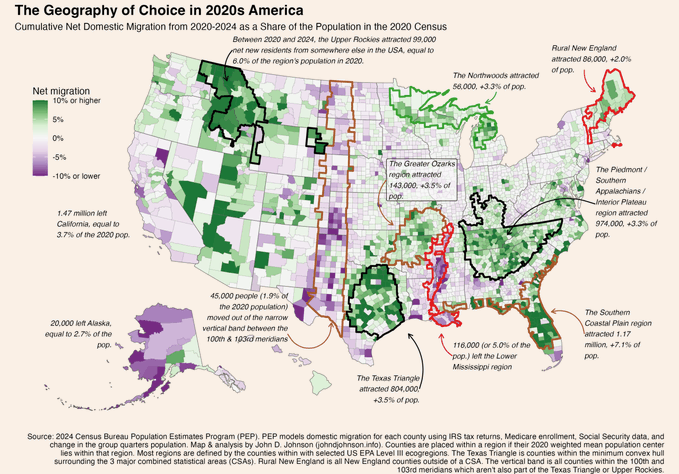
Most maps are sorted by states, but this one is sorted by regions.
We are included in the Piedmont/Southern Appalachians/Interior Plateau growth region that experienced a gain of 974,000 residents through domestic migration, or 3.3% of its population. We share the region with some of the nation’s hottest brands: Atlanta (4.5 hours), Charlotte (3 hours), Raleigh-Durham (4 hours), Nashville (4 hours), Greensboro-Winston-Salem (3 hours), Greenville-Spartanburg (2.5 hours), Louisville (5 hours), Knoxville (1.5 hours), Chattanooga (3 hours), Huntsville (4.75 hours), and Lexington (4 hours).
Among the seven positive-migration regions highlighted on the map, ours was the second-largest numerical gain in the country, behind only the Southern Coastal Plain:
- Southern Coastal Plain — +1.17 million (Florida-South Carolina)
- Piedmont/Southern Appalachians/Interior Plateau — +974,000
- Texas Triangle — +804,000 (Houston-Dallas-Austin-San Antonio)
- Greater Ozarks — +143,000 (NW Arkansas, SW Missouri, NE Oklahoma)
- Upper Rockies — +99,000 (Idaho, Montana, Wyoming)
- Rural New England — +86,000 (Maine, Vermont, New Hampshire)
- Northwoods — +56,000 (Northern Michigan, Wisconsin, Minnesota)
The losing side of the map is just as revealing.
California lost about 1.47 million residents to domestic migration, equal to 3.7% of its 2020 population. The Lower Mississippi region–from Southeast Missouri to the Arkansas Delta, Memphis, Baton Rouge, and New Orleans– lost about 116,000 or 5% of its population. That’s not a pattern to emulate.
Closer to home, the map changes quickly to a weak or negative migration corridor from Southwest Virginia and Southeast Kentucky to West Virginia through Pennsylvania and New York to the Canadian border.
That geographic contrast should be a warning. We are on the edge of a precipice and Northeast Tennessee already faces natural population loss.
The eight counties of Northeast Tennessee grew from roughly 517,000 in 2020 to about 539,000 in 2025.
But births did not produce that growth.
During that period, the region experienced roughly 18,000 more deaths than births. Population increased because migration more than offset those losses.
That is the central issue.
Some people understandably ask, “Why do we need to grow? Why can’t we just stay the way we are?”
Because where deaths exceed births, standing still is not really an option. Without enough newcomers, we decline.
Population decline carries consequences. Employers have fewer workers. Businesses have fewer customers. School enrollment falls. Hospitals and medical practices serve a smaller population. Communities still maintain roads, utilities, parks and public safety, but those costs are spread across a smaller economic base.
Decline can also reinforce itself. Fewer opportunities encourage younger residents to leave. Employers have more difficulty recruiting. Businesses become reluctant to invest in shrinking markets. Housing investment slows.
But rapid growth creates different problems.
Some fast-growing Sun Belt communities are struggling with housing shortages, traffic, overcrowded schools, infrastructure costs and rising land prices. Growth can happen so quickly that it damages the qualities that attracted people in the first place.
We should not want that either.
What Northeast Tennessee needs is grounded growth.
Enough to offset natural population loss, maintain our workforce, support schools and healthcare, strengthen businesses and broaden the tax base—but not so much that roads, housing and public services cannot keep pace.
Our current growth appears close to that balance. We are gaining residents without experiencing the overwhelming growth pressures found elsewhere.
But the map is a reminder that migration patterns can change.
We are fortunate to sit within one of America’s strongest migration regions while communities immediately to our north face a very different demographic reality.


Leave a Reply