We took the granddaughters to see Toy Story 5 at Hilton Head this week. As we were watching the opening ads, a Mountain Dew trailer depicting a fictitious scene from Tennessee in 1948 popped up on the big screen. A theatre full of people saw a ‘hoedown’ with stereotypical images of Appalachia–bibbed overalls, banjos, and a ‘ramp frolic’ as my wife would say. I shook my head.
This is why the term ‘Appalachia’ is cringeworthy to so many Appalachians.
Almost simultaneously, I also stumbled on the recently updated U.S. News & World Report’s Top 250 Places to Live in America for 2026-2027, which named 10 cities in Appalachia, including our own. In order they are: Hoover, AL, Decatur, AL, Huntsville, AL, Weirton, WV, Hickory, NC, Kingsport, TN, Dalton, GA, Florence, AL, Charleston, WV, and Johnson City, TN.
So many mixed messages. If we’re so cringeworthy, why are so many ranked as some of the best places to live in America?
If not ranked in the top 250 in the nation, many Appalachian cities ranked at the top of their respective state. For example, Anniston, AL, Gadsden, AL, Rome, GA, Gainesville, GA, Hagerstown, MD, Elmira, NY, Binghamton, NY, Ithaca, NY, Statesville, NC, Asheville, NC, Youngstown, OH, Pittsburgh, PA, Williamsport, PA, Erie, PA, Johnstown, PA, State College, PA, Scranton, PA, Greenville, SC, Spartanburg, SC, Cleveland, TN, Morristown, TN, Knoxville, TN, Chattanooga, TN, Blacksburg, VA, Wheeling, WV, Parkersburg, WV, Beckley, WV, Huntington, WV, and Morgantown, WV.
You might be questioning why some of your favorite ‘Appalachian’ cities are not on that list.
First, it helps to understand what is in ‘Appalachia’ and what is not.
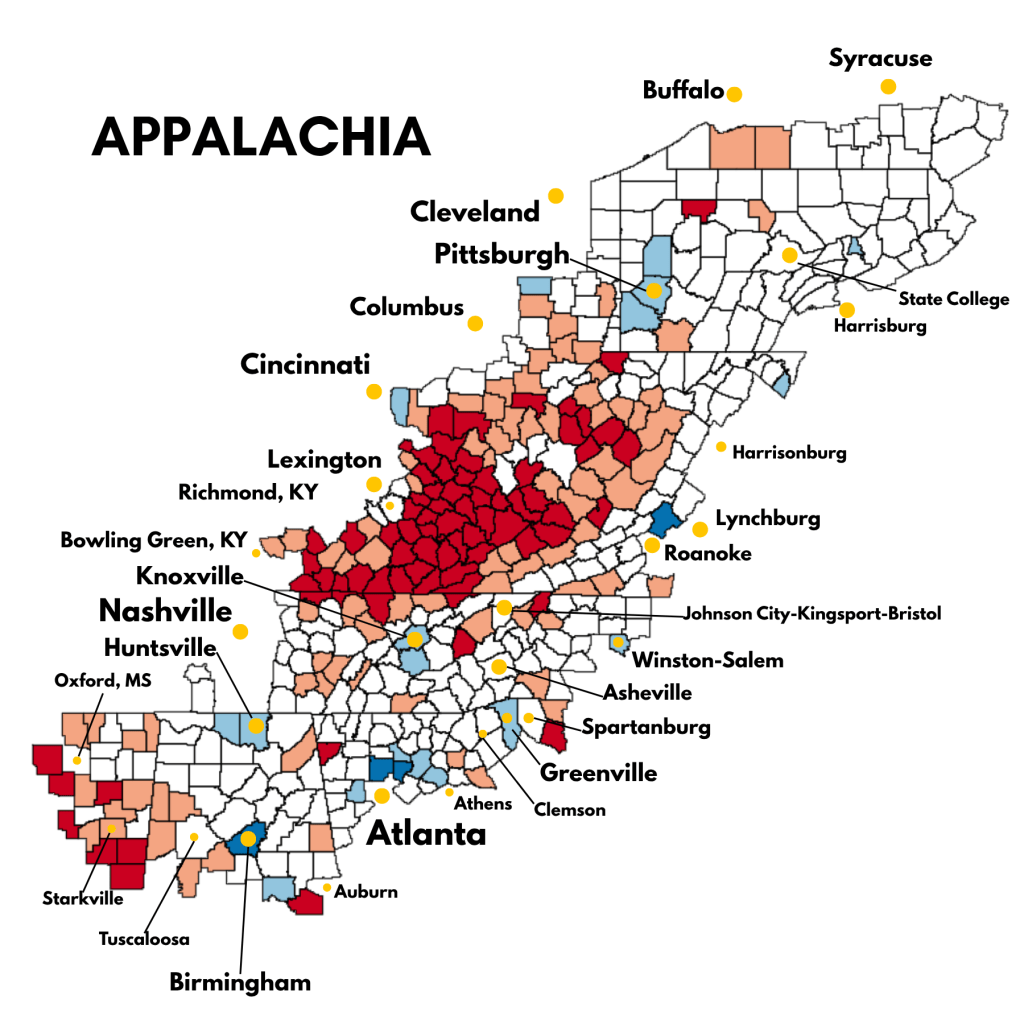
Blacksburg/Virginia Tech is part of ‘Appalachia’, but neighboring Roanoke is not. Nor are Lynchburg/Liberty and Harrisonburg/JMU. Winston-Salem/Wake Forest is, but Greensboro and High Point are not. Richmond/EKU is, but neighboring Lexington/Kentucky and Bowling Green/WKU are barely out. Predictably, Knoxville/Tennessee, Johnson City/ETSU, Cookeville/Tennessee Tech, and Chattanooga/UTC are in, while Nashville/Vanderbilt, Murfreesboro/MTSU, and Memphis are not. Starkville/Mississippi State is, but Oxford/Ole Miss is almost completely surrounded, but isn’t. Even Tuscaloosa/Alabama, Birmingham (UAB, Samford), Huntsville/UAH, Florence/North Alabama, and affluent Hoover are in, while Auburn is technically out–but adjoins. Clemson, Greenville/Furman, and Spartanburg/Wofford are in, but Athens/Georgia and Atlanta/Georgia Tech are just barely out. Athens/Ohio, Pittsburgh (Pitt and Carnegie-Mellon), Penn State, Ithaca/Cornell, Huntington/Marshall, and Morgantown/West Virginia are in, but Syracuse is barely out.
Make it make sense. Would an average American believe that any part of Mississippi is part of Appalachia? But it is.
Maybe I have just enough geographer in me to question data, statistics, and boundaries.
With those definitions in mind, I also received a copy of the updated county economic status for Fiscal Year 2027 this week.
The Tri-Cities Held Steady While Its Appalachian Neighbors Moved in Different Directions
For a Tri-Cities reader, the clearest finding in the Appalachian Regional Commission’s latest economic data is that the region’s urban core remained stable while several surrounding counties moved sharply—some for the better and some for the worse.
Before examining the results, it helps to understand the terminology. ARC places every county into one of five economic categories based on unemployment, per capita market income, and poverty compared with national averages.
From strongest to weakest, the categories are:
Attainment → Competitive → Transitional → At-Risk → Distressed
In plain language:
- Attainment counties are in the strongest economic category.
- Competitive counties are among the nation’s stronger-performing counties.
- Transitional counties occupy the broad middle of the national economic range.
- At-Risk counties face significant economic vulnerability.
- Distressed counties face the most serious economic challenges.
Moving toward attainment is an improvement. Moving toward distressed is a regression.
A county can also improve or regress without changing categories. A county may remain at-risk but move closer to transitional status. Another may remain transitional while slipping closer to at-risk.
ARC combines unemployment, per capita market income, and poverty into a composite index. A lower score is better. The index shows whether a county is gaining or losing ground relative to the nation, even when its broad classification does not change.
The fiscal-year labels do not represent conditions in one calendar year. The FY2021 classifications use unemployment data from 2016 through 2018, 2018 income, and poverty data from 2014 through 2018. The FY2027 classifications use unemployment from 2022 through 2024, 2024 income, and poverty from 2020 through 2024.
The comparison therefore captures a medium-term economic change rather than developments occurring solely between calendar years 2021 and 2027. Three counties added to ARC after FY2021 are included using their nationally calculated FY2021-equivalent classifications.
The Tri-Cities Core Remained Stable
Between FY2021 and FY2027, Sullivan County (Kingsport, Bristol, Blountville), Washington County, Tennessee (Johnson City, Jonesborough), and the Washington County, Virginia (Abingdon, Bristol City) all remained transitional.
Transitional is the middle of ARC’s five categories. None of the three principal regional-service counties improved enough to become competitive, but none regressed into the at-risk category.
Sullivan County (Kingsport, Bristol, Blountville) improved slightly within the transitional category. Washington County, Tennessee (Johnson City, Jonesborough), was essentially unchanged. Washington County, Virginia (Abingdon, Bristol City), remained transitional while improving within the category.
That stability is important. These counties continue to anchor the region through health care, higher education, manufacturing, retail, government, transportation, and a larger labor market. Their economies remain stronger than those of many surrounding rural counties.
But stability is not the same as advancement.
The Tri-Cities core did not gain ground as quickly as some other parts of Appalachia. Northeast Tennessee and Southwest Virginia improved more slowly than the broader central and southern Appalachian corridor and more slowly than the full 423-county ARC region.
Several Nearby Counties Improved
The most encouraging results occurred in several counties immediately surrounding the Tri-Cities.
Unicoi County (Erwin) recorded the strongest local improvement. It moved from at-risk to transitional, leaving the second-weakest category and entering the broad middle category. It ranked 33rd among all 423 current ARC counties in improvement in the composite economic index.
Hawkins County (Rogersville, Church Hill, Mount Carmel) also improved from at-risk to transitional. Its unemployment rate declined from 4.6% to 4.1%, its poverty rate fell from 19.0% to 15.2%, and its national economic-index position improved by 66 places.
Carter County (Elizabethton) remained at-risk, so its formal category did not change. However, it improved substantially within the category and ranked 102nd among all ARC counties in composite-index improvement. Carter County (Elizabethton) moved in the right direction, even though it did not cross the threshold into transitional status.
Wise County (Big Stone Gap, Wise, Norton City) improved from distressed to at-risk. This was a meaningful advancement because it moved out of ARC’s weakest economic category. The area remains economically vulnerable, but its position relative to the nation improved considerably.
Together, these results suggest that a ring of counties near the Tri-Cities made measurable progress.
Unicoi County (Erwin) and Hawkins County (Rogersville, Church Hill, Mount Carmel) improved into the transitional category. Carter County (Elizabethton) improved within the at-risk category. Wise County (Big Stone Gap, Wise, Norton City) moved out of distressed status.
Other Nearby Counties Regressed
Other parts of the region moved in the opposite direction.
Greene County (Greeneville) regressed from transitional to at-risk. It moved out of the broad middle category and into the second-weakest classification.
Johnson County (Mountain City) regressed from at-risk to distressed, entering ARC’s weakest category.
Lee County (Jonesville) remained distressed but worsened within that category. Its poverty rate rose from 24.0% to 28.8%, even though unemployment improved.
Scott County (Gate City) remained at-risk but also lost ground within the category. Its poverty rate increased from 18.6% to 20.2%, and its composite-index change was among the weakest in the Appalachian region.
The local pattern is therefore not simply one of improvement or decline. It is a pattern of divergence.
The Tri-Cities core remained stable. Several nearby counties improved. A more rural outer tier weakened.
That divide appears to reflect access to larger labor markets, medical systems, colleges and universities, interstate highways, regional employment centers, and growing population corridors. Counties that are more geographically isolated or dependent on a narrower economic base continue to face greater difficulty.
The Local Region Improved, but More Slowly Than Appalachia
Across the 11 Northeast Tennessee and Southwest Virginia reporting units examined, the average composite-index improvement was approximately 2.1 points.
That was below the 4.3-point average improvement across the full Appalachian Regional Commission territory and below the 6.3-point average for the broader central and southern Appalachian corridor.
Three local reporting units improved into stronger categories:
- Unicoi County (Erwin): At-Risk to Transitional — improvement
- Hawkins County (Rogersville, Church Hill, Mount Carmel): At-Risk to Transitional — improvement
- Wise County (Big Stone Gap, Wise, Norton City): Distressed to At-Risk — improvement
Two regressed into weaker categories:
- Greene County (Greeneville): Transitional to At-Risk — regression
- Johnson County (Mountain City): At-Risk to Distressed — regression
Six remained in the same category.
The number of transitional counties increased from four to five, which was an improvement. At-risk counties declined from five to four, also an improvement. The number of distressed counties remained at two.
The result was modest overall progress, but not a broad regional breakthrough.
Knoxville and Blount County Pulled Ahead
The local results become more revealing when compared with the Knoxville area.
Knox County (Knoxville) and Blount County (Maryville, Alcoa) improved from transitional to competitive. Competitive is ARC’s second-strongest category.
Sullivan County (Kingsport, Bristol, Blountville) and Washington County, Tennessee (Johnson City, Jonesborough), remained transitional.
That does not mean the Tri-Cities economy declined. It means Knox County (Knoxville) and Blount County (Maryville, Alcoa) improved more rapidly relative to national benchmarks.
The comparison provides both reassurance and a warning.
The Tri-Cities remains a comparatively strong regional center. Its principal counties avoided regression and remained economically stronger than many surrounding counties.
However, the region did not advance at the same pace as the Knoxville area. The challenge is not simply to avoid falling backward. It is to generate enough income growth, job creation, and poverty reduction to move from transitional into competitive status.
East Tennessee Was One of Appalachia’s Better-Performing Areas
Although Northeast Tennessee’s results were mixed, East Tennessee as a whole performed relatively well.
Union County (Maynardville), Rhea County (Dayton), Unicoi County (Erwin), Monroe County (Madisonville, Sweetwater), Grainger County (Rutledge), and Hawkins County (Rogersville, Church Hill, Mount Carmel) all improved from at-risk to transitional.
Bledsoe County (Pikeville) improved from distressed to at-risk. It remained economically vulnerable but moved out of the weakest category.
Knox County (Knoxville) and Blount County (Maryville, Alcoa) improved from transitional to competitive.
East Tennessee recorded more upward category changes than any of the other major subareas examined in the central and southern Appalachian corridor.
However, the improvement was not universal.
Greene County (Greeneville) regressed from transitional to at-risk. Johnson County (Mountain City) regressed from at-risk to distressed. Sequatchie County (Dunlap) regressed from transitional to at-risk.
The East Tennessee story is broadly positive, but the gains were concentrated in particular metropolitan, suburban, and well-connected rural counties.
A Stronger Central and Southern Appalachian Corridor
Expanding the view beyond East Tennessee reveals a larger area of improvement extending through North Georgia, Western North Carolina, southern West Virginia, Southwest Virginia, southeastern Kentucky, and Upstate South Carolina.
Across this 168-county central and southern Appalachian corridor, 29 counties improved into stronger categories and 12 regressed into weaker categories. The remaining 127 stayed in the same category.
The number of distressed counties declined from 43 to 41. At-risk counties fell from 38 to 30. Transitional counties increased from 82 to 88, competitive counties from four to seven, and attainment counties from one to two.
The average composite-index improvement was 6.3 points—considerably stronger than the 2.1-point improvement in Northeast Tennessee and Southwest Virginia.
North Georgia Recorded Broad Improvement
North Georgia produced the strongest average improvement among the subareas examined.
Towns County (Hiawassee), Murray County (Chatsworth), and Polk County (Cedartown) improved from at-risk to transitional.
Jackson County (Jefferson, Commerce), Hall County (Gainesville, Flowery Branch), and Paulding County (Dallas, Hiram) improved from transitional to competitive.
Cherokee County (Canton, Woodstock) improved from competitive to attainment, reaching ARC’s strongest classification.
Chattooga County (Summerville) was the major exception. It regressed from at-risk to distressed.
The North Georgia results show the growing economic strength of counties connected to metropolitan Atlanta and major transportation corridors. They also demonstrate how quickly economic conditions can diverge between neighboring counties.
Western North Carolina Also Improved
Western North Carolina performed well overall.
Graham County (Robbinsville) recorded the largest composite-index improvement of any current ARC county and improved from at-risk to transitional.
Alleghany County (Sparta), Clay County (Hayesville), and Jackson County (Sylva) also improved from at-risk to transitional.
Buncombe County (Asheville), however, regressed from competitive to transitional.
That regression does not necessarily mean Asheville’s economy is shrinking. It means Buncombe County (Asheville) lost ground relative to national benchmarks involving unemployment, income, and poverty.
Population growth, tourism, and popularity can coexist with housing pressure, uneven income growth, and persistent poverty.
Southern West Virginia Made Significant Gains
Southern West Virginia recorded one of the strongest average improvements.
Boone County (Madison) ranked second among all ARC counties and improved from distressed to at-risk.
Nicholas County (Summersville) and Fayette County (Fayetteville, Oak Hill) also improved from distressed to at-risk.
Wayne County (Wayne) and Monroe County (Union) improved from at-risk to transitional.
Those gains are important in an area long associated with coal-industry decline and population loss.
Yet the progress was uneven. Raleigh County (Beckley) and Greenbrier County (Lewisburg) regressed from transitional to at-risk.
Several southern West Virginia counties improved substantially but remained distressed. They became less economically disadvantaged without escaping the weakest category.
Southwest Virginia Showed Both Improvement and Regression
Southwest Virginia also produced mixed results.
Dickenson County (Clintwood) and Wise County (Big Stone Gap, Wise, Norton City) improved from distressed to at-risk.
Smyth County (Marion) improved from at-risk to transitional.
Tazewell County (Tazewell, Bluefield, Richlands) and Carroll County (Hillsville, Galax City) regressed from transitional to at-risk.
Bath County (Warm Springs) experienced one of the region’s largest regressions, falling from competitive to transitional.
Southeastern Kentucky Improved Within Distress
Southeastern Kentucky’s picture was more difficult.
Several distressed counties improved substantially in the composite index but did not improve enough to enter a stronger category.
Knott County (Hindman), Letcher County (Whitesburg), Harlan County (Harlan), Magoffin County (Salyersville), and Leslie County (Hyden) all became less distressed relative to the nation but remained in the distressed category.
Only Russell County (Jamestown) moved into a stronger classification.
Martin County (Inez) ranked last among all 423 current ARC counties, showing the largest deterioration in the composite index. It remained distressed and fell even further behind national benchmarks.
Rockcastle County (Mount Vernon), Knox County, Kentucky (Barbourville), and Wolfe County (Campton) also regressed within their existing categories.
The distinction is important. A county can improve without leaving the distressed category, just as it can regress without changing its formal label.
Upstate South Carolina Was the Regional Exception
Upstate South Carolina was the major exception to the broadly improving Southern Appalachian pattern.
Greenville County (Greenville, Greer, Simpsonville) remained competitive.
Anderson County (Anderson), Oconee County (Walhalla, Seneca), Pickens County (Pickens, Easley, Clemson), and Spartanburg County (Spartanburg) remained transitional, although several lost ground within that category.
Union County (Union) regressed from at-risk to distressed when its nationally calculated FY2021 baseline is used.
The Upstate result shows that a region can attract residents, jobs, and investment while still losing ground on national measures of income and poverty.
Beyond the Immediate Region
The remaining ARC states add important context. They reinforce the larger finding that Appalachia is not moving in one direction and that the strongest results are not limited to places usually associated with rapid metropolitan growth.
Alabama Recorded the Strongest Statewide Improvement
On an unweighted county basis, Alabama recorded the strongest average improvement of any ARC state.
Eleven of Alabama’s 37 ARC counties improved into stronger categories, while only one regressed. The other 25 remained in the same category.
The Huntsville area was a major source of strength. Madison County (Huntsville) and Limestone County (Athens) improved from transitional to competitive. Shelby County (Columbiana, Hoover, Alabaster) remained in attainment, ARC’s strongest category, and improved further within it.
The gains were not limited to metropolitan counties. Lawrence County (Moulton), Walker County (Jasper), Marion County (Hamilton), Jackson County (Scottsboro), Talladega County (Talladega), Franklin County (Russellville), and Clay County (Ashland) improved from at-risk to transitional.
Hale County (Greensboro) improved from distressed to at-risk.
Bibb County (Centreville) was the principal exception, regressing from transitional to at-risk.
Alabama’s results show two forms of progress at once: continued strengthening around Huntsville and Birmingham, and movement out of at-risk or distressed status in several rural counties.
Mississippi Combined Major Gains With Serious Setbacks
Mississippi also recorded a relatively strong average improvement, but its results were much more divided.
Four counties improved into stronger categories, while four regressed into weaker ones.
Webster County (Walthall), Lowndes County (Columbus), and Tippah County (Ripley) improved from at-risk to transitional. Benton County (Ashland) improved from distressed to at-risk.
Several other distressed counties improved numerically without leaving the distressed category. This means their economic disadvantage became less severe even though they remained among the weakest counties nationally.
At the same time, Chickasaw County (Houston, Okolona), Yalobusha County (Coffeeville, Water Valley), Winston County (Louisville), and Panola County (Sardis, Batesville) regressed from at-risk to distressed.
Mississippi’s positive average therefore should not be read as broad, uniform improvement. Large gains in several counties outweighed equally important regressions elsewhere.
Ohio Quietly Improved
Ohio produced one of the more notable results outside the southern Appalachian states.
Seven of its 32 ARC counties improved into stronger categories, while two regressed. Twenty-three remained in the same category.
Athens County (Athens), Monroe County (Woodsfield), and Noble County (Caldwell) improved from distressed to at-risk. They remained economically vulnerable but moved out of ARC’s weakest classification.
Highland County (Hillsboro) and Perry County (New Lexington) improved from at-risk to transitional.
The improvement also extended into northeastern Ohio. Ashtabula County (Jefferson, Ashtabula) and Trumbull County (Warren) improved from at-risk to transitional.
The major regressions were Brown County (Georgetown), which moved from transitional to at-risk, and Scioto County (Portsmouth), which moved from at-risk to distressed.
Ohio’s performance is important because it complicates a simple north-versus-south interpretation. The southern ARC states generally performed better, but both rural southeastern Ohio and parts of the former industrial northeast recorded meaningful gains.
New York Was Mostly Stable
Appalachian New York showed comparatively little category movement.
Thirteen of its 14 ARC counties remained in the same category. Only Cattaraugus County (Little Valley, Olean, Salamanca) regressed, moving from transitional to at-risk.
Several rural counties improved numerically while remaining transitional. These included Chenango County (Norwich), Delaware County (Delhi), Cortland County (Cortland), and Schoharie County (Schoharie).
Tompkins County (Ithaca) also remained transitional and improved modestly within the category.
Other parts of the Southern Tier lost ground without changing categories. Broome County (Binghamton) and Chemung County (Elmira) remained transitional but weakened relative to national benchmarks.
The New York result was therefore one of broad stability rather than strong advancement or widespread decline. Most counties retained their position, but the region did not experience the larger number of upward category changes seen in Alabama, Tennessee, Georgia, or Ohio.
Maryland Changed Little
Maryland has only three ARC counties, and all three remained transitional.
Garrett County (Oakland) improved within the transitional category. Washington County, Maryland (Hagerstown), also showed modest improvement.
Allegany County (Cumberland) weakened slightly but remained transitional.
Because Maryland’s ARC territory is so small, its statewide average is sensitive to changes in a single county. Even so, the larger finding is straightforward: Western Maryland remained economically stable, with no county moving into either a stronger or weaker category.
Pennsylvania Was Stable in Classification but Weaker on Average
Pennsylvania has 52 ARC counties, more than any state except West Virginia. Its pattern differed from those of Alabama, Georgia, Tennessee, and Ohio.
Fifty-one of Pennsylvania’s 52 ARC counties remained in the same economic category. Only Cameron County (Emporium) changed classifications, regressing from transitional to at-risk.
That apparent stability concealed a mild statewide regression in the composite index.
Allegheny County (Pittsburgh) remained competitive. Erie County (Erie) and Centre County (Bellefonte, State College) remained transitional with relatively small numerical changes.
Lackawanna County (Scranton) and Luzerne County (Wilkes-Barre, Hazleton) remained transitional but lost ground within the category.
Forest County (Tionesta) remained distressed and weakened further.
Pennsylvania therefore did not experience widespread category regression, but many counties failed to keep pace with national improvement. The result was broad formal stability accompanied by a modest average decline.
This is different from the pattern in parts of the South. Alabama and Georgia combined category advancement with numerical improvement. Pennsylvania largely held its classifications but weakened within them.
The Appalachian-Wide Picture
Across all 423 counties now included in the Appalachian Regional Commission’s territory, the overall trend was positive.
Sixty-two counties improved into stronger categories. Twenty-eight regressed into weaker categories. The remaining 333 stayed in the same category.
The number of attainment counties increased from two to four.
Competitive counties increased from 13 to 18.
Transitional counties increased from 225 to 240.
At-risk counties declined from 105 to 85.
Distressed counties declined from 78 to 76.
The strongest average gains were generally concentrated in the southern half of the ARC region. Alabama recorded the largest average improvement, followed by Georgia, North Carolina, Mississippi, West Virginia, and Tennessee.
Ohio also performed relatively well, demonstrating that improvement was not confined to the South.
Maryland and New York were mostly stable. Kentucky and Virginia produced mixed results, with major gains in some deeply distressed counties offset by serious regressions elsewhere.
Pennsylvania regressed modestly on average, while South Carolina recorded the weakest average performance despite the strength of Greenville-Spartanburg as a growth and relocation market.
The overall pattern was therefore not a simple north-to-south progression. It reflected local industry, access to metropolitan markets, population change, poverty, income growth, housing conditions, and recovery from earlier economic decline.
Two Different Appalachian Success Stories
The data show two distinct kinds of progress.
The first is the advancement of metropolitan, suburban, and university-centered counties. These places moved toward competitive or attainment status. Examples include counties associated with Huntsville, Atlanta, Knoxville, and other growing Southern economies.
The second is improvement from a deeply distressed starting point. Several coalfield counties in Kentucky, West Virginia, Virginia, and Mississippi recorded large numerical gains but remained distressed or at-risk.
Both represent improvement, but they mean different things.
A county moving from transitional to competitive is entering one of ARC’s stronger economic categories.
A county that remains distressed but improves its composite score is still economically weak, but less disadvantaged relative to the nation than before.
Conversely, a county can remain transitional or at-risk while regressing within the category. The formal label may not change, but its economic position can still weaken.
What It Means for the Tri-Cities
The Tri-Cities is neither one of Appalachia’s fastest-improving metropolitan areas nor one of its declining economic centers.
Its core counties remained stable.
Sullivan County (Kingsport, Bristol, Blountville), Washington County, Tennessee (Johnson City, Jonesborough), and Washington County. Virginia (Abingdon, Bristol City) all remained transitional.
That stability is preferable to regression, but it also means the region did not move closer to the competitive category.
Around the core, the picture was encouraging in Unicoi County (Erwin), Hawkins County (Rogersville, Church Hill, Mount Carmel), Carter County (Elizabethton), and Wise County (Big Stone Gap, Wise, Norton City).
The results were more troubling in Greene County (Greeneville), Johnson County (Mountain City), Lee County (Jonesville), and Scott County (Gate City).
The larger pattern is becoming clearer: the Tri-Cities core remains economically stable, counties with strong access to that core are generally improving, and a more distant rural tier is struggling to keep pace.
Appalachia as a whole improved between FY2021 and FY2027. The southern Appalachian corridor improved even more strongly.
Northeast Tennessee and Southwest Virginia improved too—but more slowly, and with sharper differences from one county to the next.
The challenge for the Tri-Cities is not simply to avoid decline. It is to convert regional stability into stronger income growth, lower poverty, and broader economic opportunity so that the core can advance—and so that improvement reaches the counties around it.


Leave a comment