For generations, Kingsport has been known as an industrial city.
This is a place built by blue-collar workers, managers, supervisors, engineers, executives, and working families — people who changed clothes before and after work, carried lunch boxes, worked rotating shifts, parked at plant gates, punched time clocks, and helped make products that reached far beyond East Tennessee.
There is honor in that story. Work built much of this city. For much of Kingsport’s history, industrial life was also community life — where CEOs, managers, supervisors, and laborers worked in the same plants, lived in the same city, sent their children to the same schools, worshiped in the same churches, served on the same civic boards, and cheered for the same hometown teams.
But if we are not careful, that image can become too narrow.
Kingsport is not simply an industrial city where people drive in from long distances, pull a shift, punch a clock, and leave. Kingsport is a place where people live.
Census data helps tell that story. Roughly 47% of employed Kingsport residents work in the Kingsport area. That means nearly half of the people who live here also work here. Kingsport remains a substantial employment center, but for thousands of families, it is also where work, school, church, recreation, errands, and daily life fit together.
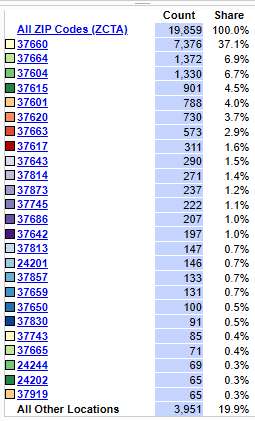
At the same time, Kingsport residents are clearly part of a larger regional economy. More than 10% of employed Kingsport residents work in the Johnson City area, while roughly 5% work in the combined Bristol, Tennessee/Virginia area.
But the movement is not one-way. About 8% of employed Johnson City residents work in Kingsport’s main employment area, and roughly 8% of employed Bristol, Tennessee/Virginia residents work in the Kingsport area. Nearly 20% of employed Kingsport residents work outside the top 25 ZIP-code destinations altogether.
That last number is important. It does not mean all of them are remote workers, but it does suggest a more dispersed workforce than we once imagined. Some may work remotely or in hybrid arrangements. Some travel for work. Some work for companies headquartered elsewhere. Some work in smaller communities that do not show up individually near the top of the list.
But the Census data still tells only part of the story because it measures workers. It does not measure everyone else who makes a city a community.
Census data shows that about 45% of Kingsport residents age 16 and older are not in the civilian labor force. Johnson City’s share is lower, at about 37%. Bristol, Tennessee is about 38%, while Bristol, Virginia is about 44%. Those differences should not be treated as a competition. They reflect different community roles and demographics. Kingsport and the combined Bristol community have larger retirement-age populations, while Johnson City’s numbers are influenced by East Tennessee State University and a larger student population.
Others outside the labor force may be retired, students, stay-at-home parents, caregivers, disabled residents, or people in a season of life where paid employment is not the center of their daily schedule.
That is why a city cannot be understood only as a labor shed. It is not just commuters, payrolls, shifts, and job counts. A real community serves people before work, after work, and outside of work altogether.
The broader Tri-Cities pattern is clear. Kingsport, Johnson City, and Bristol each have their own employment base, civic identity, and economic role. None is simply a bedroom community for the others, and none stands completely apart. They are three distinct anchors in one connected regional economy.
That does not erase local identity. The region is stronger when Kingsport, Johnson City, and Bristol are each healthy, confident, and successful.
Kingsport should continue pursuing industrial recruitment, business expansion, downtown investment, redevelopment, and small business growth. A strong employment base is essential. But communities are also competing for people, including people who may not be in the workforce at all.
That means housing, neighborhoods, parks, schools, public safety, downtown life, churches, nonprofits, trails, libraries, healthcare, and everyday quality of life all count.
Kingsport’s strength is that it is not just a workplace. It is a 24/7/365 livable community.
You can live in Kingsport and work in Kingsport. You can live here and work elsewhere in the region. You can work remotely, travel for work, retire here, raise children here, care for family here, volunteer here, and build a life here.
Kingsport has always been proud of being an industrial city and a working city. We should remain proud of that. But our future will not be defined only by shifts, plants, offices, and payrolls.
The data confirms what many of us already know from experience: Kingsport is not just a place where people come to work.
Kingsport is a place where people come home.


Leave a comment