Recently, I was asked to compare Maryville and Kingsport. I gave what I believed was a fair answer, but it was worth checking the facts. Make no mistake: my job is to advocate for Kingsport. But I also want to preserve a reputation for candor, accuracy, and truth.
Maryville (population 32,553) has earned its place among Tennessee’s most desirable small cities. It serves as a southwestern gateway to Great Smoky Mountains National Park, benefits from the Knoxville-area economy, and offers strong schools, attractive neighborhoods, outdoor access, greenway connections, a vibrant downtown, and a polished quality of life. It is easy to understand why people are drawn there.
Kingsport (population 57,908) is a story that is different, but equally worth understanding.
On paper, Maryville has a stronger income profile and a lower poverty rate. Census data shows Maryville with a median household income of about $82,000 and a poverty rate under 7%. Kingsport’s median household income is lower, and its poverty rate is higher. That difference should not be minimized. Poverty affects schools, housing stability, health, transportation, family stress, and the daily work of churches, nonprofits, and local government.
But the comparison needs context.
Maryville functions, in part, as a Knoxville-area suburban community. It wasn’t always that way, but it has evolved into that role as the metropolitan area continues to expand. Many residents benefit from access to a much larger employment market, including the University of Tennessee, regional medical systems, Oak Ridge, Alcoa, state and federal jobs, and proximity to burgeoning Farragut-West Knoxville corridor. People can live in Maryville while earning income from a much larger job base. That does not take anything away from Maryville. It helps explain its profile.
Kingsport is not a residential extension of a larger city, like Knoxville. Kingsport is its own central city, with a regional employment base, nonprofit network, and social challenges. It serves as a regional anchor.
The county context helps explain that role. Blount County, home to Maryville and Alcoa, has about 142,000 residents. Sullivan County has about 163,000, and Hawkins County has about 59,000. Together, Sullivan and Hawkins represent more than 222,000 people, with Kingsport serving as a major employment, medical, retail, cultural, and civic center for that larger area.
That broader responsibility also helps explain Kingsport’s poverty numbers. A mature, independent city usually includes a wider cross-section of the population than a suburban community. Kingsport’s higher poverty rate should not be excused or ignored. It reflects real hardship. But it also reflects the broader responsibilities Kingsport carries for its region, much like Knoxville does for Maryville.
Both communities also understand the value of strong public education. Maryville City Schools has a well-earned reputation for quality across the district, and Maryville High School continues to rank among Tennessee’s strongest public high schools according to U.S. News & World Report. Kingsport City Schools can point to a similar record of high expectations and proven results, with Dobyns-Bennett High School also recognized by U.S. News & World Report among Tennessee’s strongest public high schools. Just as important, both systems show strength beyond a single building. Their reputations are built on consistent performance, community support, strong extracurricular programs, and a clear expectation that public education remains central to community quality of life. For families comparing Maryville and Kingsport, the fair conclusion is that both communities offer strong public schools. Kingsport’s advantage is that families can access that quality in a community with a lower overall cost of living.
Cost of living sharpens the contrast. According to BestPlaces, Kingsport’s overall cost of living is 20.8% below the national average, while Maryville’s is 13.5% below the national average. Both communities remain affordable by national standards, but Kingsport’s lower cost stretches a household budget further. The housing gap is even more pronounced: BestPlaces reports that Maryville’s housing costs are 66.6% higher than Kingsport’s. Maryville’s higher median income helps to somewhat offset its higher cost structure, while Kingsport offers more financial breathing room.
That is an important part of Kingsport’s value proposition. For those looking for a community that remains relatively affordable while still offering strong schools, strong amenities, outdoor access, and a genuine sense of place, Kingsport deserves a serious look.
Both cities have invested in visible quality-of-life assets. Maryville has a strong downtown and greenway system that connects neighborhoods, parks, businesses, and daily life. Kingsport has its own vibrant downtown, anchored by Church Circle, local restaurants, small businesses, events, historic character, and ongoing reinvestment. The 10-mile Kingsport Greenbelt adds another layer, tying together recreation, neighborhoods, parks, and the growing Riverwalk area.
Maryville’s outdoor appeal is obvious, and the community has momentum and a strong reputation. But those advantages come with tradeoffs, including more traffic, more development pressure, and more daily movement through the Alcoa-Maryville corridor.
Kingsport’s outdoor setting is often understated. Bays Mountain, a 3,500-acre nature preserve, sits inside the city, giving Kingsport a direct connection to the same great Appalachian Mountains without the national park congestion and tourist pressure that come with living beside one of America’s busiest national parks. Residents enjoy mountain views, trails, wildlife, a lake, a planetarium, nature programs, and year-round outdoor access woven directly into daily life.
Kingsport also has another 900 permanently preserved acres in Warriors’ Path State Park. The Holston River and nearby TVA lakes give residents easy access to boating, fishing, paddling, hiking, camping, golf, and family recreation. Kingsport is not short on outdoor assets. They are simply less crowded, less commercialized, and more accessible as part of everyday life.
Many people still think of Kingsport first as a city of industry — and it is. That industrial base has shaped the city’s economy, workforce, philanthropy, and identity for generations. It remains an important part of Kingsport’s strength.
But that image is incomplete.
The neighborhoods most closely associated with the industrial core are primarily in the Midtown area. Kingsport is much larger and more varied than that one impression suggests. From many Kingsport neighborhoods, Bristol, Johnson City, and Jonesborough are just as practical for shopping, dining, work, entertainment, or day trips as downtown Kingsport itself. That is part of Kingsport’s overlooked advantage. It is not just an industrial city. It is a regional access point — close to its own downtown, close to major outdoor assets, and close to neighboring communities across the Tri-Cities.
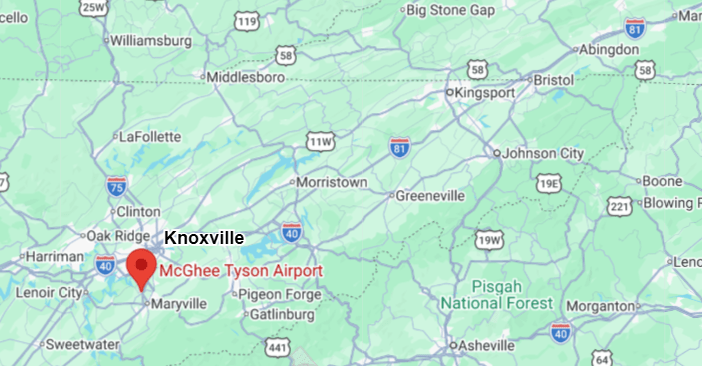
Airport access is another important comparison. Knoxville’s McGhee Tyson Airport, located 4 miles from Downtown Maryville, offers convenience and often cheaper flights. But it also means Maryville is affected by approach and departure patterns, road traffic, and the cumulative effects of a growing airport that attracts customers from hundreds of miles away into the daily life of local residents.
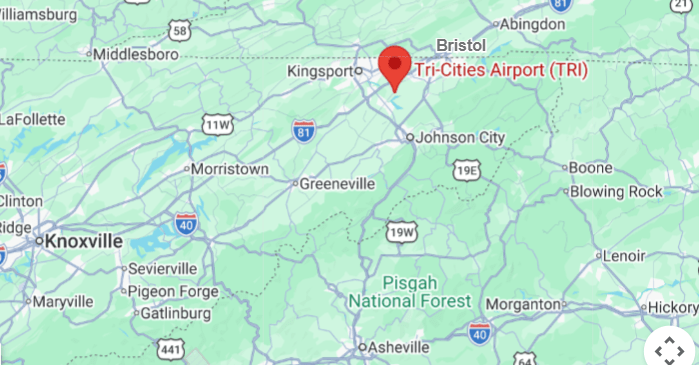
Kingsport is served by Tri-Cities Airport, which is more convenient than many outsiders realize, without placing the city under the daily burden of an airport corridor. TRI is roughly 25 minutes from even the most distant Kingsport addresses and as little as nine minutes from some nearby subdivisions. But its northeast-southwest orientation keeps Kingsport out of the airport’s flight path. TRI offers nonstop service to Atlanta, Charlotte, Chicago, Dallas, Orlando, and Washington, DC, and two leisure destinations (Orlando-Sanford and St. Pete-Clearwater). The Asheville and Knoxville airports are less than two hours away if more flight options are needed.
Maryville and Kingsport are both strong communities. Maryville offers the benefits of a desirable Knoxville-area setting, a larger nearby employment market, strong schools, and a strong suburban quality of life.
Kingsport offers something different: the advantages of a mature, independent city with convenient daily amenities, strong public education, outdoor access, a lower cost of living, and more variety than its reputation suggests.
Maryville has earned respect. So has Kingsport.
For families, retirees, remote workers, and newcomers looking for substance, affordability, good schools, and a genuine sense of place, Kingsport still offers something increasingly rare in Tennessee, an exceptionally high quality of life coupled with a relatively low cost of living.

 Kingsport Spirit
Leave a reply to Miles Burdine Cancel reply