“Blair Court” is one of the new streets in Kingsport’s Brickyard Village, named after Blair & Company. But who were they?
To answer that, we have to begin not in Kingsport, but in New York City — in the world of late 19th- and early 20th-century finance, when Wall Street banking houses helped build railroads, reorganize industries, underwrite securities, and move capital into growing regions of the country.
Blair & Company was one of those firms. It was not the largest financial house in America. That distinction belonged to names like J. P. Morgan & Company, Kuhn, Loeb & Company, National City Bank, First National Bank of New York, Guaranty Trust, and Bankers Trust. But Blair & Company operated in that same financial universe — a world where railroads, banks, trust companies, coal fields, land companies, securities, and industrial towns were often tied together by capital.
One way to understand Blair & Company’s importance is to understand the stature of the man who brought that world to Kingsport: John B. Dennis.
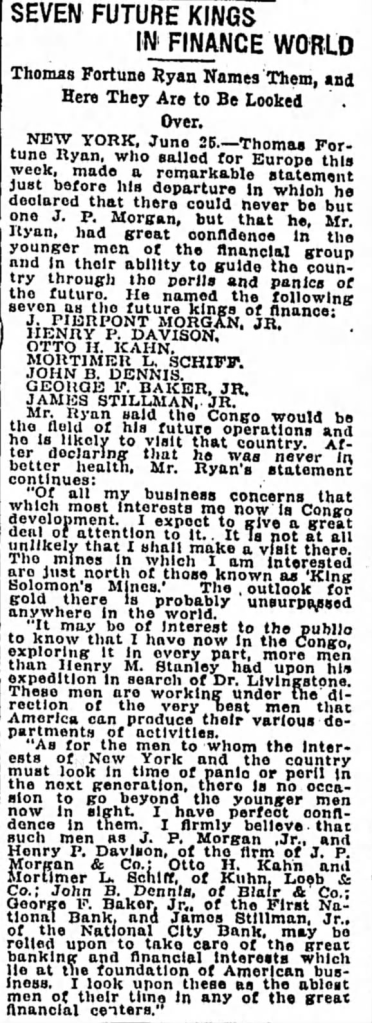
In 1910, The New York Times ran a Sunday feature titled “Here Are America’s Future Kings of Finance.” The article identified Dennis of Blair & Company among seven younger men whom financier Thomas Fortune Ryan believed would become the forces of the future on Wall Street. The list placed Dennis alongside J. P. Morgan Jr., Henry P. Davison, Otto H. Kahn, Mortimer L. Schiff, George F. Baker Jr., and James Stillman Jr.
That is remarkable company.
Morgan and Davison were tied to J. P. Morgan & Company. Kahn and Schiff represented Kuhn, Loeb & Company, one of America’s great railroad-finance firms. Baker was tied to First National Bank. Stillman was connected to National City Bank, the ancestor of today’s Citibank.
And sitting among them was John B. Dennis of Blair & Company.
That tells us something important. Dennis was not a minor land speculator who happened to invest in East Tennessee. He was recognized nationally as part of the rising generation of American finance at a time when finance was shaping the country’s railroads, industries, cities, and future.
Blair & Company financed real things. Its interests included major railroad and infrastructure projects, including the Carolina, Clinchfield & Ohio Railway, later known as the Clinchfield Railroad. Blair interests were also connected to rail properties such as the Western Pacific, Denver & Rio Grande, and Western Maryland. In Chicago, a Blair & Company syndicate helped finance the reorganization of the Lake Street Elevated Railroad, part of the system remembered today as Chicago’s “L.” The firm’s reach extended into investment banking, oil-related finance, coal, land, and securities.
But the Kingsport story begins before Kingsport’s modern rebirth. It begins with an earlier failure.
In the 1880s and early 1890s, this region was full of ambition. Railroads, coal, iron, timber, land speculation, and industrial dreams were all tied to borrowed money and national credit. Johnson City was promoted as a potential railroad and industrial powerhouse. John T. Wilder’s industrial suburb of Carnegie was supposed to help make that vision real. The Charleston, Cincinnati & Chicago Railroad, better known as the Triple C, promised to connect the Ohio Valley, Appalachia, and the South Atlantic.
Then came the Panic of 1893.
That panic hit this region where it was most exposed: railroads, coal, iron, land speculation, and borrowed capital. The Triple C collapsed into foreclosure. Carnegie’s promise unraveled. Johnson City’s railroad-boom momentum stalled. Bristol, already an important railroad and commercial center, was exposed to the same regional pressures through railroads, coalfield access, credit conditions, and the broader slowdown in investment.
The Panic of 1893 did not kill the region’s ambition. But it humbled it.
That is where the later Clinchfield story becomes so important. George L. Carter, Blair & Company, and John B. Dennis did not start with a blank slate. They inherited a landscape of failed dreams — the Triple C, distressed railroad properties, unfinished rights-of-way, coalfield ambitions, and industrial hopes that had outgrown their financing.
The vision was not wrong. It simply needed stronger capital, better execution, and a more coordinated plan.
A second financial crisis also belongs in this story: the Panic of 1907. If the Panic of 1893 explains the local railroad collapse that helped set the stage for the Clinchfield, the Panic of 1907 explains the national financial world Blair & Company operated in.
In 1907, banks and trust companies came under pressure. Credit tightened. Railroads struggled. Investment slowed. Before the Federal Reserve existed, the United States had no true central banking system to steady credit in a national emergency. Private bankers, especially J. P. Morgan and his circle, stepped in to calm the panic. But that was precisely the problem. America had become too large, too industrial, too interconnected, and too dependent on credit to rely on a handful of Wall Street men to rescue the economy whenever panic struck.
That crisis helped set in motion the reform movement that led to the Federal Reserve Act of 1913.
After the Panic of 1907, Blair & Company remained part of that Wall Street investment-banking world, but its Kingsport role soon became more focused and practical. Around 1914, as George L. Carter faced financial difficulty, Carter sold his Kingsport holdings to John B. Dennis and Blair & Company. The next year, Dennis organized the Kingsport Improvement Corporation and brought J. Fred Johnson into the central leadership role.
That was Blair & Company’s great Kingsport moment: turning railroad-related land and industrial possibility into a planned-city strategy.
But Blair & Company’s name did not remain over Kingsport forever. By 1920, the old private banking house had been reorganized into Blair & Co., Inc. By 1929, Blair & Co. had been drawn into A. P. Giannini’s Bank of America/Transamerica financial empire. In Kingsport, the baton had already begun to pass. Dennis remained the guiding financial figure. Johnson became the day-to-day civic builder. Tennessee Eastman, Kingsport Press, Mead, Borden, and other industries helped carry the plan from Wall Street-backed vision into local reality.
Modern Kingsport was not built by accident. It was assembled.
George L. Carter brought the railroad vision. J. Fred Johnson, his brother-in-law, brought local leadership and civic devotion. James A. Blair and Blair & Company brought Wall Street capital. John B. Dennis brought financial management and deal-making. John Nolen brought city planning.
George Eastman’s interests brought the industrial anchor that helped secure Kingsport’s future.
That combination made Kingsport different. It was not simply another railroad stop or county seat, but a planned industrial city of national signficance.
But John B. Dennis’s Kingsport story did not end with finance, land companies, and industrial recruitment.
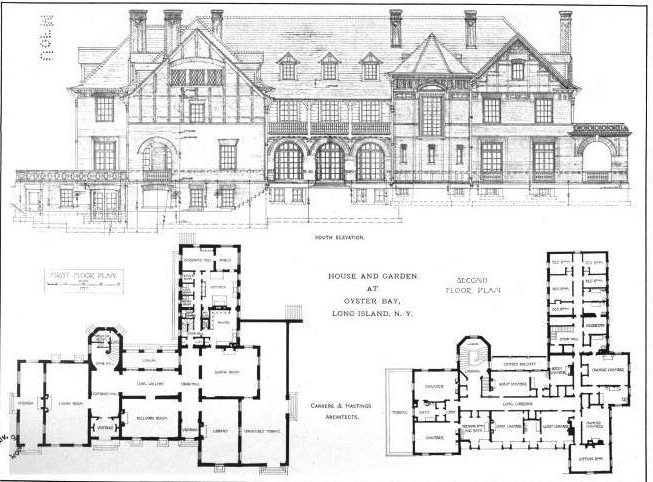
Eventually, Dennis became more than the New York financier behind the plan. He became part of the place. He and his wife, Lola Anderson Dennis, made their home at Rotherwood Mansion, overlooking the Holston River. Around it stretched Rotherwood Farms, a roughly 6,000-acre estate and working farm known for its cattle, riding horses, and prized livestock. Dennis raised competition cattle and poured himself into the land with the same seriousness he had once brought to railroads, banking, and city-building.
For a man who had spent his life organizing capital, land, transportation, and industry, Rotherwood must have represented something deeply personal.
Then came World War II.
As the nation mobilized, Kingsport’s strategic value took on a new meaning. The same assets that had helped make Kingsport a planned industrial city — rail access, industrial capacity, available land, water, power, and location — also made it important to national defense. Rotherwood Farms was sold to the United States government as part of the wartime expansion that became associated with Holston Defense and the munitions effort.
For the nation, it was necessary. For Kingsport, it was part of the city’s contribution to winning the war.
But for Dennis, it had to be a profound personal loss.
The man who had helped bring Wall Street capital to the Holston River, who had helped turn Kingsport from possibility into a planned industrial city, saw his own prized farm absorbed into the machinery of national defense. It was not simply a transaction. It was a surrender of place — a patriotic necessity, but a sacrifice all the same.
And it is worth pausing to imagine what Rotherwood Farms might have been today had history taken a different turn.
A 6,000-acre estate along the Holston River, tied to one of Kingsport’s founding figures, could have become one of the great historic landscapes of East Tennessee.
But that is not the path history chose.
Rotherwood was sacrificed to a larger purpose. The land that had been Dennis’s refuge became part of the national defense infrastructure needed to fight and win a world war. That is the hard truth of the story: Kingsport’s contribution to victory was not only industrial. It was personal. It required land, labor, disruption, and loss.
After that chapter closed, Dennis relocated to Asheville’s Biltmore Village, a place that also reflected the world he had known: old capital, mountain beauty, planned development, and the lingering presence of nationally prominent families and financiers who had found their way to western North Carolina. There, Dennis lived out his final years.
But he came home in the end.
John B. Dennis died in 1947 and was returned to Kingsport for burial at Oak Hill Cemetery — the city he helped create, the city whose future he had helped finance, plan, and believe in.
That gives the story its full measure.
Dennis came to Kingsport from the world of Wall Street finance. He helped salvage a failed regional railroad dream. He helped connect Appalachian opportunity to national capital. He helped assemble the pieces of a planned industrial city. He lived here, farmed here, gave up land here for the needs of a nation at war, and returned here in death.
The Panic of 1893 explains the earlier failure. The Panic of 1907 explains the national financial reckoning. The Federal Reserve story explains why the old Wall Street order was changing. Blair & Company explains how national capital found its way to the Holston River valley. And John B. Dennis explains how that capital became personal — tied not only to railroads and industries, but to land, home, loss, and legacy.
That is why “Blair Court” matters.
It is more than a street name in a new neighborhood. It is a reminder that Kingsport’s story has always been larger than Kingsport. The Model City was shaped by people who understood railroads, finance, industry, land, planning, and community — and who believed those pieces could be brought together here.
A street name can be easy to miss.
But sometimes a street name carries the whole story.


Leave a comment