Kingsport helped set the tone for Northeast Tennessee’s housing market in November. While the region recorded 609 home sales—up 6.7% year over year—and a flat median price of $260,000, Kingsport stood out as one of the submarkets providing momentum beneath an otherwise steady regional headline.
That distinction becomes clearer when housing activity is viewed on a per-capita basis, using postal population rather than city limits. In a region where people routinely live in one community and work, shop, or seek services in another, this approach better reflects real housing patterns and allows more meaningful comparisons across markets of different sizes.
Viewed through that lens, Kingsport (postal population 87,823) recorded 97 home sales in November, down 10.2% from a year earlier, while the median sales price rose 12.43% to $285,000. Fewer sales paired with sharply higher prices is a familiar signal of demand outpacing available supply, particularly in markets where inventory remains constrained. Rather than indicating weakness, the pattern suggests a market tightening under sustained demand.
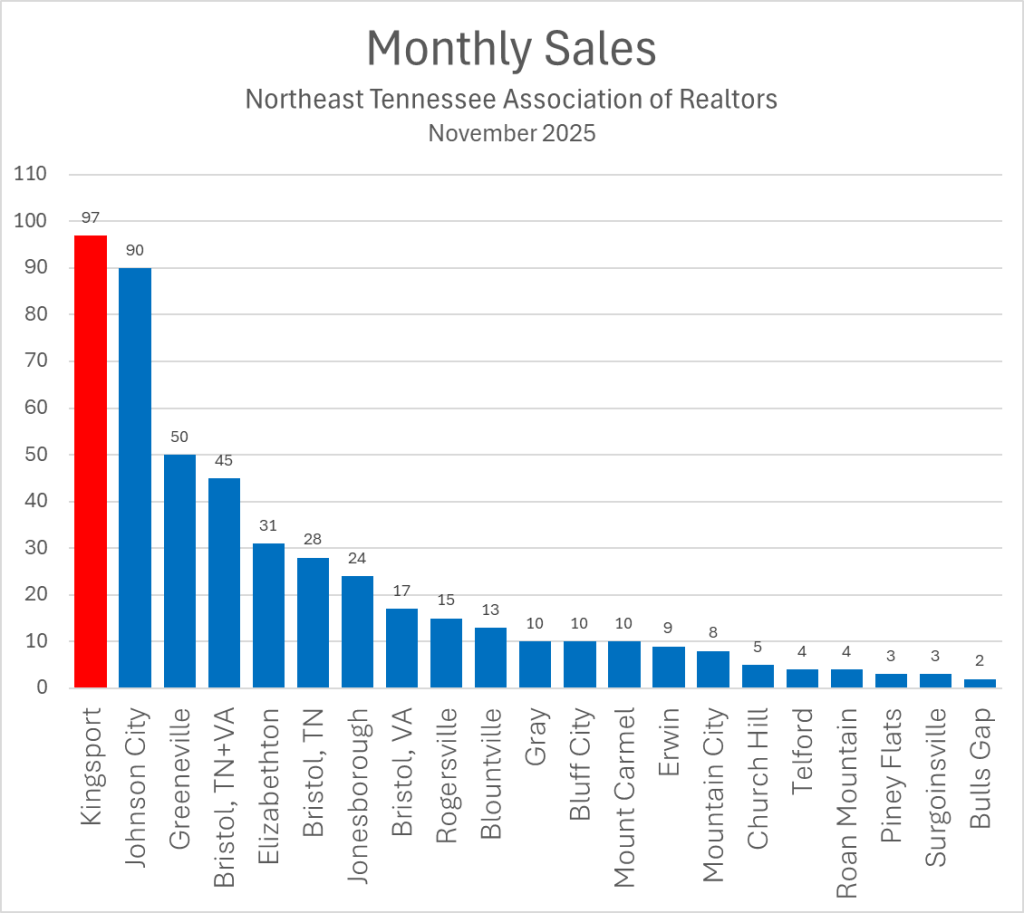
It is also important to note that much of Kingsport’s recent homebuilding activity falls within a Blountville postal district, meaning it does not appear in Kingsport’s totals in most national databases that classify sales by mailing address rather than municipal boundaries. Only data drawn directly from city records or the U.S. Census captures this activity under Kingsport. Similar mismatches exist elsewhere, including Bristol subdivisions with Bluff City addresses and parts of Johnson City carrying Jonesborough designations. Adding complexity, the Gray postal code was reassigned several years ago to default to Johnson City, causing areas long identified as Gray to appear as Johnson City in many datasets.
Across the region, performance varied. Johnson City (100,282) posted fewer November sales than Kingsport but experienced stronger price appreciation. Greeneville (45,469) showed steady per-capita participation with more modest gains. Bristol continued to function as a more affordability-oriented market with moderate turnover, with gains on the Tennessee side offset by declines in Virginia—illustrating how conditions can diverge even within a shared labor market.
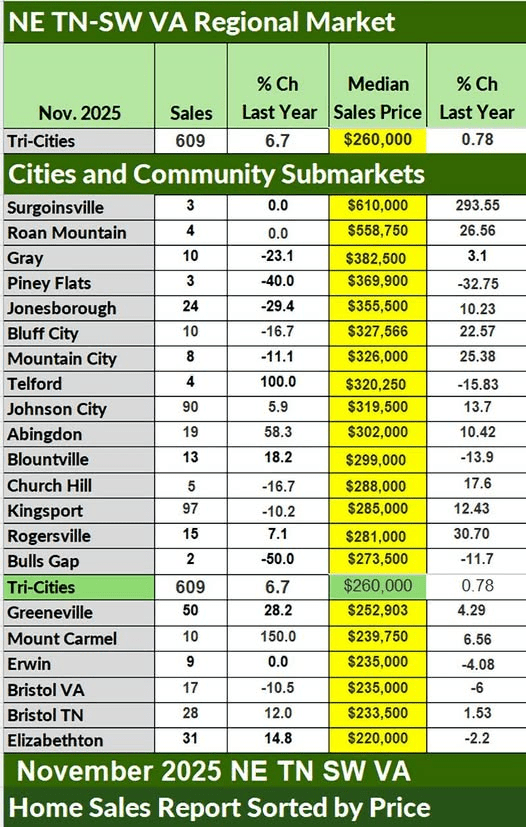
Between these larger centers, the “in-between” regional addresses—Jonesborough (29,313), Blountville (14,422), Bluff City (12,729), and Piney Flats (8,207)—play a distinct role in the housing ecosystem. These communities tend to attract residents who live and work throughout the region rather than orienting around a single city. In November, prices in these markets generally landed in the upper tier of the regional range, while sales volumes varied by location, reflecting differences in housing mix more than shifts in demand.
A slightly different pattern appears on the region’s edges, like Hawkins County, where Mount Carmel (5,469), Church Hill (20,510), Surgoinsville (4,158), and Rogersville (21,026), which tend to access the region by driving through Kingsport and, thus, are more closely tied to Kingsport’s patterns. In November, these communities absorbed demand at varying price points. Mount Carmel showed higher per-capita turnover, while Rogersville and Surgoinsville paired steadier participation with notable price appreciation. Church Hill, despite lower volume, posted strong year-over-year price growth.
What ultimately distinguishes Kingsport within this framework is scale. With one of the largest postal populations in Northeast Tennessee, it takes a substantial number of transactions for Kingsport to register strong per-capita activity. When that activity coincides with double-digit price growth, it signals sustained demand meeting limited choice—a dynamic shaping nearby markets as well.
It’s a monthly snapshot that offers clarity. Housing demand in and around Kingsport remains firm, and its effects are visible across a network of nearby and interconnected communities.
Kingsport remains one of the region’s most active housing markets, and its continued strength is shaping conditions well beyond its own boundaries.
 Kingsport Spirit
Leave a comment