We looked at recent home sales across all counties in East Tennessee and Western North Carolina—on both sides of the Blue Ridge. Why? Because these areas share many of the same traits. They’re clustered in the foothills of the Great Smoky Mountains, the highest peaks in Eastern North America. The communities in this region are more alike than different: similar landscapes, climates, and lifestyles.
But move farther east or west, and the picture starts to change. Cities begin to align with some of the country’s hottest markets—like Charlotte and the Piedmont Triad to the east, or Nashville and Middle Tennessee to the west. Go south, and the region blends into the edges of Metro Atlanta. Head north, and the land stretches into the more rural Valley of Virginia. That’s why we focused here—on the mountain communities that are distinct, yet deeply connected by geography and culture.
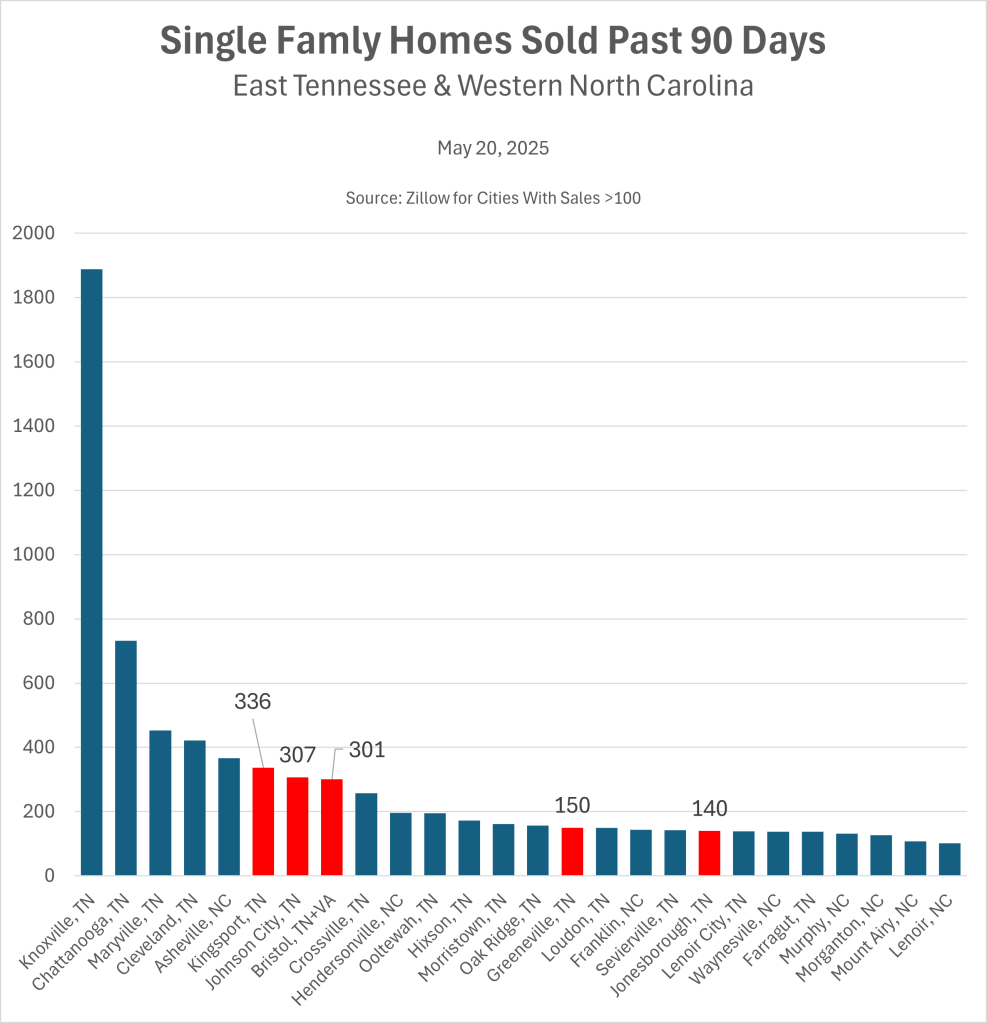
26 cities had more than 100 sales of single-family homes in the past three months. The largest—Knoxville (1,888) and Chattanooga (725)—lead by far. Mid-sized markets like Maryville (452), Cleveland (420), and Asheville (367) follow. But those highlighted in red—Kingsport (336), Johnson City (307), Bristol (301), Greeneville (150), and Jonesborough (140)—stand out as a strong and active group.
The Tri-Cities Core
Kingsport, Johnson City, and Bristol are often called the Tri-Cities. Combined, they recorded 1,234 home sales in just 90 days. Kingsport leads this group with 336 sales—about half of Chattanooga’s total—even though it’s a smaller city. Johnson City had 307 sales, thanks to its role as both a college town and a regional business center. Bristol, which spans the Tennessee-Virginia line, had 301 sales and benefits from affordable housing and easy access to nearby jobs. These cities offer a good mix of activity, livability, and affordability—without the high prices found in bigger markets.
Greeneville and Jonesborough: Smaller but Growing
Greeneville and Jonesborough add even more strength to the region. Greeneville had 150 home sales—an impressive number for a city of about 15,000 people. It attracts buyers looking for affordable homes and great schools. Jonesborough, Tennessee’s oldest town, had 140 sales. With just 6,500 residents, that’s a high volume. Buyers are drawn to its historic downtown, small-town charm, and location between Kingsport and Johnson City. These two towns show how growth is spreading outward from the Tri-Cities as more people look for value and quality of life.
How the Region Compares
Outside the red-highlighted cities, others like Crossville (253) and Hendersonville, NC (192) are also doing well, though they sit outside the Tri-Cities area. Suburban places like Ooltewah (195), Hixson (172), Morristown (161), and Oak Ridge (157) fall in the middle of the chart. Smaller North Carolina towns like Murphy (131), Morganton (127), Mount Airy (108), and Lenoir (102) show some activity, but not as much. That makes the red-cluster—a clear standout: more active than most small towns, and more affordable than the big cities.
What This Means
For homebuyers, realtors, and local leaders, this group of five cities sends a clear message:
- Steady Growth: These cities are active without being overheated.
- Affordability and Access: They offer decent prices, good services, and access to schools, jobs, and highways.
- Room to Grow: As big cities get more expensive, people are searching nearby.
Conclusion
In East Tennessee, real estate isn’t just about big or small cities. It’s about strong, mid-sized communities that offer the best of both worlds. Kingsport, Johnson City, Bristol, Greeneville, and Jonesborough show how towns with history, charm, and connections can grow steadily and stay affordable. For anyone watching the market, this region is full of opportunity.
 Kingsport Spirit
Leave a comment