Gross Domestic Product (GDP) is a key measure of a local economy’s health, representing the total value of goods and services produced within a specific area. It provides insight into economic growth, business activity, and overall financial well-being. While the Census tracks population and demographics, GDP serves as a measure of economic output and business vitality.
GDP consists of four key components: consumer spending, business investment, government spending (including higher education), and net exports minus imports. When GDP is rising, it typically signals a strong economy—businesses are expanding, jobs are being created, and consumer spending is increasing. This growth attracts further investment, fueling economic momentum. Additionally, higher GDP leads to increased tax revenue for local governments, allowing for improvements in schools, infrastructure, healthcare, and public services.
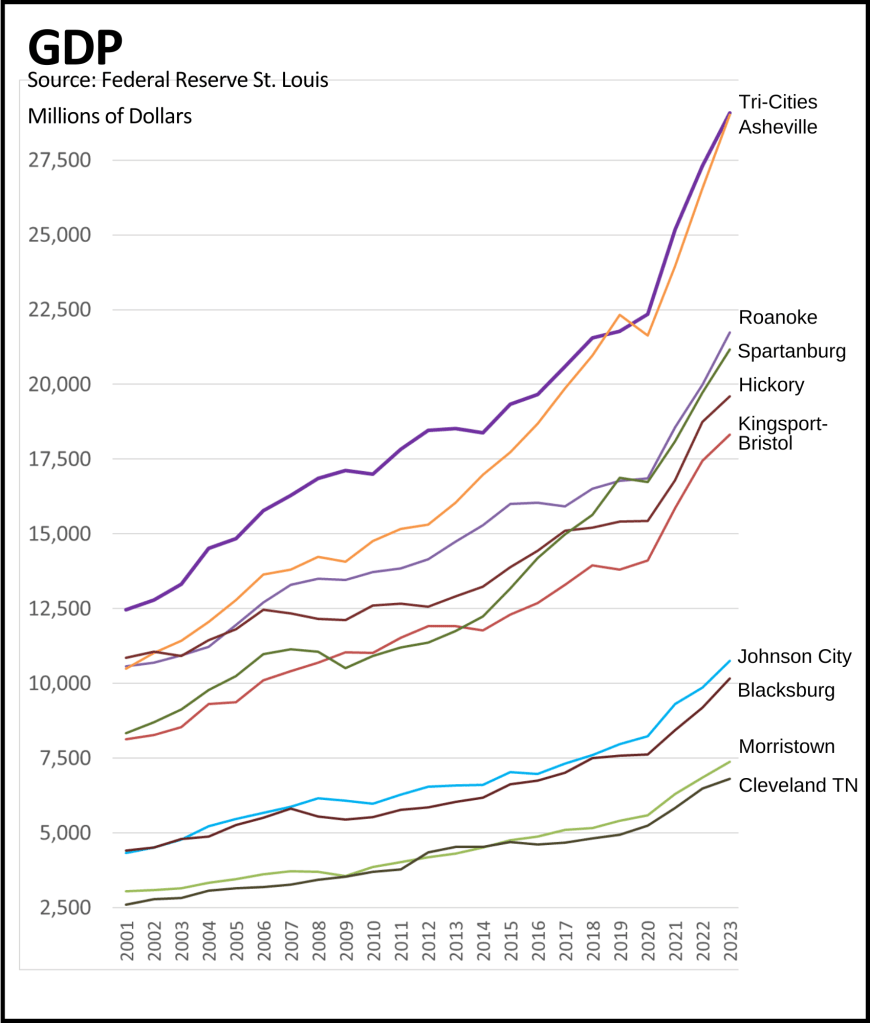
Tri-Cities leads among comparably sized metropolitan areas in East Tennessee, Southwest Virginia, Western North Carolina, and Upstate South Carolina, all of which have seen an influx of new residents since 2020.
The Role of Population Growth in GDP
Population growth is essential for sustaining GDP expansion. A growing population expands the labor force, increases demand for housing and services, and drives consumer spending—all of which contributes to economic growth. In contrast, regions with stagnant or declining populations may struggle to maintain GDP growth, as fewer workers and consumers can lead to reduced business activity and lower tax revenue. Attracting new residents is key to long-term success.
Regional Economic Contributions
While the Tri-Cities functions as a unified region, the federal government classifies it into two separate metropolitan areas: Kingsport-Bristol and Johnson City. Within this framework:
- Kingsport-Bristol drives the region’s economy through business investment and exports.
- Johnson City serves as the hub for government spending, including higher education, nuclear fuel, and the V.A. Medical Center.
- Consumer spending is distributed fairly evenly across both areas.
Mutual Interest
While statistical classifications separate the Tri-Cities into two MSAs, the reality is that economic success depends on regional cooperation. Kingsport, Bristol, and Johnson City are interconnected through commerce, infrastructure, and workforce mobility. By working together on projects of mutual interest, local leaders can leverage the strengths of each area to drive collective growth. A strong regional economy benefits every community, creating a more attractive environment for businesses, residents, and investors.


Leave a Reply