Last night, I noticed that Blountstown, Florida, was playing at Sevier County, Tennessee, some 500 miles from home. That’s roughly the distance from Kingsport to Memphis, except these schools aren’t even in the same state. How did they find each other? I have no idea. But seeing “Sevier” and “Blount” together sent me down a familiar rabbit hole.
I’ve discovered that names on a map often lead back to East Tennessee. Gainesville, Florida, for example, honors General Edmund Pendleton Gaines, whose family settled around present-day Kingsport. Jacksonville honors Andrew Jackson. And Blountstown?
Turns out, these stories are connected.
Blountstown, on Florida’s Apalachicola River, is named for Chief John Blount, a leader of the Apalachicola Creek people. Local historians identify him as the son of William Blount and a Coushatta woman. Although the relationship isn’t conclusively documented, the historical tradition is intriguing.
William Blount helped establish Tennessee. A signer of the U.S. Constitution, he became governor of the Southwest Territory in 1790, establishing his first headquarters at Rocky Mount in today’s Sullivan County. He helped guide Tennessee to statehood in 1796 and became one of its first U.S. senators.
Blount County honors William. Sevier County honors John Sevier, Tennessee’s first governor. Both men helped shape our young state.
William’s career ended in controversy. In 1797, he was expelled from the Senate for involvement in a scheme to seize Spanish territory with British assistance. He died in Knoxville in 1800.
The next chapter unfolded during the War of 1812, which extended well beyond America’s conflict with Britain. In the Southeast, the Creek War, Native resistance, territorial ambitions and struggles over Spanish Florida became intertwined.
Andrew Jackson defeated Creek forces at Horseshoe Bend in 1814 and the British at New Orleans in 1815. Those victories made him a national hero and accelerated American expansion.
Meanwhile, Edmund Pendleton Gaines fought the British along the Canadian frontier. In 1815, he married Barbara Blount, William’s daughter, in Knoxville. By 1816, Gaines was serving under Jackson’s southern military command along the Florida border.
Their military campaigns helped reshape the Southeast. In 1816, American troops under Gaines’s command destroyed a fort in Spanish Florida occupied largely by formerly enslaved people, killing hundreds. Fighting escalated into the First Seminole War.
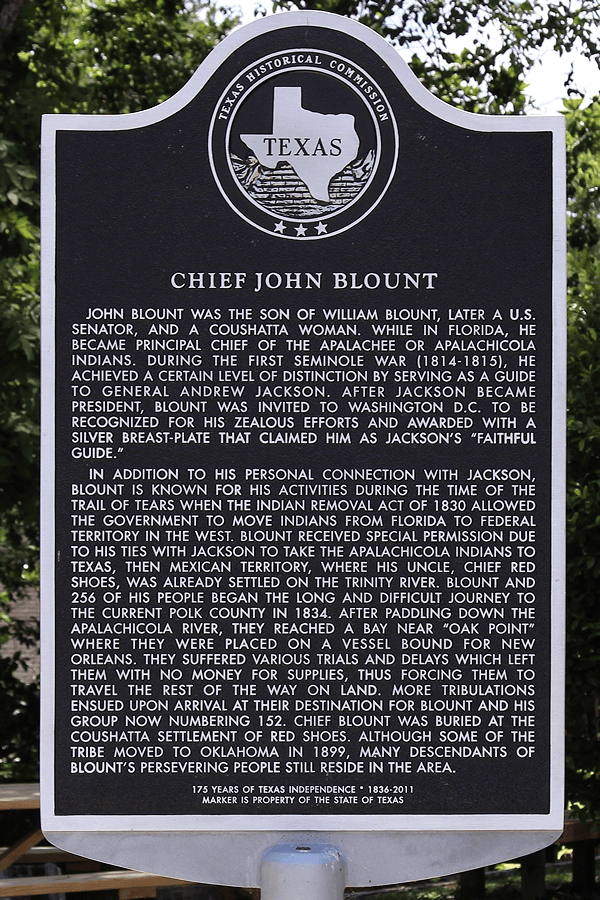
In 1818, Jackson invaded Spanish Florida. Chief John Blount, who had supported American forces during the Creek conflict, served as a guide. Jackson praised his knowledge of the territory and later presented him with a silver breastplate identifying him as his “faithful guide.”
American military pressure helped persuade Spain to cede Florida in 1819. The United States took possession in 1821. Jacksonville was named for Jackson in 1822, although he never visited the city. Gainesville would later honor Gaines.
But John Blount’s loyalty carried a bitter irony.
The man who honored him would become president and sign the Indian Removal Act of 1830. Although Blount’s people had received a reservation in Florida, mounting pressure and harassment eventually drove them from their homeland.
In 1834, Blount led his followers to Texas, then part of Mexico, near modern Houston (named for Sam Houston, another Tennessean). A Texas historical marker records that 256 began the journey, but only 152 reached their destination. Blount died shortly afterward.
Their ordeal was part of the broader tragedy of Native removal associated with the Trail of Tears, although it preceded the Cherokee removal of 1838.
Consider the contradiction. Jackson rewarded John Blount for helping secure American control of Florida, then championed policies that helped displace the very people who had assisted him.
And if John’s reported parentage is correct, Gaines—Jackson’s fellow general—was his brother-in-law.
A founding father, two generals and a Native chief. Their lives intersected through family, war, ambition and the expansion of a young nation.
We remember them through the names of counties, cities and towns. But those names tell only part of the story.
Sometimes understanding our history requires looking beyond the people we honored to the people who paid the price.
All of that from a football game.


Leave a Reply