Tenth in a 12-part monthly series to commemorate Sullivan County’s role in the 250th birthday of the United States of America
October 2026 | 10 of 12
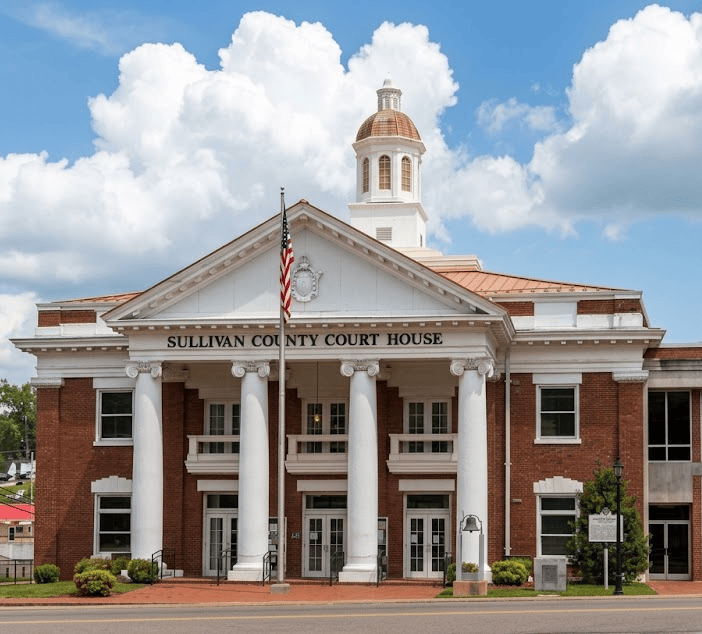
The name Blountville was not chosen by accident.
Neither was its location.
By the 1790s, Sullivan County was moving beyond its earliest frontier days. Government needed permanence.
Until then, county government had been remarkably mobile. The first Sullivan County Court met at Moses Looney’s fort house in 1780, then at James Hollis’s property near Eaton’s Station, later known as Yancey’s Tavern. Other accounts place the court at Mrs. Sharp’s near the mouth of Muddy Creek and at Joseph Cole’s property at Thomas Bridge on Beaver Creek—the historic homestead later associated with the McClellan and Cox families.
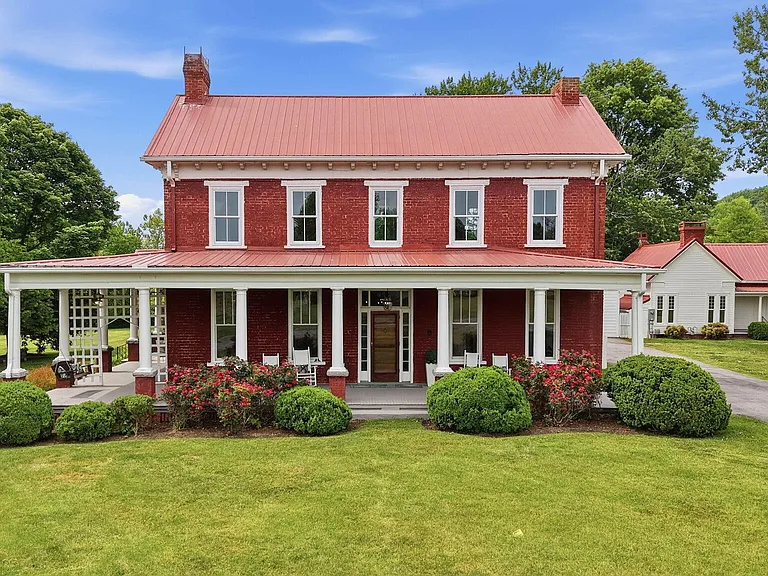
After Hawkins County was carved from Sullivan County in 1786, the old western court locations were no longer central. Officials sought a better place for a permanent courthouse.
So why Blountville?
Looking at today’s map, it is tempting to ask why not Kingsport, Bristol, Bluff City—or Rocky Mount.
The answer is that none existed in anything resembling their modern form.
Kingsport is really a tale of two cities. The first grew along the Holston River around Long Island and the Boat Yard. Christianville was laid out there in 1802, and adjoining Rossville followed in 1818. In 1822, the Tennessee General Assembly joined the two communities and incorporated them as Kingsport. It was a riverport town built around transportation and trade, but over time its fortunes faded.
Nearly a century later came the second Kingsport—the “Model City,” rechartered in 1917 and built around industry, railroads and deliberate planning. It eventually became Sullivan County’s largest population and economic center.
Bristol had an important predecessor, too. Evan Shelby settled at Sapling Grove in 1771 and established Shelby’s Station, or Fort, a frontier refuge and settlement center. But it was not Bristol. Joseph R. Anderson would not lay out the town until 1852, after recognizing the opportunity created by the coming railroad.
Bluff City’s predecessor was Choate’s Ford, an important Holston River crossing used by the Overmountain Men in 1780. But it was a crossing, not yet a town.
Then there was Rocky Mount.
William Blount used William Cobb’s home near present-day Piney Flats as headquarters for the Southwest Territory beginning in 1790. For roughly two years, it served as the territorial seat of government.
So why not there?
Because Rocky Mount was a private farmstead temporarily serving as the governor’s headquarters, not a planned governmental center. Even Blount described Cobb’s home as being in Washington County, a reminder that boundaries and geographic identities on the frontier were still evolving. In 1792, he moved the territorial government to Knoxville.
That same year, James Brigham offered Sullivan County 30 acres for a courthouse, jail, stocks—and a town.
That last part matters.
They were not putting a courthouse in an existing town.
They were creating a county seat.
In 1795, Blountville was laid out. That same year, Blount County was created and named for William Blount, while its county seat, Maryville, honored his wife, Mary Grainger Blount.
Together, Blountville, Blount County and Maryville capture Blount’s influence at the moment Tennessee was moving toward statehood.
History eventually shifted Sullivan County’s population and commerce elsewhere. Railroads created Bristol. Kingsport’s riverport gave way to the twentieth-century Model City. Bluff City grew from transportation.
Blountville did not.
And that may be part of why so much of it survives.
Still centrally located, yet somewhat off the beaten path, Blountville never faced the same urban pressure to raze and rebuild. Its historic district preserves an extraordinary collection of early buildings, and Sullivan County records cite the state archaeologist as describing it as Tennessee’s largest concentration of preserved eighteenth-century buildings.
Blountville also remains Tennessee’s only unincorporated county seat.
More than 230 years later, it still exists largely for the purpose for which it was created.
Government.
As America marks its 250th anniversary, that makes Blountville more than an old name on a map.
The choice was central, practical and permanent.
And, in an unexpected way, it may also have helped preserve the place.
Next in the series: November 2026 | 11 of 12 — 1779: Why Sullivan County Took Its Name—and What That Choice Signaled


Leave a comment