Thousands of people cross it every day.
Ask them the name of the bridge carrying West Stone Drive across the North Fork Holston River, though, and you may get a blank stare.
The Stone Drive bridge?
The 11W bridge?
The bridge north of Netherland Inn Road?
All are understandable answers.
But the State of Tennessee has another one.
D.W. Moulton Bridge.
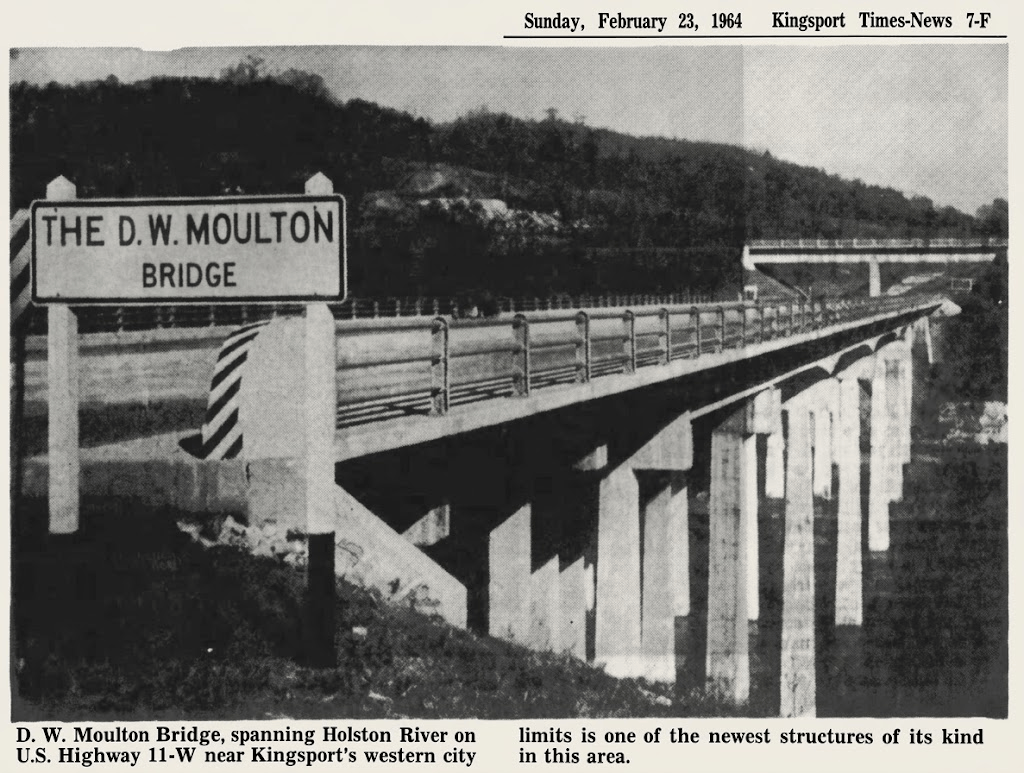
Tennessee Department of Transportation records are surprisingly definitive. An August 2024 inspection report lists the assigned name as “D.W. Moulton Bridge (1963)” and notes a “D.W. Moulton Br. Plaque.”
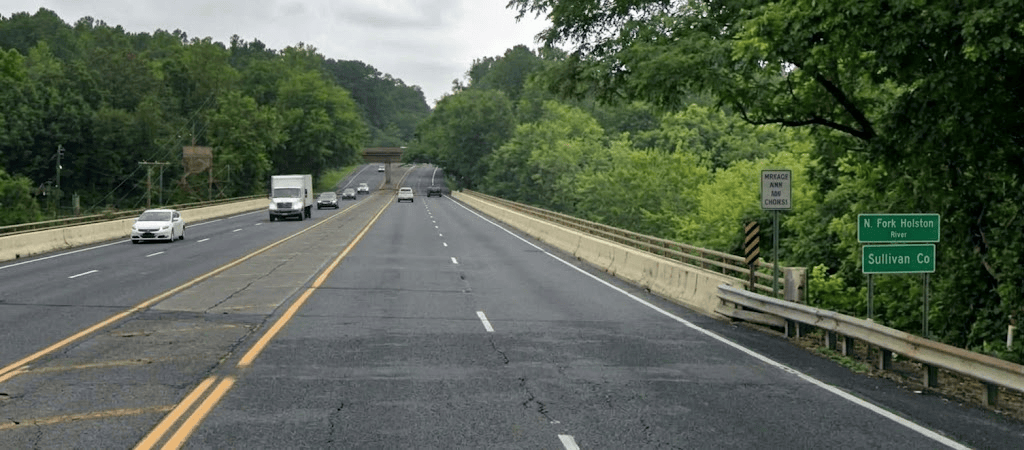
But there is no green highway sign today like those marking other named bridges.
There used to be.
So who was D.W. Moulton?
Denzil William Moulton was Kingsport city manager from 1946 to 1959, during the city’s rapid postwar growth. Kingsport’s population nearly doubled from 14,404 in 1940 to 26,314 by 1960. Today, at 57,530, it has more than doubled again. His entire tenure was spent managing the demands that came with that growth: streets, water, sewer, schools and public services. I wonder what he would think of the foundations he put into place if he could see them today.
He did not arrive as an inexperienced administrator.
Born in 1897, Moulton’s name first appears in a Jonesborough newspaper in 1920. His career took him through Morristown, Rockwood, Johnson City and Knoxville. In Morristown he married Carolyn Witt, a descendant of the family of historic Witt’s Foundry.
By 1926, he was Division Maintenance Engineer for East Tennessee. He became State Maintenance Engineer in 1933 and later moved to Chattanooga, where he was city engineer by 1944.
Then Kingsport came calling.
Moulton became city manager on June 1, 1946, just days before his 49th birthday. The Chattanooga Times lamented losing a man it praised for his “progressive ideas” and “efficiency,” then congratulated Kingsport on securing him.
By then, newspaper database searches produce nearly 600 references to Moulton across Tennessee. He was already a well-known public-works professional.
Kingsport dramatically increased his visibility.
During his nearly 13 years as city manager, his name appears almost 3,600 times in local newspaper searches. Anyone who has worked in local government understands the fish bowl. The city manager’s name gets attached to everything from major capital projects to the everyday workings of City Hall.
And there was plenty happening.
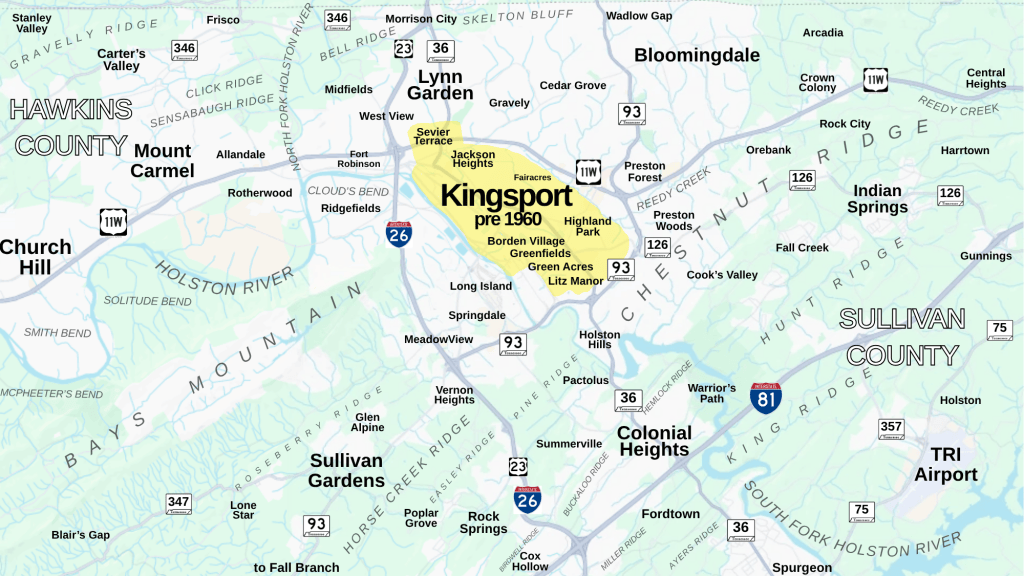
During Moulton’s tenure, Kingsport opened a new Douglass High School and George Washington Carver branch library, Andrew Johnson Elementary, and Ross N. Robinson Junior High. Washington-Lee Elementary was renovated, and the former Kingsport Junior High became John Sevier Junior High.
At the same time, Fort Patrick Henry Dam, the lake, and Warriors’ Path State Park were reshaping the area, while groundwork was being laid for Stone Drive and the John B. Dennis Bypass, both completed shortly after he left City Hall. Moulton also presided over major public housing initiatives at Cloud Homes and Riverview Homes, along with development of Borden Village.
By 1955, Kingsport’s municipal government had attracted enough attention that the U.S. Department of State included the city on an international observation tour of American local government.
Moulton was the city manager.
In January 1959, Gov. Buford Ellington appointed him Tennessee Commissioner of Highways and Public Works.
His stage suddenly became much larger.
The Interstate Highway System was taking shape, and Tennessee was building a transportation network that would reshape the state. During Moulton’s four years as commissioner, newspaper database searches return roughly 4,500 mentions of his name, tied to projects from the Great Smoky Mountains to midtown Memphis.
I wondered if his name had a local connection.
It caught my attention because, in one of my many former jobs with the City of Kingsport, I maintained the master street and address guide. I knew there was a Moulton Road and Moulton Greene Road in Fall Branch.
Turns out, that was home.
The Moulton family had deep roots there even before Tennessee statehood. Family members served as postmaster and rural mail carrier, operated a general store and blacksmith shop, and owned property prominent enough to appear in Fall Branch’s original incorporation boundaries.
Back in Kingsport, the U.S. 11W bridge over the North Fork Holston was completed in 1962, during Moulton’s final years as highway commissioner (when this future city manager was 1 year old). TDOT records say it became the D.W. Moulton Bridge in 1963.
Over time, Moulton Bridge became simply the Stone Drive bridge.
The last published newspaper reference I have found was nearly 30 years ago.
The official designation survived, but the sign did not.
Community memory faded.
D.W. Moulton devoted 43 years to public service, from highway engineering to city management to leading Tennessee’s highway department.
Perhaps it is time to remember his service and impact — the ripples of which we still enjoy today.
D.W. Moulton lost his wife, Carolyn Witt Moulton, three years after his retirement. He lived 13 years without her, passing in 1979 in Nashville. They are buried in Jarnigan Cemetery, Morristown.


Leave a comment