I recently visited what our guide called a “museum of stories.” Rather than focusing mainly on artifacts, it sought to preserve the lives of ordinary people. Many visitors were descendants trying to piece together their family histories.
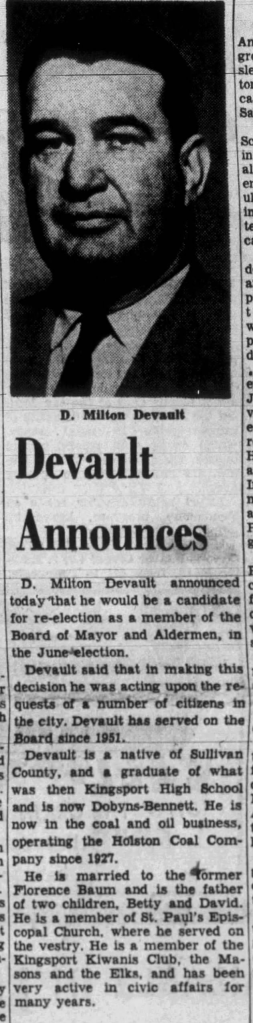
That experience reminded me of a conversation. My niece introduced me to a friend in Knoxville who mentioned that her grandfather had once been mayor of Kingsport—Milton DeVault. I recognized the name but could offer few details.
It made me think about the many people who have taken a turn in public office, often with little fanfare or personal recognition, simply to serve their community.
So I decided to learn more about Mayor DeVault.
David Milton “Milton” DeVault served eight years on the Kingsport Board of Mayor and Aldermen (BMA), from 1951 to 1959. He came onto the board shortly after the deaths of two giants of early Kingsport, J. Fred Johnson and John B. Dennis. In many ways, the torch had been passed to a new generation.
DeVault served alongside leaders including City Manager D.W. Moulton, namesake of the Stone Drive bridge over the North Fork, and education leaders Ross N. Robinson and M.C. Stone. They were guiding a growing city during a period increasingly shaped by civil rights, changing schools and the processes that would eventually lead to integration.
DeVault spent his first four years as an alderman. After his re-election in 1955, fellow BMA members selected him as mayor. He served two consecutive two-year terms through 1959.
That distinction matters because Kingsport operates under the council-manager form of government. The BMA establishes policy, adopts budgets and represents the public, while the city manager directs day-to-day administration. Projects of the 1950s should not be described as things “Mayor DeVault built.” They were Kingsport accomplishments—the work of elected officials, professional staff, civic leaders and citizens.
DeVault also carried a surname with deep regional roots. The name is an anglicized form of Dewald, brought to America by German-speaking Pennsylvania families. Milton DeVault’s ancestor Henry Dewald purchased 637 acres along the Watauga River from John Bean in 1797 for his sons. That family became associated with DeVault’s Ford and DeVault Bend near today’s Winged Deer Park. The Valentine DeVault House is listed on the National Register of Historic Places, as is the nearby DeVault-Massengill House built by Isaac DeVault opposite Rocky Mount.
A separate DeVault family became associated with Old Kingsport, the Boatyard and Netherland Inn Road. Guy Elliott DeVault—postal official, photographer, historian and community band organizer—came from that branch. Its presence helps explain the DeVault name that remains in Old Kingsport, including DeVault Street.
While his name was among the earliest in Tennessee, his work shaped the modern city of Kingsport.
DeVault’s BMA years coincided with substantial postwar growth. City leaders worked with the state on highway improvements that eventually produced the modern Stone Drive/U.S. 11W corridor. Kingsport annexed areas including Green Acres, Highland Park, Warpath/Litz Manor, Sevier Terrace and Eastwood Hills while extending streets, drainage, utilities and municipal services. That work helped prepare the way for the much larger 1963 annexations that nearly doubled the city’s size–Ridgefields, Fort Robinson, Rivermont, Preston Woods, Skyland, Cliffside, and Holston Hills.
The city was also planning improved municipal facilities, including a new City Hall on West Center Street that would be completed after DeVault left office.
Education was another major investment. During his eight years on the BMA, Kingsport opened a new Douglass Elementary-High School in 1951, Andrew Johnson Elementary in 1953 and Ross N. Robinson Junior High in 1955. Washington-Lee was renovated, the former junior high became John Sevier Junior High, and Highland Park entered the city system as Thomas Jefferson Elementary in 1959.
Douglass also reflects the realities of the time. The new building represented a significant investment in education for African American students, but Kingsport’s schools remained segregated. Integration would come in the following decade.
By the end of the 1950s, leaders were also confronting overcrowding at Dobyns-Bennett. The present Fort Henry Drive campus would not open until 1967, but planning for expanded high school capacity had begun.
Perhaps that is the best way to remember Milton DeVault. He served during a period when Kingsport was expanding roads, schools, utilities, neighborhoods and public facilities. He was not the sole author of that progress—and Kingsport’s form of government was never designed for him to be.
He was part of the team.
In Kingsport’s council-manager tradition, perhaps the highest compliment for a mayor is not that the city revolved around him, but that he worked effectively with others to move the community forward.
Milton DeVault appears to have done exactly that.
His story is also a reminder that generations of people have taken their turn on “Team Kingsport,” leaving the community better than they found it—often without fanfare, a namesake or any expectation of recognition.
For that, we should be grateful.
 Kingsport Spirit
Leave a comment