Many people instinctively equate higher tax revenue with higher quality. They assume that if a state collects more per person, it must provide better schools, better services, better infrastructure, and better local government. Sometimes that may be true. But it is not automatic. Higher collections can also reflect higher costs, greater service demands, larger bureaucracies, higher wages, more expensive infrastructure, or policy choices that require residents and businesses to carry a heavier load.
That is why the latest Tax Foundation comparison is worth noting. In fiscal year 2023, Tennessee collected $4,912 per person in combined state and local taxes, ranking 49th among the 50 states. By contrast, New York collected $12,506, California $8,942, and Illinois $8,339 per person. On the lower-revenue end, Tennessee sits alongside Florida at $5,141 and Texas at $5,737. The national average was $7,038.
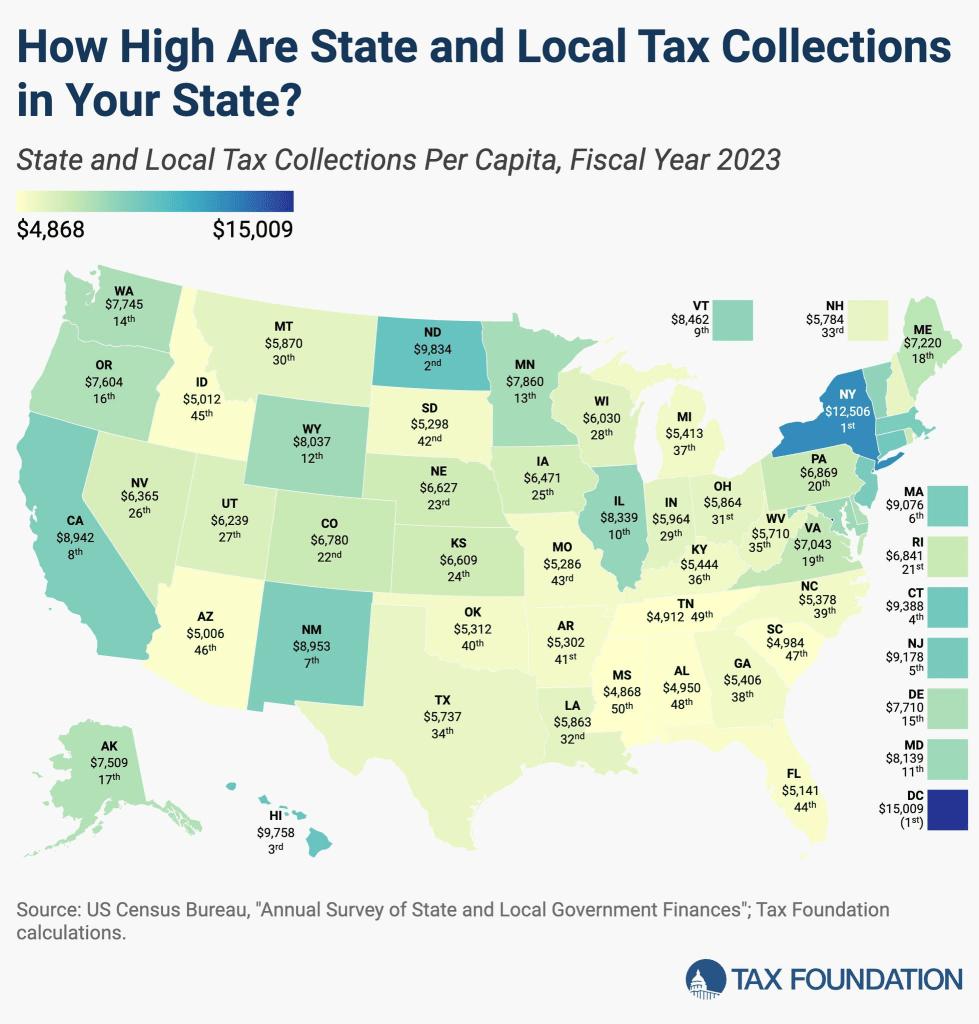
For some communities, low taxes could be a warning sign. Low revenue can mean leaner services, deferred infrastructure, weaker schools, or fewer public amenities. But Kingsport offers a different story. Kingsport is not simply located in a low-tax state. It is a city that continues to deliver the building blocks of a strong community within that low-tax environment.
Education adds important context. Higher-tax states such as California, New York, and Illinois certainly have statewide results that are often more mixed than their reputations suggest. Kingsport’s local story compares well. Dobyns-Bennett High School was recognized among the top public high schools in U.S. News & World Report. Kingsport City Schools also achieved Tennessee’s top value-added composite growth score of 5 for the ninth consecutive year. The point is that families do not have to move to a high-tax, high-cost state to find strong public education, and all stereotypical perceptions of Tennessee are not reality.
Public safety is another example. Kingsport’s police and fire departments are not merely “locally recognized.” They are accredited under professional standards that reach well beyond Tennessee. The Police Department has maintained national accreditation since 1992 and currently holds one of the highest levels of recognition available. Fewer than 6% of law enforcement agencies nationally achieve that accreditation. Kingsport Fire Department is internationally accredited, a distinction achieved by only about 1% of fire departments nationally, and it also holds a strong fire-protection rating. Residents can rest assured that these departments are being measured against serious professional standards, not just local opinion.
Water is another overlooked advantage. In many parts of the country, drought, scarcity, contamination concerns, aging infrastructure, and public distrust have made reliable drinking water a growing issue. Some households pay high rates and still rely heavily on bottled water. Kingsport’s water source is close to its mountain headwaters compared with systems that depend on distant, stressed, or heavily reused sources. The city is naturally blessed with a consistent source of both quantity and quality. Water quality is monitored around the clock, with more than 14,000 samples analyzed each year. The Water Treatment Plant has also received a national performance award for 15 consecutive years.
Kingsport is also modernizing City Hall. The Connect Kingsport app allows residents to report needs from their phones, using built-in location services for problems without a street address — a pothole, graffiti along the Greenbelt, a downed sign, or a maintenance issue in a park. The city’s AI phone assistant adds convenience even after normal business hours.
Some states may still look down on Tennessee. They may assume low taxes mean low quality. But Tennessee’s quiet response might simply be: bless their hearts.
Kingsport proves the point. A community can be affordable without being second-rate. That is the real achievement: balance. Kingsport is high quality at a lower cost.


Leave a Reply