In 2026, the Dobyns-Bennett Band marks its centennial, a full century of music, discipline, and public pride. That milestone is more than just a birthday for a school organization. It marks a tradition of excellence first shaped in the band’s early years by Director S. T. “Fess” Witt and carried forward through generations of students and directors to the present day under Lafe Cook. From the beginning, the Dobyns-Bennett Band was more than a school ensemble. Under Witt’s leadership, it quickly became one of Kingsport’s most visible and effective ambassadors, and it still is.
Long before marching bands became a routine part of school and civic life, the Dobyns-Bennett Band was carrying the name of Kingsport beyond the city limits and doing so with unusual distinction. Newspaper accounts from the 1930s and early 1940s show a pattern that is hard to miss. Wherever the band went—Gate City, Appalachia, the football field at home, or major public gatherings in Kingsport—it represented not just Dobyns-Bennett High School, but the pride, discipline, and aspirations of the city itself.
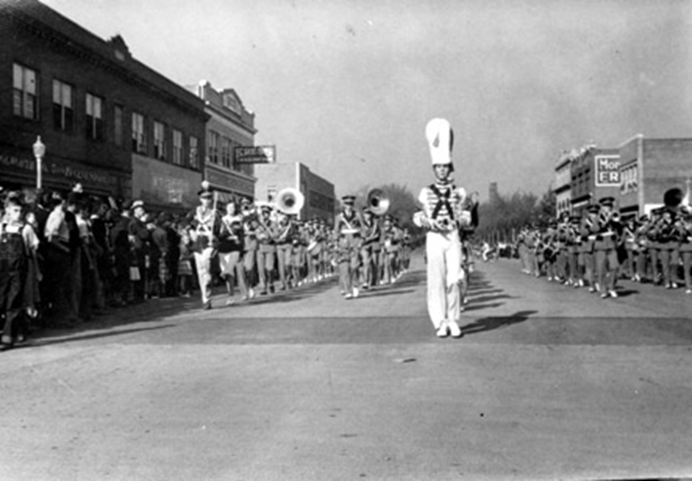
(Source: Kingsport Public Library & Archives
That ambassadorial role was evident as early as 1938, when the Dobyns-Bennett Band traveled to Appalachia, Virginia, to take part in a United Mine Workers parade connected to a major miners’ gathering. This was no small local appearance. Coal stood at the center of American industrial life, and in Southwest Virginia, it shaped both the economy and the character of entire communities. Kingsport, as a growing rail-linked commercial center, had its own ties to that wider coalfield world. The event drew participants from the Southwest Virginia coalfields and several hundred mine workers from Eastern Kentucky, placing a Kingsport high school band in the middle of a gathering connected to one of the country’s most important labor movements.
Two years later, in April 1940, the band again filled a broader civic role when it traveled to Gate City for a benefit concert in support of the Shoemaker High School band. Witt himself described the trip as a “goodwill tour” intended to strengthen cooperation between the two schools. That phrase is revealing. This was not simply a performance engagement. It was an act of cultural diplomacy. The proceeds helped another band, the expenses were covered by the Kingsport Merchants Association (forerunner to the Chamber of Commerce), and the Dobyns-Bennett musicians represented the city’s generosity as well as its talent.
By late 1940, the Dobyns-Bennett Band had earned a reputation that went well beyond courtesy appearances. One Kingsport Times article said Witt’s group had not been outclassed in ten appearances against some of the best bands in East Tennessee and called it the top musical and marching outfit in the area. It added that the season’s stiffest competition would come from the Charleston, West Virginia, band at intermission, a reminder that Dobyns-Bennett was being compared not just with nearby schools, but with respected programs from farther afield. That is a striking claim, but the larger point matters even more. The band had become part of Kingsport’s identity. Just as the football team carried the city’s competitive spirit onto the field, the band carried its polish, energy, and confidence into public view.
During World War II, that public role took on even greater meaning. In 1942, the Dobyns-Bennett Band participated in a major wartime gathering at J. Fred Johnson Park connected to the Office of Civilian Defense, where Dr. Nat Copenhaver, commander of the Tennessee Department of the American Legion, was the principal speaker. The program included a State Guard drill, scouts and other uniformed groups, a planned air raid demonstration, and even a motion picture showing an actual bombing in England. This was not simply a band appearance. It was part of a solemn public ritual of patriotism and preparedness on the American home front. In helping advance the colors, the Dobyns-Bennett Band became part of a civic ceremony that linked Kingsport’s youth to the greater demands of wartime citizenship.
As Dobyns-Bennett celebrates the band’s centennial in 2026, these early newspaper accounts help explain why that anniversary matters. They show what Fess Witt built in the program’s early decades: not merely a fine band, but an institution that linked school, city, and region. His musicians performed, but they also represented. In parades, concerts, football games, and public ceremonies, the Dobyns-Bennett Band projected an image of Kingsport as organized, spirited, cultured, and generous. That tradition did not end with Witt. It was handed from one generation to the next, strengthened over time, and continues today under Lafe Cook. A century later, the Dobyns-Bennett Band remains one of Kingsport’s proudest ambassadors.

 Kingsport Spirit
Leave a reply to optimisticmortally0f2c4c9729 Cancel reply