I find tidbits of Kingsport history in the most unexpected places. This week, it came from a Retired Police Officers magazine out of Long Island, New York, where Kingsport has quietly placed a small ad for years.
Inside was an article on the burning of Norfolk in 1776, and there, in the middle of that Revolutionary story, was a familiar to local Kingsport historians: Edmund Pendleton — alongside Gaines and Preston through local placenames like Pendleton Place, Preston Woods, Preston Park, Preston Forest, and the Gaines-Preston Farm, better known as Exchange Place.
Although I was aware of Edmund Pendleton, I didn’t know much more about him.
Turns out, a Virginia Museum of History and Culture podcast said, “Despite his omnipresence in politics of the American Revolution, Pendleton tends to be one of the less-remembered founding fathers.”
Another source, Founder of the Day YouTube channel, described him as “an extremely interesting American founder” mostly because of something he was involved in a decade before the American Revolution–the John Robinson scandal. The same John Robinson that Fort Robinson is named for. It turns out, Edmund Pendleton was a protege of John Robinson and was ultimately charged with settling the Robinson estate upon his death.
Wait, a founding father? With interests in Kingsport? A scandal? Tell me more.
A quick timeline to put things in perspective.
1748–1750 — Thomas Walker is the earliest clearly documented Anglo explorer tied directly to the Kingsport vicinity. His first exploration to the mouth of the North Fork Holston in 1748, and the same source says that in 1750 he saw Indian houses in the fork between the Holston and North Fork Holston. More broadly, the Tennessee Encyclopedia identifies Walker as one of the earliest explorers sent west by the Loyal Land Company in 1749.
1756 — Edmund Pendleton received a Virginia colonial patent issued under the Crown through the Virginia Land Office, under the administration of Lieutenant Governor Robert Dinwiddie. A colonial patent was the original instrument from the colonial government conveying title from the Crown, through the colony, to a private person. The Library of Virginia distinguishes land patents (1623–1774) from later land grants (1779 forward), which shows that “patent” was the technical term for the colonial-era original conveyance. It is considered to be the earliest official conveyance of private land in what is now Tennessee. The size is disputed. One source says 3,000 acres, others say 6,000-8,000 acres on Reedy Creek (then called West Creek). This is a key title fact because it predates most permanent settlement in old Kingsport proper.
1760–1761 — During the Anglo-Cherokee War—a conflict within the broader French and Indian War era, but not identical to it—Colonel William Byrd marched against the Cherokees after the Fort Loudoun massacre and built Fort Robinson in the winter of 1760–61 near Long Island. Byrd named it for John Robinson Jr. (1705–1766), one of his Virginia lead-mining partners and the powerful speaker of the House of Burgesses and treasurer of Virginia.
1761 — The same campaign also left behind the Island Road, later remembered as the oldest wagon road in Tennessee. Sullivan County history ties the road, the fort, and the military movement together.
1765 — The Tennessee Encyclopedia says the first permanent settlers in the area came from Lancaster, Pennsylvania, in 1765.
1766 — David Ross (who eventually built Rotherwood Mansion) made an unsuccessful journey to the Cherokee Nation seeking permission to build a trading post at Long Island. That shows Ross’s interest in the area before his better-known iron and land activity of the 1790s.
1775 — Gilbert Christian’s family became the first permanent settlers of Kingsport proper when they moved to the mouth of Reedy Creek opposite Long Island in the autumn of 1775.
1776 — Revolutionary-era conflict brought a second fort to the same strategic site. In September 1776, Lt. Col. William Russell established Fort Patrick Henry on or near the site of Fort Robinson after Dragging Canoe’s attacks and the Battle of Island Flats in July 1776. Fort Patrick Henry then became a major gathering point for the anti-Cherokee campaign that fall.
1777 — The Long Island of the Holston Treaty strengthened Cherokee claims to Long Island, even though whites had already tried to treat the site as private property. The same year, Reedy Creek Road was improved, with Gilbert Christian acting as surveyor.
1779–1780 — The North of Holston settlements, long assumed to be in Virginia, were determined by survey to lie in North Carolina, and Sullivan County was formally created in 1779 and organized in 1780.
1782 — Gilbert Christian registered his earliest 850-acre land grants, which covered much of the land on which old Kingsport was later built. By the same year, John Menefee and Christian Rhodes were associated with a 2,480-acre tract later purchased by David Ross.
1789–1790 — The area moved decisively from frontier defense to commerce and industry. A local source says David Ross’s Log Agency and Tavern was in operation by 1789, and by 1790 Ross’s iron forge was being worked by his agents. The same source says Ross owned more than 7,000 acres in Sullivan County and thousands more in Hawkins County. Also in 1790, local history says James and Thomas Gaines were acting as Pendleton’s land sale agents, showing the continued breakup and resale of the old Pendleton tract.
1794–1796 — Settlement spread across the old Pendleton Grant, with named settlers appearing on parcels carved from that tract, including the Moore and Gaines families.
The Founding Father Time Forgot
Edmund Pendleton (1721–1803) was one of the most important civilian leaders of revolutionary Virginia. Trained as a lawyer, he rose from modest beginnings to become a member of the House of Burgesses, a delegate to the First Continental Congress in 1774, a leader in Virginia’s revolutionary conventions, the first Speaker of the Virginia House of Delegates under the 1776 constitution, and later the presiding judge of Virginia’s Court of Appeals, the commonwealth’s highest court. He was influential, cautious, and widely respected for his legal judgment and political moderation.
By the time of the Revolution, Pendleton was already in his fifties and initially urged restraint, insisting that “this unhappy dispute” did not necessarily require independence. But by 1776 he had fully aligned himself with the American cause and played an important role in the formation of the new nation. He worked with George Mason during the drafting of the Virginia Declaration of Rights, and in 1788 he presided over the Virginia ratifying convention that approved the United States Constitution.
Pendleton’s prominence was political and judicial rather than military. He did not hold a notable field command in the way Patrick Henry, Andrew Lewis, or other Revolutionary figures did. Instead, during the crisis of 1775–1776, he became president of Virginia’s Committee of Safety, effectively serving as governor after royal government collapsed. In that role, he oversaw Virginia’s revolutionary administration and militia authority. Later, as president of the Court of Appeals, he stood at the head of Virginia’s judiciary.
He also played a role in Virginia’s response to the Norfolk crisis. Under Pendleton’s leadership, the Committee of Safety dispatched the Second Virginia Regiment toward Norfolk to contain Loyalists and check Lord Dunmore’s position. After the burning of Norfolk, the convention and committee allowed reports blaming the British to circulate widely through the colonies, helping turn opinion further against Dunmore and the Crown. The best-supported interpretation is that British bombardment began the destruction, while Patriot troops and later official demolition orders completed much of it. Norfolk had become both a military problem and a Loyalist center.
Pendleton also had a more personal reason to resent imperial policy. The Crown’s Proclamation of 1763 prohibited settlement west of the Appalachian Mountains. That posed a direct problem for Pendleton because his Kingsport-area land had been conveyed in 1756. In practical terms, the proclamation placed new limits on lands already claimed by men like Pendleton, reinforcing the colonial belief that British policy was increasingly unfair to American interests.
The John Robinson Scandal
According to Founder of the Day YouTube, Edmund Pendleton was 45 years old and serving as Virginia’s attorney general in the 1760s, just as Parliament was passing the Stamp Act and other measures, including the Currency Act, which is especially important to this story. Around that same time, Pendleton’s mentor, John Robinson, died, and Pendleton was chosen to help settle Robinson’s estate. Robinson had been one of the most powerful men in colonial Virginia, serving simultaneously as speaker of the House of Burgesses and treasurer of Virginia. In hindsight, that was probably too much power concentrated in one man. He was also the namesake of Fort Robinson in modern Kingsport.
After the French and Indian War, Virginia, like many colonies, slipped into an economic downturn. War often stimulated an economy; peace, especially with lingering military obligations and public debts, could bring contraction. To ease the strain, Virginia issued paper money intended to circulate temporarily, help debtors meet obligations, and then be recalled and destroyed by the treasurer to prevent lasting inflation. That was the plan.
But that is not what happened. Instead of destroying the recalled notes, Robinson quietly loaned them out. Many of Virginia’s elites were already deeply in debt before the war, and the postwar recession only made matters worse. They borrowed more money, often without realizing that the funds were not Robinson’s personal money at all, but public currency that was supposed to have been retired and destroyed. When Robinson died in 1766, Pendleton discovered the problem while working through the estate. Once the news became public, the scandal shook Virginia’s political and financial world.
The timing was remarkable. The crisis broke just as the colonies were protesting imperial taxation and restrictions, with the Stamp Act being repealed even as the Currency Act underscored Britain’s determination to control colonial paper money. From the British point of view, the Robinson affair seemed to justify tighter oversight. From the colonial point of view, it became one more sign of a system under strain.
Pendleton seems to have feared that his association with Robinson might damage his own reputation, but the opposite happened. He handled the affair capably, especially in his role as attorney general, and emerged with his standing strengthened rather than ruined. Increasingly, he also placed blame on British policy for helping create the broader economic and political pressures in which such a crisis could unfold. So it is not surprising that, only a few years later, when resistance to Britain deepened, Pendleton was chosen as a delegate to the First Continental Congress, where he signed the Articles of Association and supported the boycott of British goods.
The next year, Pendleton returned to the Second Continental Congress, but he did not remain in Philadelphia to sign the Declaration of Independence. Instead, he returned to Virginia, where he assumed what was, for him, the more consequential role of president of the Virginia Committee of Safety. That position made him governor in all but name and placed him at the head of Virginia’s revolutionary administration and militia authority. Like many founders, Pendleton believed the most important work was often in the home state, not in the continental capital.
He also presided over Virginia’s revolutionary conventions, including the Fifth Virginia Convention, which instructed Richard Henry Lee to propose independence. Pendleton signed the communication that sent Lee to Congress with that charge, leading directly to Lee’s famous resolution that these colonies “are, and of right ought to be, free and independent states.” He also worked with George Mason during the drafting of the Virginia Declaration of Rights, a document that would later influence the United States Bill of Rights. Although Mason is rightly credited as its principal author, Pendleton advised him during its composition and was part of the circle that shaped its final form.
By then, Pendleton had become one of the elder statesmen of revolutionary Virginia, widely respected for his judgment, moderation, and legal mind. He later served as president of Virginia’s Supreme Court of Appeals, effectively one of the highest judicial officers in the state at a time when court systems were still evolving. When he died in 1803 at the age of 82, nearly forty years had passed since John Robinson’s death and the scandal that followed. Yet even then, Pendleton was still dealing with the long aftermath of the Robinson estate. The debts had run so deep, and the damage had spread so widely among Virginia’s elite, that repayment and settlement continued across decades—through the Revolution itself and into the presidencies of George Washington, John Adams, and Thomas Jefferson.
That long shadow helps explain why Pendleton deserves to be remembered as one of the most overlooked and underappreciated leaders of revolutionary Virginia. Names like George Mason, Richard Henry Lee, and Patrick Henry remain familiar. Edmund Pendleton, much less so. Yet he was unquestionably one of the central figures of his era.
After the Revolution
American independence removed one obstacle to Pendleton’s western claims, but another remained. Lands north of the Holston River had long been assumed to be in Virginia, but later boundary surveys showed they were actually in North Carolina. That meant Pendleton held substantial property that had effectively been granted by the wrong colony.
Using his legal and judicial skill, Pendleton sent agents to seek recognition from the government of North Carolina. At first, officials balked, but eventually the claim was formalized. It was officially recorded in Sullivan County, then part of North Carolina, in 1792.
Pendleton never lived on the property himself, but 36 years after obtaining it from the Crown, he sold it off in tracts. In that way, his connection to the Kingsport area was not as a settler, but as an early landholder whose title predated the community that later grew there.
In 1794, one of the Reedy Creek parcels was reportedly sold to Samuel Moore, who made a partial payment in cattle worth 22 pounds, 10 shillings. Moore then built his log home, called “Meadow Place,” on a rise on the north side of Reedy Creek in the shadow of Chestnut Ridge.
It is the current home of Kay and Zane Vanover, née Cleek, who is now a Sullivan County commissioner who is running for mayor.
Edmund Pendleton had no biological children. By the early nineteenth century, land from the old Pendleton grant had passed into the hands of the Gaines family.
James named one of his sons Edmund Pendleton Gaines, who went on to fight at the Battle of New Orleans and became the namesake of Gainesville, Florida; Gainesville, Georgia; Gainesville, Texas; and Fort Gaines.
Another son, John Gaines, remained in the Kingsport area and operated Exchange Place, now a living history farm. The site served as a store, stage stop, and center of commerce on an important regional route. Eventually, the Preston family of Abingdon, Virginia, acquired the property. In 1845, John Gaines sold the western section to John M. Preston, which is why it became known as the Gaines-Preston Farm (Exchange Place).
It is hard to imagine that just 250 years ago, the namesakes of so many counties, towns, and historic properties were involved in our area, which was then America’s first frontier.
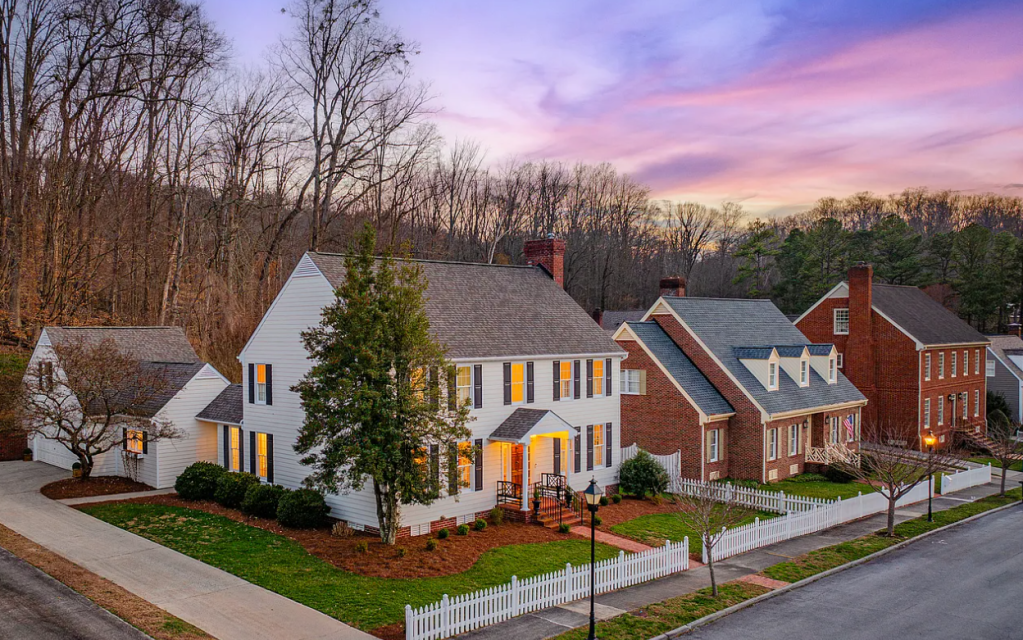
In 1986, Planning Commissioner P.J. Burns advanced plans for a housing development beside Exchange Place that took a more thoughtful approach to neighborhood design than the standard subdivision model. Named Pendleton Place in honor of Edmund Pendleton, the project was conceived as a Williamsburg-style community, with a Charlottesville architect engaged to help shape its early American character. Rather than forcing a rigid grid onto the site, the plan worked with the landscape, treating the terrain and natural features as assets rather than obstacles. Rock outcroppings were not simply blasted away, but incorporated into the design as part of the neighborhood’s character.
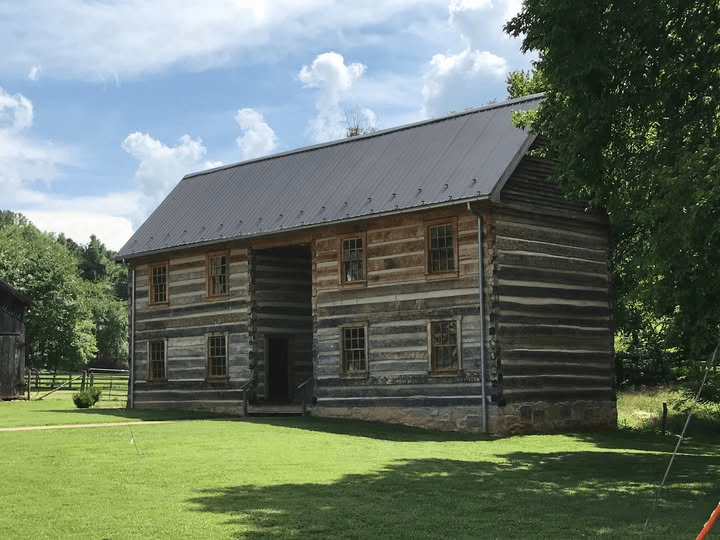
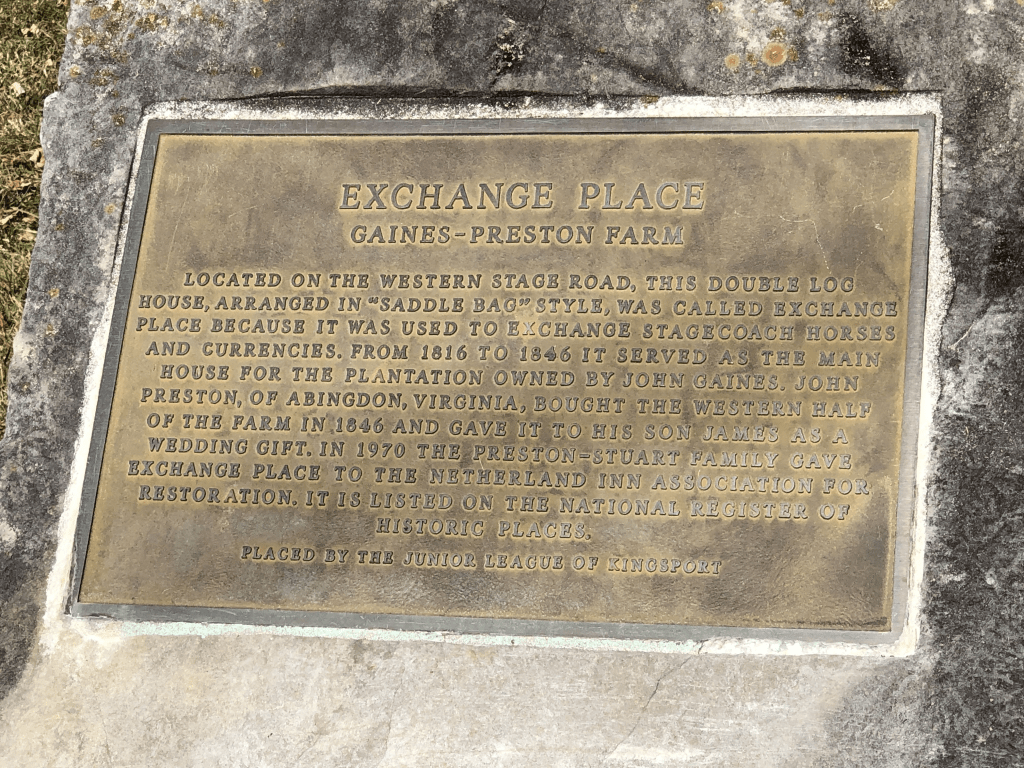
The homes were placed on relatively small private lots while being oriented around shared greens and common spaces. White picket fences, sidewalks, covenants, and architectural review all reinforced a cohesive appearance. At the same time, the houses were designed to fit the overall concept without feeling repetitive or cookie-cutter. One of the design’s subtle “easter eggs” is that each home’s picket fence has its own distinct, yet complementary, pattern. Unless someone pointed it out, you might never notice. That level of care in both layout and architectural detail helped make Pendleton Place one of Kingsport’s most distinctive and admired neighborhoods.


 Kingsport Spirit
Leave a reply to purplephantomae83fa8a60 Cancel reply