Why City Residents Should Care
Sullivan County plays a critical role in the lives of city residents, even if it can sometimes feel distant from Blountville, our collective county seat. That sense of distance is amplified by scale.
The decennial census is the baseline used nationwide to establish voting precincts. In 2020, Sullivan County had a population of 158,163 residents. Kingsport’s total population was 55,442—with 52,724 in Sullivan County and 2,718 in Hawkins County—while Bristol, TN, had 27,147 residents and Bluff City had 1,822. Blountville, by contrast, is an unincorporated community of 3,120.
After removing Kingsport’s Hawkins County residents from the equation, Sullivan County is almost evenly split, with 81,693 residents (51.6%) living in incorporated cities and 76,470 residents (48.4%) living in unincorporated areas.
That’s about as balanced as it gets.
Within the incorporated total, Kingsport alone accounts for 33.3% of the county’s population, while Bristol and Bluff City represent 17.2% and 1.5% percent, respectively.
This balance underscores the importance of electing representatives who govern with the interests of the entire county in mind – and historically they have – rather than focusing narrowly on any single district, whether urban, suburban, or rural.
In simple terms, Sullivan County provides the foundational services of local government, including support for education, courts, the jail, public safety, and essential administrative functions. These responsibilities include assessing and collecting taxes; maintaining public records such as deeds, plats, and vital documents; operating elections; providing public health, EMS, and social services; and maintaining county roads and buildings.
Cities layer additional municipal services on top of those county functions. These include police and fire protection; parks and recreation; enhanced funding for city school systems; paving and maintaining city streets; garbage, yard-waste, and leaf collection; snow removal; water, sewer, and stormwater utilities; and sidewalks.
When a city resident asks, “Why do I pay county taxes if I live in the city?”, the answer is simple: everyone relies on core countywide services. City residents also receive additional municipal services that are funded through city taxes and fees. Residents outside city limits either pay privately for certain services or pay added fees when they choose to receive city services beyond the city boundary.
When the county commission votes to establish policy and rates, it affects all of us, and that impact should be thoroughly considered from all points of view.
Sullivan County has 11 commission districts with a total of 24 commissioners. One to three commissioners are assigned to each district based on population. Kingsport city residents live in six of these county commission districts.
District 1 (Bristol East) and District 3 (Bristol West) each elect one commissioner.
The following elect two commissioners each: District 5 (Bluff City-Piney Flats), District 7 (Kingsport South-Airport), District 8 (Kingsport Southwest), District 9 (Kingsport Northwest), and District 10 (Kingsport Northeast).
The remaining elect three commissioners each: District 2 (Bristol Central), District 4 (Blountville SE-Bristol South), District 6 (Kingsport East-Blountville NW), and District 11 (Kingsport Central).
Viewed through this lens, 14 of the county’s 24 commissioners represent districts that include Kingsport city residents.
To add even more context, I used the City of Kingsport’s map and definition of large-scale neighborhoods. Some of the commission districts are based on natural features (like creeks or ridgelines), while some use streets. The even numbers are one district and the odd numbers are another. It’s important to pay attention to the edges.
If you are a Kingsport City resident or utility customer, you can go to KingsportTN.gov => My City Services => Enter Your Address. This will tell you you’re assigned county commission district, as well as your garbage/trash day, school zone, emergency services zone, power provider, water district, and your official neighborhood designation.
Remember, though, the authority on commission districts is the Sullivan County Election Commission map or your voter ID card.
Below is my attempt at a general description using zip codes to determine the city name. These are not the official names adopted by the government.
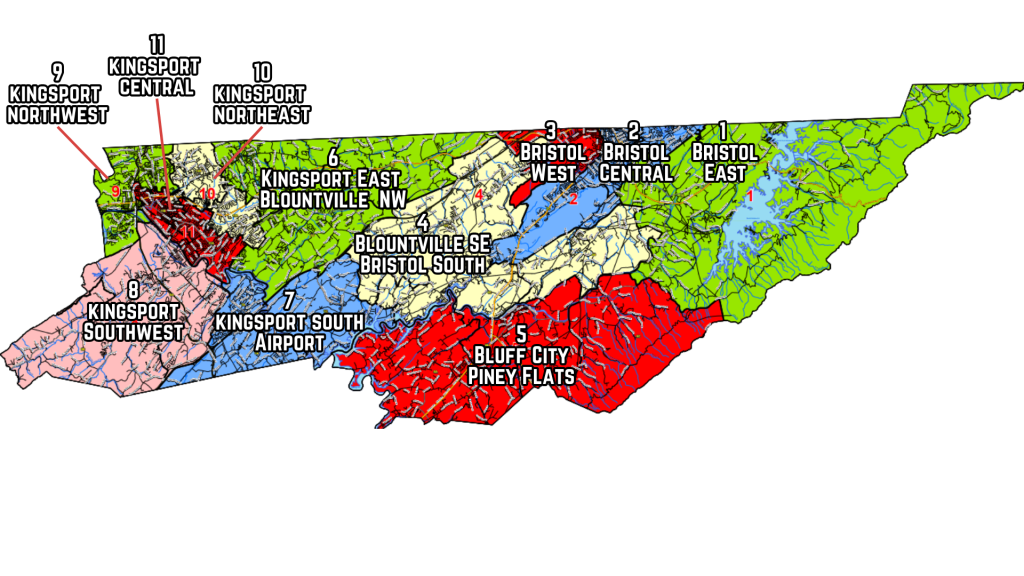
Sullivan County Commission Districts
- Bristol East (Holston Valley, South Holston Lake, Hickory Tree)
- Bristol Central (Downtown Bristol, Volunteer Parkway, including Speedway vicinity)
- Bristol West (west of Volunteer Parkway, including Steele Creek, The Pinnacle & Hospital)
- Blountville SE-Bristol South (Blountville, Boone Lake NE, Sullivan East HS vicinity)
- Bluff City-Piney Flats (Bluff City, Piney Flats, Boone Lake SE)
- Kingsport East-Blountville NW (Bloomingdale (pt), Arcadia, Orebank-Rock City, Indian Springs, Fall Creek, Preston Woods (pt), Cook’s Valley (pt), Central Heights
- Kingsport South-Airport (Colonial Heights, Fordtown-Midway, Boone Lake NW, Airport-Holston, Eastern Star)
- Kingsport Southwest (Sullivan Gardens, Fall Branch, Rock Springs, MeadowView, Pactolus, Springdale-Long Island)
- Kingsport Northwest (Ridgefields, Amersham, Huntington Hills, Rivermont-Fort Robinson, Midfields, Carter’s Valley, Lynn Garden (pt), Bloomingdale (pt), Sevier Terrace (pt), West View (pt)
- Kingsport Northeast (Midtown (pt), Bloomingdale (pt), Malabar Heights-Stone East, Preston Forest (pt), Preston Woods (pt), Cook’s Valley (pt), Skyland-City View (pt), Hillcrest (pt), Highland (pt)
- Kingsport Central (Downtown, Midtown (pt), Fairacres, Lovedale, Skyland-City View (pt), Hillcrest (pt), Highland (pt), Cliffside-Holston Hills, Litz Manor, Greenfields-Green Acres, Borden Village, Riverview, Riverfront-Riverport, Sevier Terrace (pt), West View (pt), Lynn Garden (pt)
For Kingsport city residents, here is even more clarification:
District 11 Kingsport Central
- Downtown Kingsport
- Midtown (pt) north of Sullivan Street and south of Reedy Creek inc. Church Circle radial streets, White City, Dale-Maple, Sevier Middle School, Lincoln School & vicinity
- Fairacres, including Tellico Hills
- Lovedale, including Cherokee Village, Jackson Heights, Teasel Drive, Cobblestone, Country Garden Apts., and Andrew Jackson School vicinity
- Skyland-City View (pt) west of Harbor Chapel, including Skyland Falls, Miller Village
- Hillcrest (pt) south of Memorial Boulevard
- Highland Park (pt) south of Center St, including Robinson Middle School vicinity
- Cliffside-Holston Hills
- Litz Manor
- Greenfields-Green Acres, including Andrew Johnson & Dobyns-Bennett High School vicinity
- Borden Village
- Riverview
- Riverfront-Riverport
- Sevier Terrace (pt) south of Lake Street
- West View (pt) south of Virgil Avenue, including Roosevelt School area
- Lynn Garden (pt), including Eastwood Hills
District 9 Kingsport Northwest
- Ridgefields
- Amersham
- Huntington Hills
- Rivermont-Fort Robinson
- Midfields
- Carter’s Valley
- Lynn Garden, including the John F. Kennedy School and the Lynn View Community Center vicinity
- Bloomingdale (pt) Stone Edge, Orbin Dr, King’s View Apts
- Sevier Terrace (pt) north of Lake Street
- West View (pt) north of Virgil Avenue
District 10 Kingsport Northeast
- Midtown (pt) north of Reedy Creek around Gibson Mill circle
- Bloomingdale (pt) east of Shipp Springs, west of John B Dennis
- Malabar Heights-Stone East (inc. Indian Path/Cross Creek)
- Preston Forest (pt) west of Clark Branch
- Preston Woods (pt) west of Caintuck Drive
- Cook’s Valley (pt) west of Palomino, east of Harbor Chapel
- Skyland-City View (pt) east of Harbor Chapel
- Hillcrest (pt) north of Memorial Boulevard
- Highland Park (pt) north Center St, east of Eastman Rd inc. Jefferson School area
District 6 Kingsport East-Blountville NW
- Bloomingdale (pt) east of John B Dennis
- Preston Forest-Crown Colony (pt) east of Clark Branch inc. Windridge, Aurawood
- Arcadia
- Orebank-Rock City
- Indian Springs inc. Old Island, Settler’s Ridge
- Fall Creek inc. Warrior Falls, Old Mill, Shekinah, Fieldcrest, Magnolia Ridge
- Preston Woods (pt) east of Caintuck Drive
- Cook’s Valley (pt) west of Harbor Chapel inc. Cook’s Crossing
District 8 Kingsport Southwest
- Springdale-Long Island
- MeadowView, including Willowbrook
- Sullivan Gardens, including Bailey Ranch, Vernon Heights, soccer fields, and vicinity
- Rock Springs, including Edinburgh, Cox Hollow, Hunter’s Crossing, John Adams School vicinity
- Pactolus, including Historic Hills, Southwood, and Windmere
- Fall Branch and Jonesborough addresses within Sullivan County
- Colonial Heights (pt), including most of Colonial Acres, Summerville, Colonial View, Foothills (pt), Copperfield, Hunt’s Crossing, Southampton, Windrush, Andover, Woodleaf, Moccasin Ridge, and South View Park vicinity
District 7 Kingsport South-Airport
- Colonial Heights (pt), both sides of Fort Henry Drive, including Hemlock Park, but excluding most of Colonial Acres, Summerville, Colonial View, Foothills (pt)
- Fordtown-Midway
- Airport-Holston
- Eastern Star, including city neighborhoods at Tri-Cities Crossing, Miller Parke, Breckenridge, Alpine, and Mitchell Road
Conclusion
Sullivan County’s future will not be defined by whether someone lives inside a city limit or beyond it, but by whether we approach decisions with a countywide perspective and a sense of shared responsibility. Each level of government has a purpose: cities deliver local control and tailored services, the county provides foundational services and coordination, and the state sets the rules that apply to both.
That structure is intentional—it keeps many decisions as close to the people as practical. At the same time, certain responsibilities are inherently countywide: tax rates and fiscal policy; county courts and the jail; elections administration; public safety coordination; public health and social services; and long-range planning for infrastructure, tourism, and economic development that spans every district.
Reaching our full potential requires leadership that respects local differences while governing fairly for the county as a whole. It means listening across boundaries, building coalitions, and making policy with a long view—focused on competitiveness, quality of life, fiscal responsibility, and equitable services. When residents and leaders rally around shared priorities rather than competing constituencies, Sullivan County becomes more than just the sum of its parts.
Where do we want Sullivan County to be in 10 years? 25 years? And what do we want to protect as we grow? What is our plan to get there—jobs, housing, roads and utilities, schools, public safety, and land use that fits the community? And how will we pay for it, set clear limits, and track progress each year so we know what’s working and what needs to change?
If we keep these questions at the forefront, we can leave Sullivan County better than we found it—not by accident, but by design. It does not have to be a sweeping campaign with increased costs and new revenue streams. I once worked with a guy who told a story about moving his wife’s rock collection. He put his foot down, saying he would not be hauling those rocks again. She didn’t argue. But when they arrived at their new home, he noticed something: there was only one rock in each box. The load had been carried in small, manageable pieces—yet the entire collection made the trip, and it never felt overwhelming. That is how progress usually happens. Small steps, taken consistently, add up over time. As the old adage goes, we do not inherit this place from our ancestors; we borrow it from our children.
 Kingsport Spirit
Leave a comment