Do you ever see a photograph that triggers a memory?
Recently, I discovered that Ancestry.com has digitized many of our nation’s yearbooks. In the process, I stumbled on the 1948 Maroon & Grey—my mother’s final yearbook at Dobyns-Bennett. It offers a remarkable window into student life in that era.
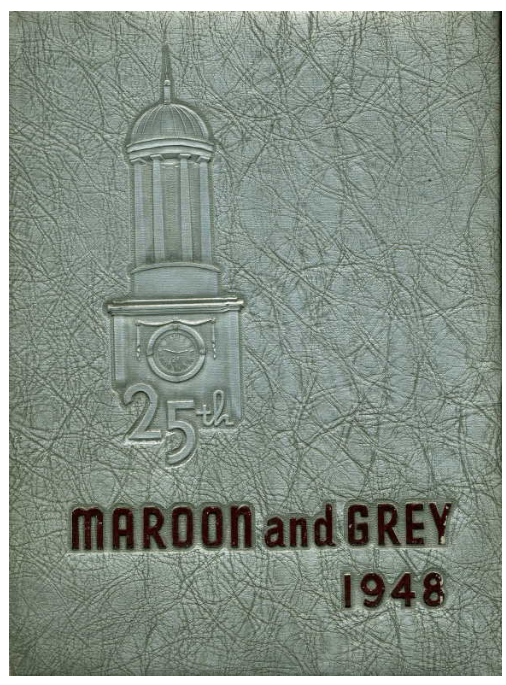
Twenty school years later, in 1967–68, the old Dobyns-Bennett building became John Sevier Junior High after DBHS moved to its current campus. Much of the architecture remained unchanged. And six years after that, in 1973, I walked into those same halls as a new Sevier student.
When I first entered the building, I must have seen it much as my mother had: the broad front porch and steps, the flagpole out front, the historic gyms, the familiar split foyer—and that sculpture greeting everyone who came through the doors.
I loved that sculpture.

“Appeal to the Great Spirit” stood in the main entrance of Dobyns-Bennett and stayed there after the transition to John Sevier. I knew nothing of its origins at the time, only that it moved me. I have since learned that it was a replica of Cyrus E. Dallin’s Appeal to the Great Spirit (1908–09), part of a four-piece cycle he called The Epic of the Indian. First exhibited in plaster at the 1909 Paris Salon, where it won a medal, it was later cast in bronze and placed at the Museum of Fine Arts in Boston in 1912, where the full-sized version still stands.
National debates continue over Native imagery, but here in our corner of East Tennessee, it has long been worn as a badge of honor, respect, and remembrance. Many residents proudly claim Cherokee ancestry—sometimes even when the DNA record cannot confirm it. That alone speaks to the deep regard for our Native heritage.
I’m no exception. According to Ancestry.com, I am the fifth great-grandson of Dragging Canoe and also a distant cousin of Rebecca Bryan Boone, wife of Daniel Boone.
Just as many families had relatives on both sides of the Civil War, many of us also had ancestors on both sides of the struggles surrounding westward expansion and the birth of the United States, which celebrates 250 years in 2026.
History makes clear that modern Kingsport and the Long Island of the Holston were sacred to the Cherokee. Early treaties even prohibited European settlement in the vicinity, but opened lands to the south and east.
Dragging Canoe and Daniel Boone ultimately became defining adversaries on this early Appalachian frontier. Their conflict grew out of the fight for control of Kentucky and the upper Tennessee Valley after the 1775 Sycamore Shoals land cession—Boone blazing the Wilderness Road for settlers, and Dragging Canoe warning that the disputed land would become “a dark and bloody ground.” Boone’s stations became targets of Dragging Canoe’s war parties during the Cherokee–American wars, while Boone emerged as a celebrated defender of the expanding settlements. In essence, they represented two competing visions of the frontier: Boone advancing westward expansion, Dragging Canoe fighting to preserve Cherokee homelands.
Our region still reflects this layered heritage. Down the road are the Daniel Boone Trailblazers, the Sullivan East Patriots, the David Crockett Pioneers, and the Cherokee High Chiefs. Together, they capture the complexities of who we are and where we come from. We may debate the past, but we live in today’s reality and honor those who shaped this place. And in doing so, we acknowledge that it is possible to hold and respect dual realities at once—to recognize both the triumphs and the tragedies of our history, and still find common ground in the community we share today.
On a separate note, I’ve never quite understood why ETSU calls its teams the Buccaneers, given that we’re nearly 300 miles from the nearest ocean. Around here, a 10-point trophy “buck” seems far more fitting than a skull-and-crossbones or a swaggering “buc” with a parrot on his shoulder—but I digress.
I do understand the pride and heritage of Indians, Chiefs, Trailblazers, Pioneers, and Patriots.
As new Tennessee schools open, their mascots increasingly drift toward safe, phonetically catchy choices that have little grounding in local history or culture. Names like Blackman Blaze, Siegel Stars, Summit Spartans, Rockvale Rockets, Battle Creek Grizzlies, and Nolensville Knights sound modern enough, but they’re so generic they could belong in almost any state. After all—when’s the last time you saw a Spartan or a grizzly bear roaming around Tennessee?
Perhaps I’m in the minority, but I’m proud of my heritage—and I’m proud that our region continues to pass that pride from one generation to the next instead of quietly erasing it for the sake of convenience or trend.
Which leads me to wonder: what became of that sculpture? To my knowledge, it is no longer at John Sevier or Dobyns-Bennett. And I’d love to know where it went.


Leave a comment