Move To Kingsport Monthly Report – October 2025
Kingsport’s draw remains both steady and far-reaching. In October 2025, the city welcomed 41 new families from 17 states, averaging 1.95 families per workday—virtually identical to the same month last year. That consistency is impressive at a time when national relocation trends have cooled significantly.
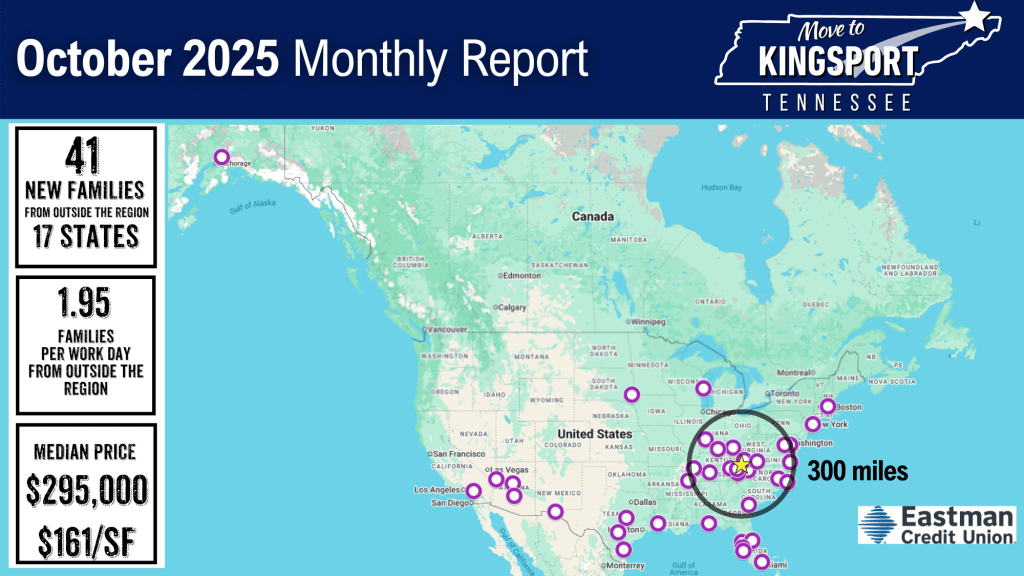
What’s changed most this year is affordability. The median sale price fell from $395,750 in October 2024 to $295,000 in 2025, with the price per square foot dropping from $179 to $161. Nationwide, high mortgage rates and slower economic growth have dampened housing demand, especially in large metros. Yet, in Kingsport, these trends have created opportunity: families from across the U.S. are taking advantage of a more balanced, accessible market without compromising quality of life.
Over the past 12 months, Kingsport attracted 609 new families from 46 states, down slightly from 653 families from 47 states the prior year. That 6.7% dip reflects a softening migration wave nationwide, as the post-pandemic relocation boom levels off. Still, Kingsport’s numbers remain remarkably strong compared with peer cities. Even with fewer overall moves, median home prices held steady—rising slightly from $332,215 to $335,000, and the price per square foot climbed from $155 to $166, signaling market strength.
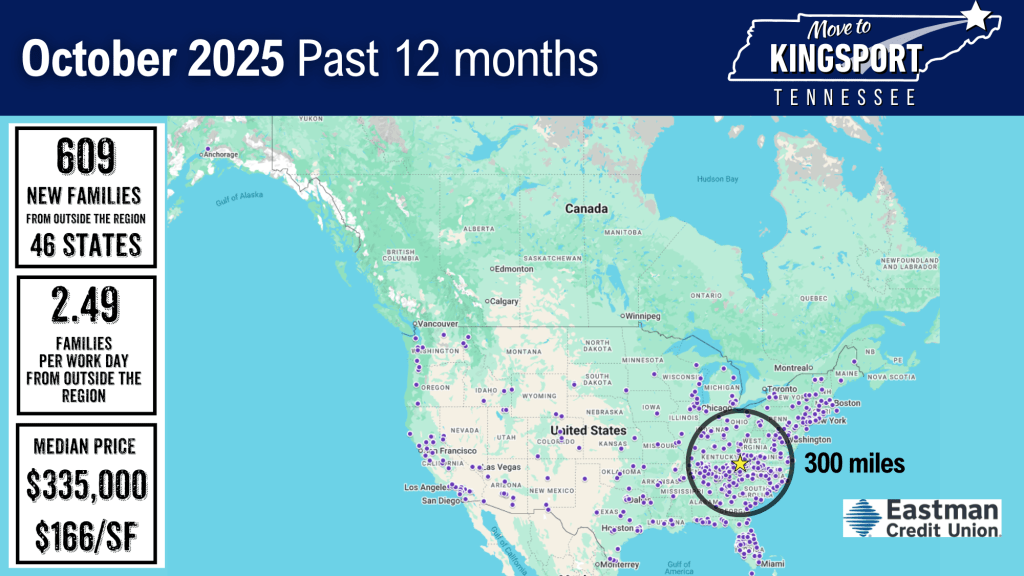
Perhaps most telling are the families relocating from the farthest reaches of the country—places like Alaska, Maine, California, and Washington State. These are not regional transfers or short-distance moves; they are cross-continental commitments to a new way of life. When a family trades the Pacific Coast or the far Northeast for East Tennessee, it’s not by accident. They are choosing Kingsport for its affordability, natural beauty, safety, and sense of community—qualities increasingly rare in high-cost or crowded regions.
At the same time, the 300-mile migration radius around Kingsport is deepening, with growing numbers arriving from Tennessee, Kentucky, Ohio, the Carolinas, and Virginia. This shows that Kingsport’s strongest pull now comes from families seeking proximity to extended relatives, flexible work-from-home arrangements, or simply a better balance between cost and quality of life.
Nationally, migration patterns are shifting toward mid-size metros with character, culture, and connectivity. Kingsport fits that description perfectly: large enough to offer opportunity and amenities, small enough to preserve belonging and ease of living.
In summary, Kingsport’s 2025 data reflects a city that’s stable, affordable, and nationally visible—a place that continues to attract families from coast to coast, even as the broader U.S. market slows. Whether they come from Alaska, Maine, or nearby North Carolina, they’re all finding the same thing: a community that feels like home, built on values that still matter.
 Kingsport Spirit
Leave a comment