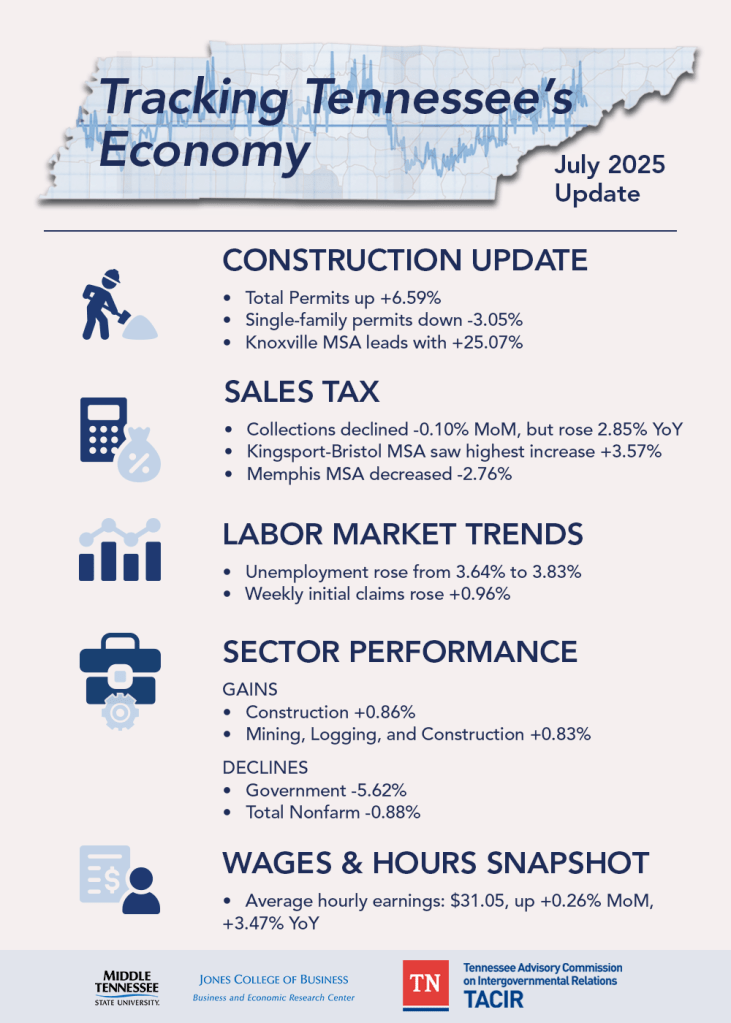
The Tennessee Advisory Commission on Intergovernmental Relations (TACIR) released its July 2025 report with a statistic that turned heads across the state. Kingsport-Bristol posted the highest retail sales tax growth in Tennessee at 3.57%, while Memphis, by contrast, recorded the largest decline at -2.76%. Overall, sales tax collections were down -0.1% statewide month-over-month, but up 2.85% year-over-year.
That comparison makes for an easy headline, but it misses the deeper point. The real story is about how Kingsport-Bristol, often overlooked in statewide conversations, has quietly become one of Tennessee’s most resilient regional economies.
In a state where economic discussions tend to orbit around the “Big Four”–Nashville, Memphis, Knoxville, and Chattanooga–the Tri-Cities have taken a different path. Growth here is steady, not spectacular, but it’s also sustainable. The region doesn’t chase runaway expansion or speculative surges—it builds around stability, affordability, and community strength. That approach is now showing up in the numbers, with Kingsport-Bristol leading the state in retail tax growth at a time when many larger metros are slowing down.
There are several reasons for this momentum. Population gains in the Kingsport-Bristol MSA are modest, but they are consistent, fueled by a mix of in-migration from nearby states and families choosing to stay rooted in the area. Housing costs remain affordable compared to Tennessee’s larger cities, which allows households to spend more freely at local businesses instead of being stretched thin by high rents or mortgages. The region’s retail pull also extends well beyond its immediate boundaries. Whether it’s big-box stores, regional shopping centers, or revitalized downtown districts, Kingsport-Bristol continues to attract shoppers from across Sullivan and Hawkins Counties, as well as neighboring Virginia.
The picture is even clearer when you look at the city level. The City of Kingsport’s August 2025 sales tax report shows a 4.63% increase in actual collections year-over-year—outpacing even the broader metro’s impressive growth. That local strength underscores Kingsport’s role as an economic engine of the region.
The lesson is straightforward but important: Tennessee’s economic health doesn’t rest solely on its biggest cities. The skyscrapers of Nashville and the logistics hubs of Memphis may dominate the headlines, but smaller, steady-growth regions like Kingsport-Bristol play an equally vital role. They provide stability, adaptability, and a consumer base that continues to show confidence even in uncertain times.
The July TACIR report may have drawn attention with its rankings, but Kingsport-Bristol’s real achievement lies in what those numbers represent. Here is a community investing in itself, moving forward at a sustainable pace, and proving that leadership doesn’t always have to be loud to be effective. At a moment when some of Tennessee’s largest metros are showing signs of strain, Kingsport-Bristol offers a different example—one of quiet strength.
While the report spotlights Kingsport-Bristol’s impressive gain, it doesn’t mention Johnson City’s performance, which would almost certainly be very similar. Why? Because the federal government split us apart in 2003. While we consider ourselves one Tri-Cities region, the federal government says the commuting patterns between Sullivan and Washington Counties aren’t strong enough, but somehow Nashville’s commuting patterns support a metro that spans 100-miles from the Kentucky state line to Marshall County, only one county shy of Alabama. Experts continue to monitor the numbers and, like Humpty Dumpty, will eagerly sound the alarm when we qualify to put the Tri-Cities back together again.
 Kingsport Spirit
Leave a comment