We often hyper-fixate on Kingsport’s ranking in Tennessee’s growth, but miss the context of cities that are closer than our state capital. When I first began my career, Sullivan was the fifth most populous county, but now it’s tenth, replaced by counties adjoining Nashville.
But Nashville, like Austin and Charlotte, is a national phenomenon. It’s not a fair comparison to Northeast Tennessee, but we are impacted because it shifts the center of gravity in state economics, demographics, and politics towards Middle Tennessee.
Kingsport’s population numbers won’t blow up a headline—57,109 residents in 2024, up 3.0% since 2020 and projected 7.5% by 2030—but that’s the point. Some cities are like the stock market; they boom or bust. Kingsport is more like the bond market—slow, steady, and predictable.
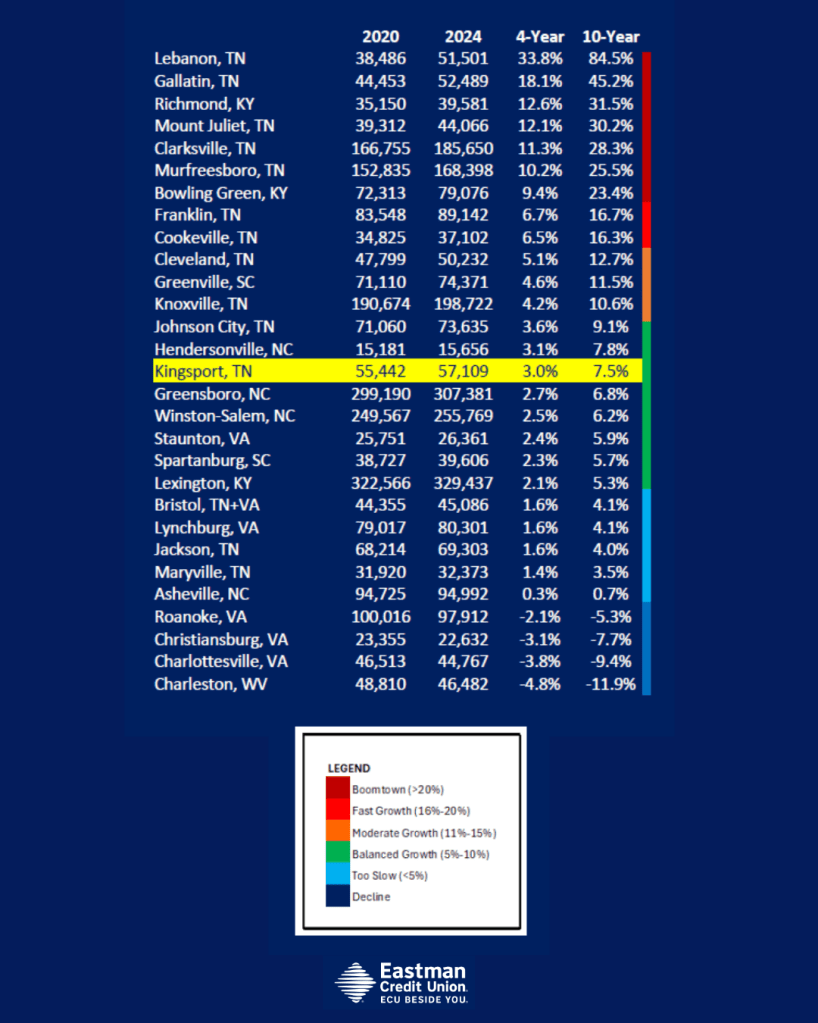
Start with the boomtowns around Nashville. Lebanon, Gallatin, Mount Juliet, Murfreesboro, and Franklin are classic big-metro suburbs—six-lane corridors, new subdivisions, short drives to Music City. Clarksville, buoyed by Fort Campbell and value pricing, belongs here too. Boom is exciting, but it comes with a tab: housing inflation that outruns wages, school overcrowding, traffic congestion, and water and sewer infrastructure challenges. Many of these cities will spend the next decade paying for the last one.
College towns form the next tier. Richmond, KY (EKU), Bowling Green (WKU), Cookeville (Tennessee Tech), Johnson City (ETSU), and Knoxville (UT) gain a reliable pipeline of students each year.
Hendersonville, NC, and Asheville add an “amenity migration” twist—tourism and retirees drive demand, but service workers struggle to live close to jobs.
Across the line in South Carolina, Greenville and Spartanburg ride the I-85 manufacturing and logistics wave; years of investment are paying off. Their risk is cyclicality—when factories cough, the region catches a cold—so reinvestment in skills and neighborhoods is essential. The Triad—Greensboro and Winston-Salem—illustrates the opposite problem: mature metros with diversified economies but slower city-proper growth. Their opportunity is quality—revitalization, advanced industry, and re-stitching older neighborhoods—even if the scoreboard moves more slowly.
Population decline tells cautionary stories: Charleston, WV, shoulders legacy industries and out-migration. Roanoke, Christiansburg, and Charlottesville show how fixed boundaries and high costs can make city counts look flat while counties absorb what growth remains. Even Lynchburg’s rapidly growing Liberty University barely moves the needle of city population. Bristol’s modest rise illustrates the holistic view of life split across a state line where the Tennessee side is growing, but the Virginia side is shrinking. And the growth of Maryville’s city population doesn’t properly capture the boom that’s happening just outside its boundaries.
So where does that leave Kingsport? We’re not an exurb with endless greenfields, and we’re not a flagship campus town minting freshmen every fall. We are the Tri-Cities’ industrial backbone and a regional medical hub with a growing quality-of-life pitch: safe neighborhoods, attainable prices, mountain access, and a civic culture that still feels personal. Our “balanced” 10-year growth—neither whiplash nor freefall—protects affordability and character. It allows us to safely manage growth without overcrowding classrooms, and reinvest in downtown to cultivate our small, unique businesses and restaurants.
A key lever is often overlooked: the airport. TRI is the quiet variable in every site-selection and recruiting conversation. The convenience of a regional airport keeps trips—and payroll—local, making the case for more frequencies. With its business park and foreign-trade-zone coverage, TRI doubles as an economic platform. Fast curb-to-gate times, easy parking, and short lines turn air service into a quality-of-life amenity that helps Eastman recruit, strengthens Ballad Health’s physician pipeline, and supports ETSU partnerships. In a crowded field of Southern contenders, air connectivity is leverage.
What, then, should we do? Lean into what scales sustainably. More “missing-middle” homes in existing neighborhoods. Accessory dwellings that let seniors downsize in place and young professionals land their first job here. Townhomes and apartments near corridors where services already exist. Renovation over demolition when the bones are good. Focus on infill and small-developer projects—dozens of units at a time—that add up without overwhelming infrastructure. And facilitate the construction of new homes to meet market demand.
Boom feels glamorous until the maintenance bills arrive; decline feels inevitable until small, compounding bets shift the slope. Kingsport’s job isn’t to chase either extreme. It’s to scale what already works—safe, clean, well-run, welcoming—and pair it with housing choice and airport-anchored connectivity. That’s how balanced growth wins the decade—and keeps winning the one after.
 Kingsport Spirit
Leave a comment