We hear a lot about the growing traffic on I-26. In a perfect world, maybe we’d all live in the same city where we work. That would ease congestion, reduce stress, and add hours back to our day. But modern life is rarely that tidy. In households with two working adults, it’s common for each person to head in a different direction—so families compromise and settle somewhere in between.
Kingsport has long been considered an inbound commuter city. Every day, 58% of its workforce—nearly 29,900 people—commute in from outside. Meanwhile, about 25% of working Kingsport residents (12,700 people) travel elsewhere for their jobs. It’s a daily ebb and flow that has defined the region for decades. Years ago, buses even picked up workers across the area and dropped them off at large manufacturing plants in the Model City.
Kingsport once shared many of the characteristics of Oak Ridge, another Tennessee job magnet. Oak Ridge is home to major federal research facilities, and today, 72% of its employees commute in. I suspect that’s what Kingsport’s numbers looked like a few years ago. But Kingsport today actually looks more like Johnson City than Oak Ridge. Johnson City brings in 60% of its workforce and sends out 22%. Bristol leans more toward outbound commuting, with 34% of residents working outside the city and 53% of its workforce commuting in.
We wanted to understand how Kingsport stacks up more broadly, so we analyzed Census commuter data for cities within a 300-mile radius with populations between 25,000 and 100,000. To get a clearer picture, we excluded suburbs of major metro areas like Atlanta, Charlotte, and Nashville—focusing on cities far enough from major centers to have independent economies.
From there, we built a simple ratio: the number of inbound workers divided by the number of outbound workers. A score of 1.0 means perfect balance—just as many people come in to work as go out. A higher score suggests a job hub with more inbound traffic; a lower score suggests a bedroom community where most residents commute elsewhere.
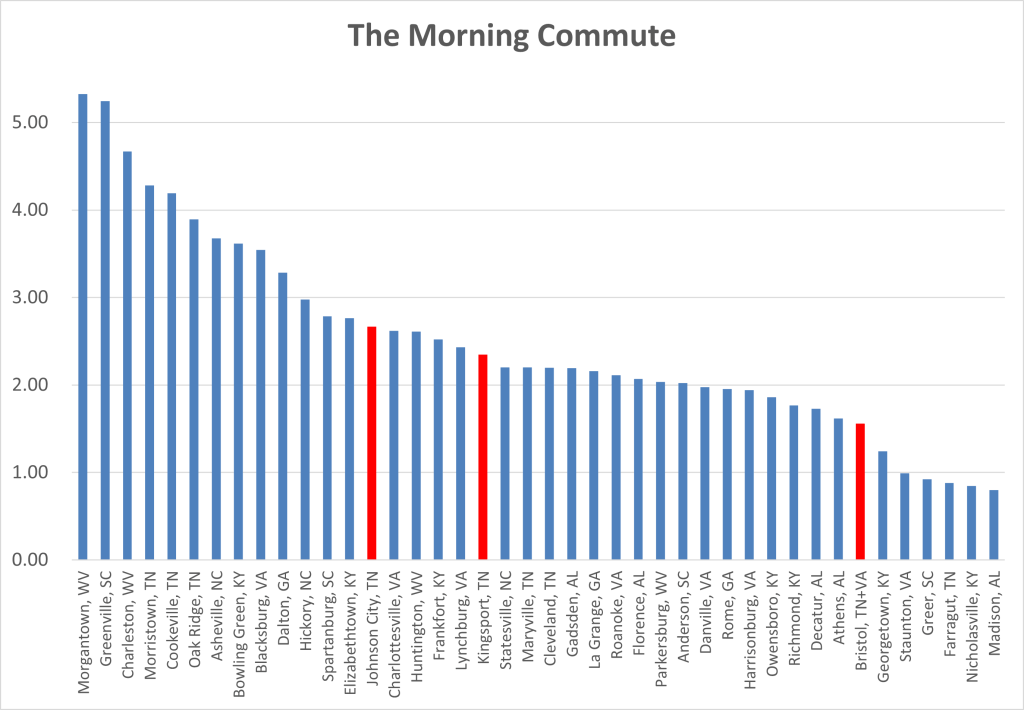
At one end of the spectrum are job-heavy cities like Morgantown (WV), Greenville (SC), Charleston (WV), Morristown (TN), Cookeville (TN), and Oak Ridge (TN). No surprise, Cookeville lives up to its nickname: “Hub of the Upper Cumberland.”
At the other end are residential-leaning communities like Madison (AL), Nicholasville (KY), Farragut (TN), and Greer (SC), where more people leave for work than stay.
Two cities—Staunton (VA) and Georgetown (KY)—are closest to that perfect balance. Bristol (TN/VA) is right behind them in achieving commuter harmony.
The median score among all these cities? 2.2, meaning twice as many people commute in than out. Kingsport scores 2.35—a little above the midpoint. We’re clearly a job center, but we’re also increasingly a residential one. People aren’t just working here—they’re choosing to live here, too.
I often say, “all things in moderation.” That’s the sweet spot—where a community is balanced in age, income, housing, jobs, and commuting. And by that measure, Kingsport lands right at the heart of its peer group.
Gone are the days when Kingsport was only a place to work. It’s a place to live. To build. To stay.
And no, I don’t cherry-pick the data to make Kingsport look good—it just seems to work out that way. Maybe that’s because it’s true: Kingsport really is a great place to live, work, play, and raise a family.
 Kingsport Spirit
Leave a comment