It’s no secret that the death rate exceeds the birthrate in every jurisdiction in Northeast Tennessee and Southwest Virginia, but we’re not alone. According to a March 2024 report from the Census Bureau, 69% of U.S. counties now have more people passing away than being born. However, 60% managed to counterbalance those losses through positive net domestic migration, i.e. newcomers.
A declining population can cause big problems, especially in small towns and rural areas. There’s a path where every county north of here—all the way to the Canadian border—is experiencing a declining population. That’s an economically ominous place to be.
When a community loses more people than it gains, schools may close or consolidate, businesses may struggle, and there may be fewer jobs. Local governments also collect less money in taxes, which can lead to cuts in public services like road repairs and emergency services. At the same time, as more people get older or lose their jobs, the need for healthcare and social services increases. If local governments don’t find ways to bring in new people and jobs, they could face serious challenges in the future.
All Things in Moderation
The key factor is moderation—a growth rate that keeps the economy healthy without changing the local culture.
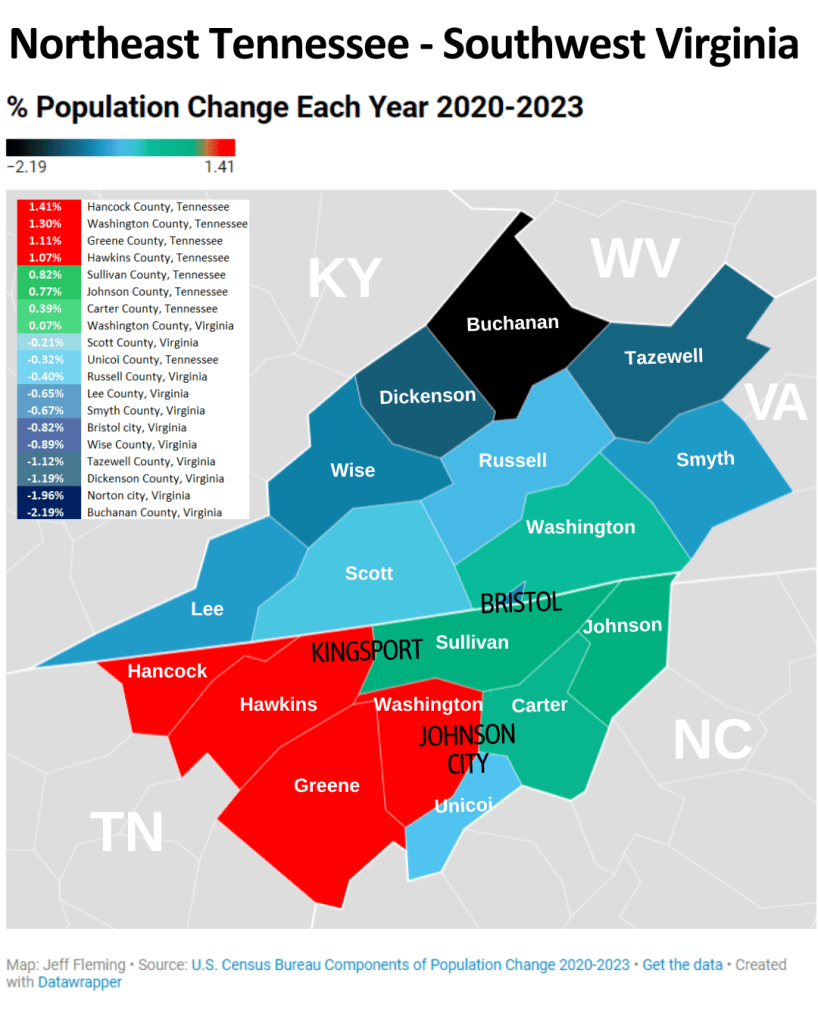
A moderate growth rate of up to 1% each year (shown in green) is important for keeping communities strong and stable. Growth at this pace helps local businesses, schools, and towns improve without overwhelming resources or changing the area too quickly. Whether we’re talking about the economy, population, or city development, moderate growth brings many benefits while avoiding problems caused by growing too fast or too slow.
When growth exceeds 1% per year (shown in red) locals may begin to feel overwhelmed. County roads designed for rural traffic may feel congested, school classrooms can become cramped, and the ability to extend water, wastewater, power, and internet can be challenging to keep pace. Residents may become more vocal about slowing things down and newcomers may become the target of local ire.
Even more concerning, however, is population decline (shown in blue), which can have serious long-term consequences for communities. This can lead to fewer public services, neglected infrastructure, and a shrinking job market. Many rural communities across Appalachia have experienced population decline as younger generations move to larger cities for work. If this trend continues unchecked, communities could face economic stagnation. A moderate and stable growth rate helps counteract these risks, keeping towns vibrant and sustainable for future generations.
Embracing Nature and Ecotourism
However, population decline isn’t inherently all bad—if the community is intentional and learns to adapt. The economic loss of year-round residents can be replaced with the economic boon of seasonal visitors and remote workers. Nature has reclaimed many of mankind’s scars on the landscape and these beautiful hills and hollows are returning to the original glory God intended. Ecotourism businesses can facilitate access to this natural beauty. I saw a YouTube movie, “Southwest Virginia: One of the Last Great Places on Earth”. Where else can you drive for hours in an area that resembles a national park, but is mostly privately owned land? And it’s right in our own backyard.
Hypergrowth: Just the Opposite
On the other end of the growth spectrum is Middle Tennessee. Anywhere within an hour’s drive from Nashville is experiencing rapid urbanization. Remember I said up to 1% per year is needed to ensure a healthy economy. Anything more can be challenging—think of Northern Virginia or Metro Atlanta back in the 1980s. That’s where Nashville is today. Believe me, no county in Northeast Tennessee is growing at a rate that I consider detrimental. However, almost every county in Middle Tennessee has been growing at a rate of 2% to 3% per year for 20 to 40 years now. Take Murfreesboro-Rutherford County, for example. It had a population of 86,809 in 1980. Today it’s 373,520. At that rate, it will soon pass Chattanooga-Hamilton County as Tennessee’s fourth most populous. That’s life-altering. And once it happens, you can’t get the genie back in the bottle. “Country” isn’t country anymore.
Planning for the Future
Returning to the original question—“Do we still need newcomers?”. With just three years of data since 2020, it’s still early, but trends are emerging—some encouraging, others concerning.
Four Northeast Tennessee counties—Washington, Greene, Hawkins, and Hancock—have grown faster than needed to offset the natural population decline caused by deaths outpacing births. These counties are on a trajectory to grow at a rate that may be uncomfortable for locals who want to preserve their familiar way of life.
Meanwhile, three other Northeast Tennessee counties—Sullivan, Carter, and Johnson—along with Washington County, Virginia, have seen moderate growth, barely offsetting the natural decline of deaths exceeding births. These counties are in the ‘sweet spot’ of growth—not booming, nor declining.
However, the remaining regional counties (Unicoi County, Tennessee, and the rest of Southwest Virginia)—have not attracted enough newcomers to counterbalance their natural population decline. If this trend continues, they will continue to face long-term population loss. This pattern extends to many cities and counties north of here in Virginia, West Virginia, Kentucky, and beyond.
Conclusion
We live in an exceptional part of the country. It’s beautiful and affordable. It’s big enough to have the everyday amenities we need, but small enough to avoid big city issues. And it’s far enough from any large urban area that we aren’t at risk of being engulfed in the path of sprawl. People still speak to each other and neighbors help neighbors. As natives, we sometimes overlook these attributes. But ask any newcomer and they’ll tell you that’s exactly what they were seeking—not seeking to change. They’ve seen the other side and don’t ever want to go back. They play a critical role in stabilizing our economy without compromising the things that got us here in the first place.
A growth rate of up to 1% per year strikes the right balance—and more than half of our region urgently needs it. The rest is growing, but just barely—not at the overwhelming pace of many counties around Nashville, for example.
Newcomers play a vital role in keeping our economy strong. They support small businesses, help offset natural population decline, and bring fresh capital and spending that stimulate growth. Rather than discouraging them, we should welcome and thank them for believing in our region. Pushing them away won’t make life more affordable—it will only deepen our economic challenges.


 Kingsport Spirit
Leave a comment