I know I’m a city planning geek who thinks way too much about this stuff, but have you ever wondered what the “right size” for a city really is?
Of course, the answer depends on individual preferences. But even if you find a city that feels like the perfect fit, how can you be sure it will stay that way?
Take Northeast Tennessee, for example. It’s no secret that our region has been discovered by people doing their homework and comparing it to the places they’re leaving. These newcomers are often surprised—and delighted—by what they find.
The area is big enough to have an airport with flights to three major hubs and two leisure destinations. That’s a pleasant surprise for many. The temperate climate avoids the extremes—no oppressive summer heat or humidity, no long, bitter winters. Spring brings colorful blooms, and fall paints the landscape in vivid reds and oranges. Traffic? Negligible, though locals may feel otherwise.
Most daily needs are met within a 20-minute drive: grocery stores, restaurants, pharmacies, medical facilities, places of worship, well-maintained roads, high-speed internet, reliable utilities, and a safe community. And for the occasional unmet need, delivery services like Amazon, FedEx, UPS, and DoorDash bridge the gap.
These conveniences might sound mundane, but the more rural you go, the less accessible these necessities become. You’re on your own.
So, where’s the balance? On a sliding scale of community size, what feels “too hot,” “too cold,” or “just right”?
Everywhere I visit, I can’t help but compare it to Kingsport. Would I want to live there? Sure, there are things I like better about other places, but there are always things I’d detest.
Recently, I visited Long Island, NY, and Atlanta, GA. Long Island was a short flight from the Tri-Cities Airport via Charlotte. Atlanta was a driving trip. We reached Buc-ee’s on the outskirts of the metro area in less than four hours—closer than Nashville, our state capital. From there, the interstates got wider, lanes multiplied, and the complexity of exits, flyover bridges, and toll roads intensified. By the time we hit I-485, my heart rate was noticeably higher.
It’s not just NY or Atlanta. Driving through Asheville on our beach trips is always tricky. The sprawl, limited alternate routes, and awkward interchanges make 30 miles on I-26 feel like a marathon. And Nashville? Its federally designated metro area extends 50 miles in almost every direction.
Sure, these places have better shopping and dining options, but at what cost? I’m happy to visit, but I’m even happier to leave it all behind and return to my “right-sized” city.
That brings me to the question: is Kingsport on track to stay “just right”? Is the attention from out-of-state newcomers leading us down a different path?
To answer that, I turned to facts, not opinions.
It’s well-known that Northeast Tennessee’s birthrate doesn’t offset its death rate—that’s true across all eight counties and the cities within them. Without newcomers, the population will naturally decline.
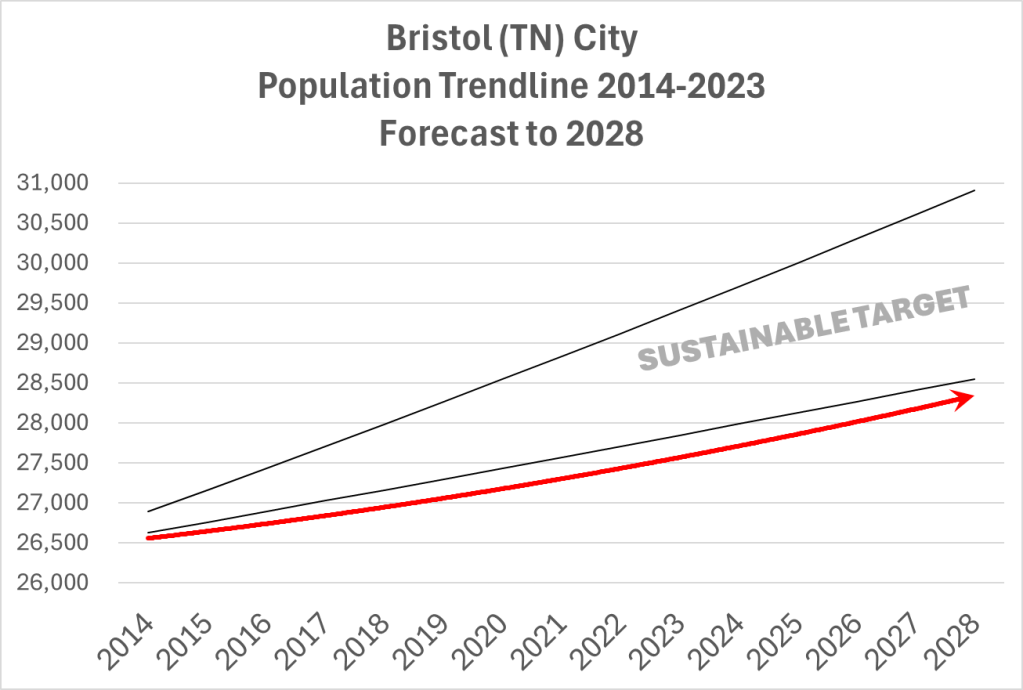
If we want to keep Kingsport the “right size,” how much growth is needed? To maintain a healthy local economy, a city needs 0.5% to 1% growth annually—balancing births, deaths, in-migration and out-migration. Anything beyond this range risks either “boom” or “bust.” Staying within it hits the “sweet spot.”
In short, a city is either growing or dying—it’s just a matter of how fast.
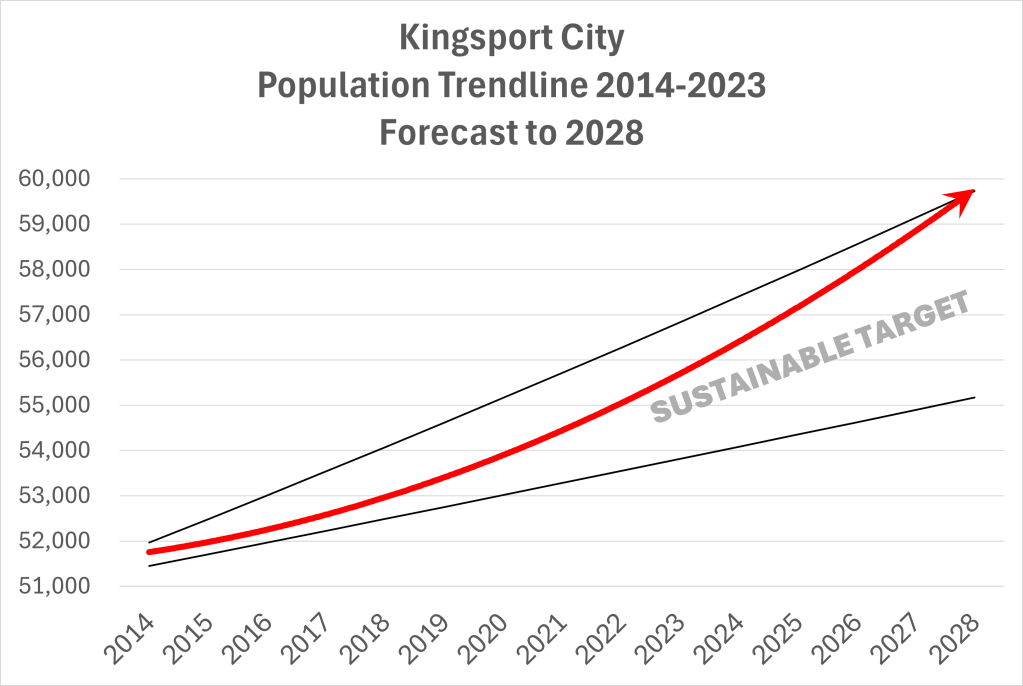
Looking at Kingsport’s growth since 2014 and projecting it forward through 2028 reveals that the city is on track to remain in the “sweet spot” (the sustainable target). This assumes that trends from the past 10 years continue. If they speed up or slow down, the outcome will be felt down the road.
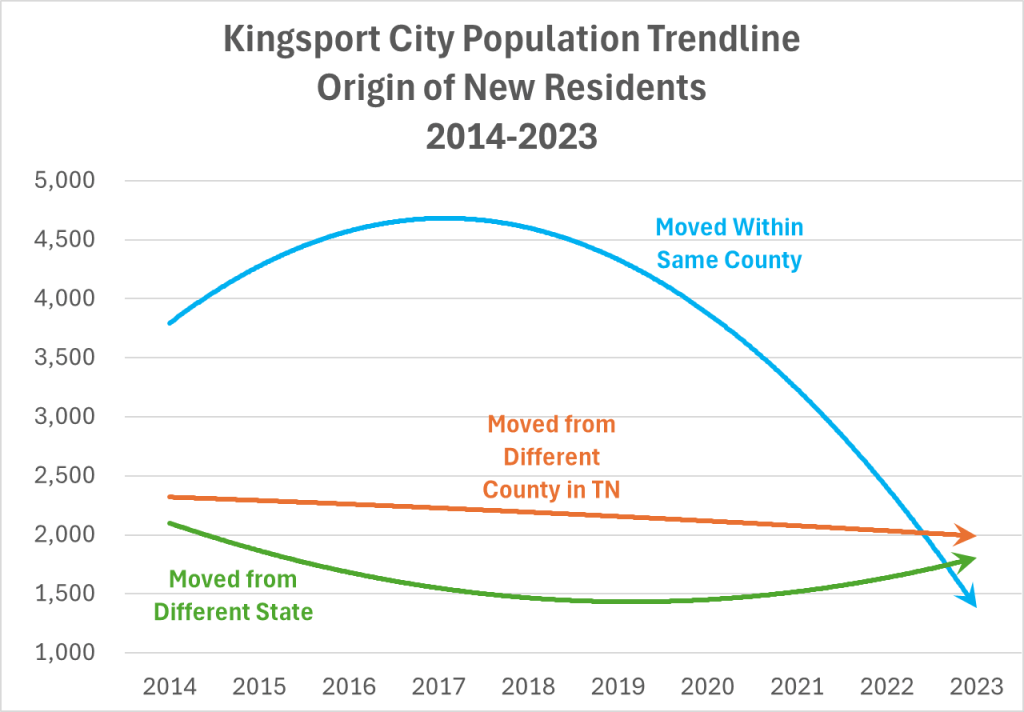
Newcomers from out-of-state, while relatively small in numbers, are keeping Kingsport afloat (see chart below). It’s the only component that’s on an upward trajectory.
Kingsport was a boomtown in the 1920s-1940s, plateaued in the 1970s, and began growing again in the 2000s. By contrast, let’s look at Lebanon, Tennessee, which is booming now. Will it last 10 years? 20 years? Only time will tell. Lebanon isn’t necessarily growing on its own, it’s growing because it’s the latest city in the bullseye for sprawling growth on Nashville’s east side.
In 2014, Lebanon’s population was a little less than 30,000. If current trends continue, it could reach 70,000 by 2028–far beyond the “sweet spot” described earlier.
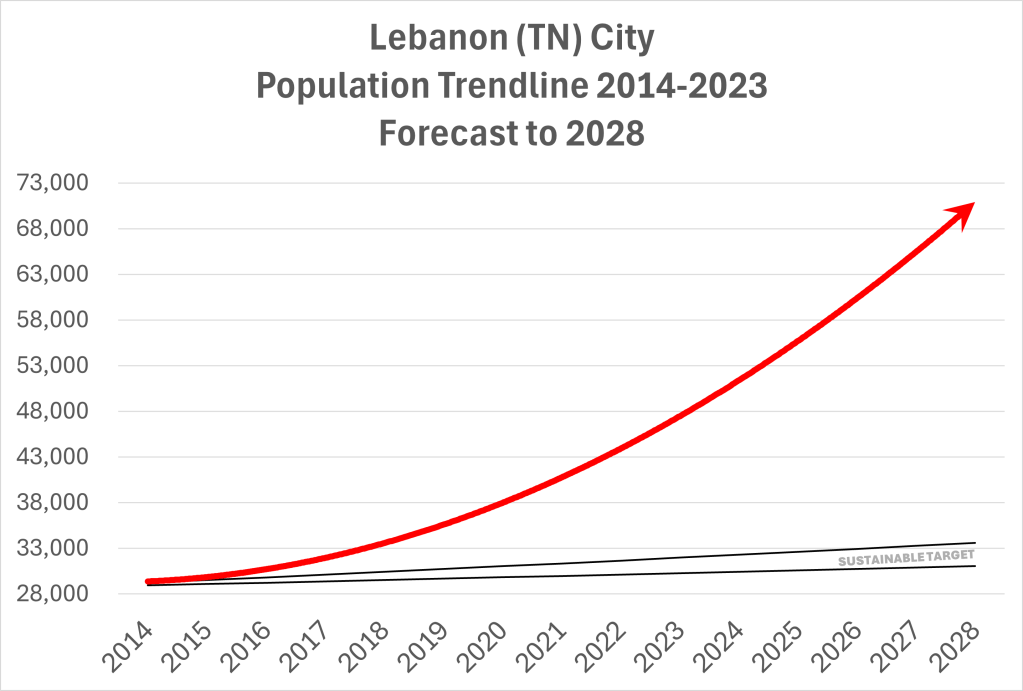

Unlike Northeast Tennessee, Lebanon’s growth stems from both natural growth and in-migration from near and far, which is like adding fuel to a fire.
What happens in a situation like this? Schools become overcrowded, traffic becomes burdensome, and many of the quaint qualities of a small town are compromised. Developers naturally gravitate to the opportunity to build more and more homes, grocery and retail offerings. They don’t have to be recruited with incentives and sold on taking a chance. It’s a sure thing for them. And when it’s over, they move to the next place.
If you pay attention to high school sports, you can gauge growth by the number of new high schools that appear in the 6A category (the largest). For example, Green Hill High School near Lebanon sprung up seemingly out of nowhere in 2020. Many of the surrounding schools—Lebanon High, Mt. Juliet, Wilson Central, and Gallatin—weren’t always 6A but grew into it in the past 20 years or so.
Contrast that with Northeast Tennessee. The only new 6A school here is West Ridge, and that wasn’t due to growth but the consolidation of three shrinking schools (Sullivan North, South, and Central). The nearest new 6A school is Hardin Valley Academy in Knoxville—built nearly 20 years ago.
So, what is the “right size”?
From my perspective, Kingsport is in an enviable position. It’s large enough to offer the amenities we need but small enough to avoid big-city problems. It’s far enough from large metros to avoid being swallowed by sprawl, yet it’s not declining like many places in the Midwest and Northeast.
Growth isn’t a given, though, and we can’t take it for granted. It’s something that we must wake up and think about every morning. Are we progressing in small daily steps? Or are we slipping? From my perspective, I’m pleased with the direction we’re headed. Sometimes it feels like we take three steps forward and one step back, but isn’t that true of life? If we have a setback, usually caused by a national economic condition, we pause, regroup, and redirect. We’ve done it for years.
Let’s hope Kingsport remains the idyllic community we call home.
And I don’t like to compare ourselves to our neighboring cities, but it’s always a question that is inevitably asked.
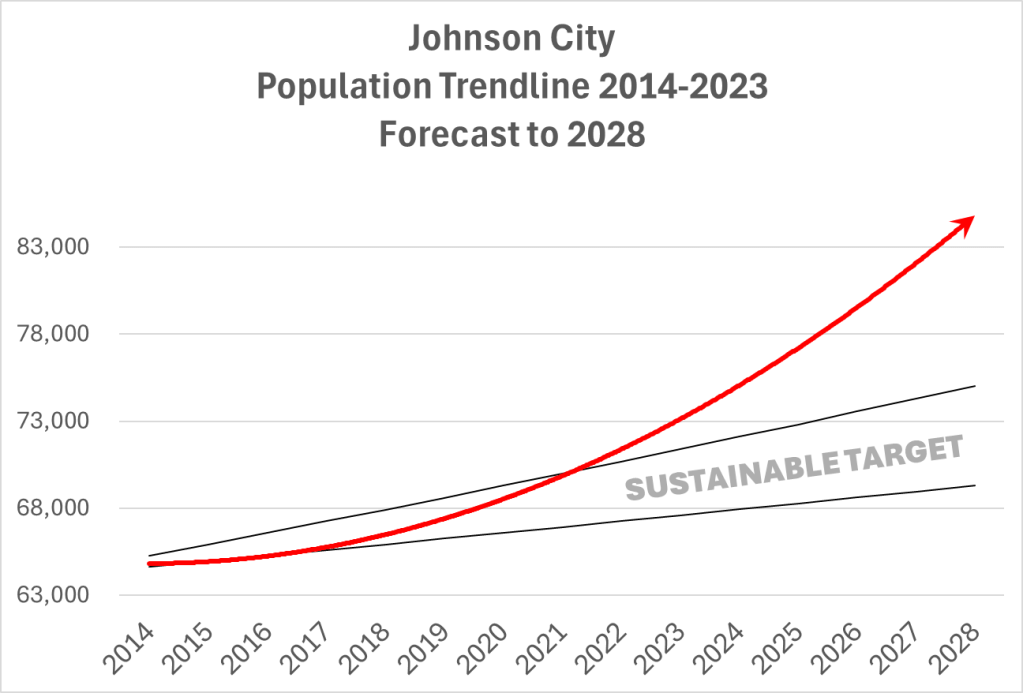
Johnson City’s population is growing at a rate that puts it on the high side of the “sweet spot” and Bristol’s is on the low side. Kingsport is right in the middle. It’s understandable that I hear more grumbling from Johnson City residents that we don’t need many more newcomers, I-26 is getting uncomfortable. But Kingsport and Bristol do need them.
As the Tri-Cities grow together, the market will likely reach equilibrium and you’ll find more people living in one city, working in another, and shopping in yet another.
By any measure, there’s nowhere I’d rather be than Northeast Tennessee.

 Kingsport Spirit
Leave a comment