I grew up hearing stories about my father’s roots in Clintwood, Virginia, in Dickenson County. It’s just over an hour’s drive north of Kingsport, Tennessee, near Virginia’s border with Kentucky. I still treasure my copy of Meet Virginia’s Baby, a book highlighting Dickenson County, the youngest in the Commonwealth, formed in 1880.
What I didn’t expect to discover was a connection to Rebecca Bryan—better known as Becky Boone, wife of Daniel Boone. So how did I arrive at this revelation? Let me explain.
Like many early North Carolina settlers, the Bryan family immigrated from Ireland to Pennsylvania. They lived there for a decade, as Presbyterians among the Quakers. Some sources suggest that my 6th-great-grandfather’s original name was Morrogh O’Brien, later Anglicized to Morgan Bryan.
Morgan Bryan along with his Quaker friend Alexander Ross, proposed opening western lands to the Council of Virginia. Their Bryan-Ross project facilitated early settlements in the Shenandoah Valley during the 1730s and 1740s.
As the valley filled with settlers, Morgan Bryan moved south to the Carolinas. In 1749, he was granted land along the Yadkin River at Shallow Ford, where he established the “Bryan Settlements.” These settlements predated the Moravians’ 1752 arrival in the Wachovia region now known as Winston-Salem.
Among the families who migrated with the Bryans were the Boones. Rebecca Bryan, granddaughter of Morgan Bryan and Martha Strode, married Daniel Boone, earning her place in history as Becky Boone.
Sarah Bryan, daughter of Morgan Bryan and Martha Strode, is my 5th-great-grandmother. This makes Becky Boone my 1st cousin, 6x removed.
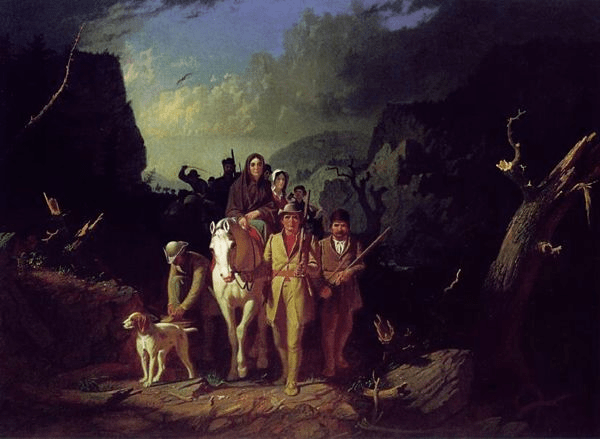
Daniel Boone, of course, is famed for blazing the Wilderness Road into Kentucky and founding Boonesborough in 1775. Some Bryan and Strode family members followed, establishing Bryan Station (Lexington) and Strode’s Station (Winchester) in 1779. These three pioneer forts were within 20 miles of each other.
As for my direct ancestors:
- Sarah Bryan (my 5th-great-grandmother), who is Becky Bryan Boone’s aunt, married Edmond Bailey and settled in Western North Carolina’s Toe River Valley, near modern Burnsville and Spruce Pine.
- Their daughter, Martha “Buckskin” Bailey, married David Cox. They lived on remnants of the Bailey land.
- Martha and David’s daughter, Ollie Cox, married John Mullins, and they, too, inherited 200 acres of Bailey land.
- In 1829, John and Ollie Mullins sold their land and moved to what is now Clintwood, Virginia, then called Holly Creek. My 3rd-great-grandfather, John Mullins, became known as “Holly Creek John Mullins,” distinguishing him from his father, “Revolutionary John” Mullins.
Revolutionary John Mullins, my 4th-great-grandfather, was one of the Overmountain Men who fought at the Battle of Kings Mountain. When Colonel Campbell’s battalion passed near the Mullins homestead, John joined their ranks.
The Toe River Valley is also the birthplace of former Kingsport Mayor Dennis Phillips. Shortly after the 2020 pandemic, he took me to visit the Cox Cemetery, where David Cox and Martha “Buckskin” Bailey, also my 4th-great-grandparents, are buried. It was a treasured day of connection.

The Toe River name may be familiar to some for its devastation during recent Hurricane Helene. It flows into Tennessee as the Nolichucky River. (Why the name changes midstream remains a mystery to me.)
Revolutionary John Mullins is the progenitor of the Mullins line in Eastern Kentucky, Southwest Virginia, and Northeast Tennessee. After the war, he received a land grant in Sullivan County, Tennessee, then part of North Carolina.
By 1810, he had settled on Shelby Creek in Pike County, Kentucky, with his son Solomon. In 1833, he appeared on tax rolls in Russell County, Virginia, near his youngest son, John Jr., in Holly Creek (now Clintwood, part of Dickenson County).
He became a local legend, recounting tales of the Battle of Kings Mountain and wilderness adventures. Known as “Buttin John” Mullins, he was famed for his unique fighting style, using his head to “butt” opponents in the stomach.
After his wife’s death, John lived with John Jr. Records suggest his wife died in the 1840s. She was likely buried near their old home in Clintwood. Tradition holds that John was buried in a hollowed-out poplar log, as coffins and sawmills were scarce.
Today, a plaque at the Dickenson County Courthouse honors Revolutionary John Mullins.

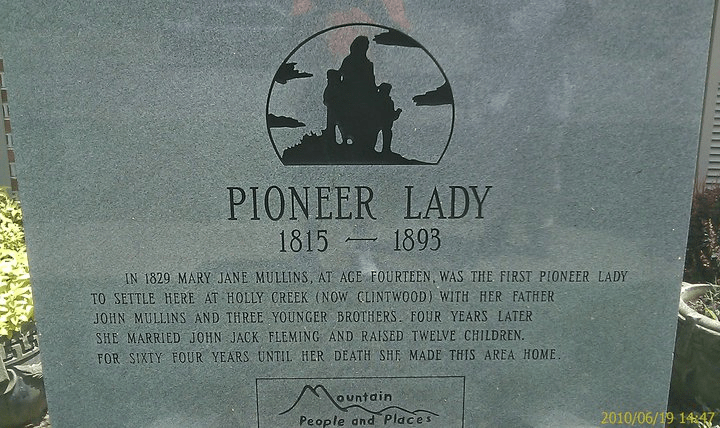
His granddaughter, Mary Jane Mullins, my 3rd-great-grandmother, is memorialized as the “Pioneer Lady” of Clintwood, with a monument in front of the Dickenson County Library. At age 15, she cared for her three brothers while her father returned to North Carolina to bring the rest of the family to Virginia. She married John Jackson Fleming.
In reflecting on these connections, I’m struck by the resilience and courage of my ancestors. From the pioneering spirit of Morgan Bryan and Daniel Boone to Revolutionary John Mullins’ role in shaping the frontier, their stories are a testament to the determination and resourcefulness that defined early America. These family ties, spanning generations and geographies, remind me that history isn’t just found in textbooks—it’s alive in the places we visit, the stories we tell, and the legacies we carry forward. Through their journeys, I find inspiration to embrace my own roots and honor the enduring spirit of those who came before me.

 Kingsport Spirit
Leave a reply to Gary Clark Cancel reply