Housing is a cornerstone of economic development, serving as a powerful driver of economic growth.
Reporting statistics per capita is important because it standardizes data by accounting for population size, allowing for fair comparisons. By normalizing data, per capita metrics avoid misleading interpretations arising from raw totals, especially when populations differ significantly.
With that in mind, we examined Tennessee’s top 50 markets to see what patterns emerged. The yellow are the “Big 4” cities, while the red represent Northeast Tennessee.
In the category of professional housing ($400k+), the top 10 were dominated by Nashville and its suburbs. Loudon, surrounded by lakefront retirement communities, also made the list, and Lakeland was the only suburb in Memphis or West Tennessee.

In the category of workforce housing ($250k-$399k), 8 of the top 10 were also in Middle Tennessee with one in the Knoxville area (Oak Ridge) and one in the Memphis area (Bartlett).
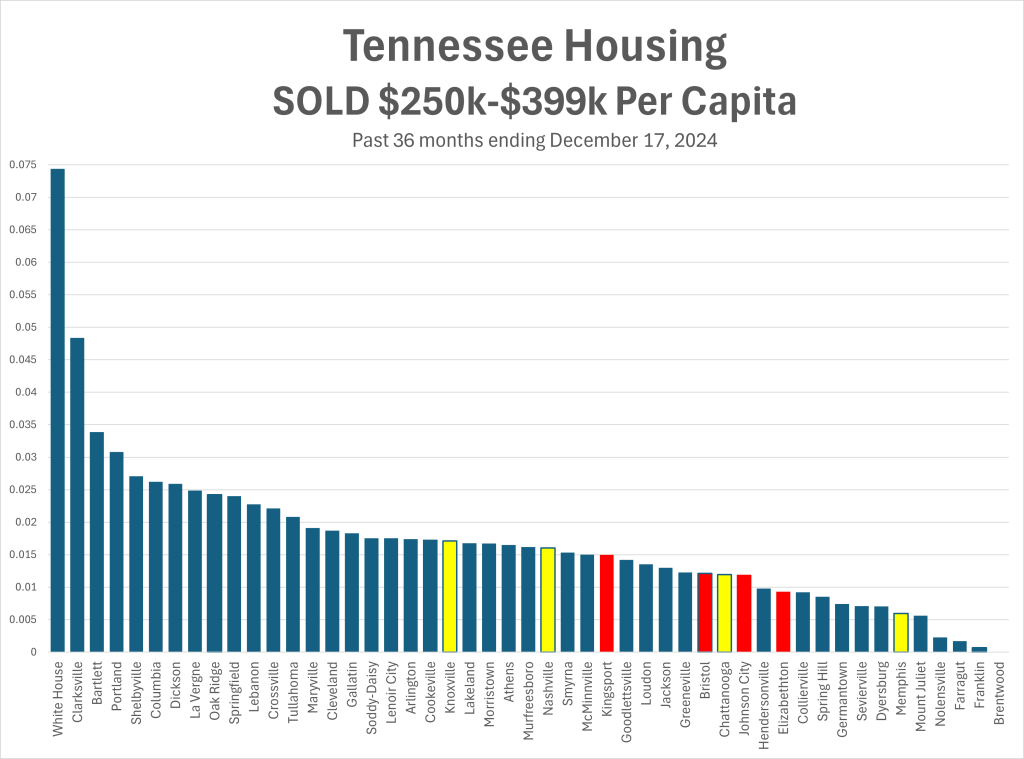
The only city to make the top 10 in both categories is White House, the latest Nashville suburb to see a growth spurt in all markets. If you’re unfamiliar, it’s a northern suburb along I-65 just 15 miles from Kentucky.
Northeast Tennessee, tucked away on the Virginia-North Carolina border, falls in the 3rd quadrant for workforce housing ($250k-$399k) and the last quadrant for professional housing ($400k+).
It’s a little off the radar, and that’s how many residents like it.
But Northeast Tennessee, with 600,000 souls, is the state’s 5th largest metropolitan area.
It’s large enough to have a convenient airport with service by 3 commercial carriers, but a growth rate that is much more stable and predictable. Though residents may complain about traffic, they don’t truly experience it at the level of other Tennessee metros.
Northeast Tennessee is a collection of relatively smaller-sized cities with the largest being just shy of 75,000. It feels more like a suburb without a large central city.
If you need to leave the region periodically for big city services, the nearest major metro is Charlotte, a full hour closer than Nashville, while Atlanta is only minutes further than our state capitol. And Northeast Tennessee is closer to Washington-Baltimore than Memphis, or Charleston, SC, than Jackson, TN.
In summary, Northeast Tennessee provides all the tax advantages of living in Tennessee plus a unique blend of affordability, stability, and accessibility. Its smaller cities and suburban feel offer a high quality of life without the congestion of larger urban centers. With its strategic location and tax benefits, Northeast Tennessee stands out as a desirable option for those seeking a high quality of life in a less hectic environment.
 Kingsport Spirit
Leave a comment