When I first began working as a naive city planner, I was under the false impression that the city had the ultimate say on all things related to building a city. I quickly learned that what matters most is private investment and the city’s ability to influence it.
The city’s professional staff can propose practical policies that guide development, but it must pass muster of a ‘jury of peers’ (the various citizen led boards, commissions, and committees). It takes an army of tireless volunteers who are passionate about their community.
We lost one of those this week: Nancy Garrett.
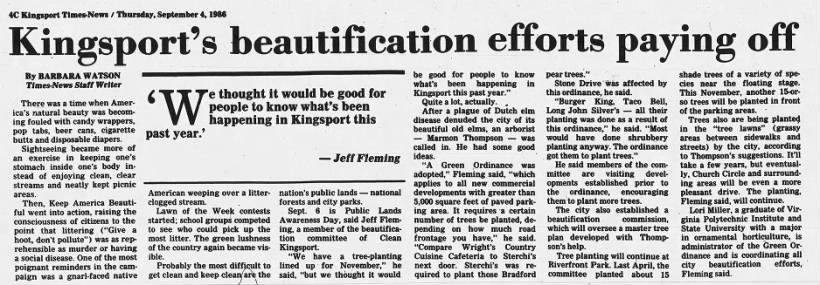
I first met Nancy in the mid-1980s when she was advocating for a “Green Ordinance”. I can’t recall if something specific had provoked her activism, but she was doggedly determined. I was assigned to help draft a proposal for consideration. The result was commonly called, “The Green Ordinance”. Until then, Kingsport zoning did not require trees and shrubbery. Surrounding counties didn’t even have zoning and only begrudgingly adopted it when it became a tool in controlling the placement of landfills.
Ironically, trees and landscaping were hallmarks of Kingsport’s original town plan that had been lost. Many know there was a “nursery tract” in the back of Fairacres. The original town planners embraced the “City Beautiful” movement and conscientiously laid out tree-lined streets to soften the urban landscape. The Kingsport Improvement Company hired a professional landscape architect, Lola Anderson, of Augusta, Georgia. She was responsible for all of the trees around Church Circle, Broad Street, the radial streets, and many early neighborhoods pre-1940. She married John B. Dennis in 1929 and they made their home at Rotherwood Mansion. When World War II broke out, they sold Rotherwood Farm to the U.S. government for an emergency wartime effort (Holston Army Ammunition Plant). They regained possession briefly after the war, but town fathers J. Fred Johnson died in 1944 and John B. Dennis died in 1947. Lola permanently relocated to Biltmore Village in Asheville, North Carolina. In 1968 she returned to dedicate Founders Fountain in Glen Bruce Park as her gift to the city.
The absence of both J. Fred Johnson and John B. Dennis left Kingsport like a child who prematurely lost its parents. In the absence of those visionary leaders, it had to grow up fast and make its own decisions. It’s only natural that a child wants to make its own independent decisions, but some of the outcomes lacked the wisdom and maturity that a loving parent would have offered.
For example, a blue-and-white striped metal building with a neon sign was allowed to be constructed in front of the Train Station. Its electric sign was placed for maximum visibility down Broad Street, obstructing the historic buildings in the background. Lola Anderson’s trees were removed from Broad Street and not immediately replaced. The iconic vase-shaped elm trees used prolifically around Church Circle had developed a fatal disease.
As the city demolished buildings in the downtown area to provide public parking, the lots were devoid of any greenery. The dumpsters, electrical wires, and back alleys were in full view. In a desperate attempt to ‘preserve’ downtown, designated public park spaces were sold to big box stores. And Stone Drive was rapidly developing almost unchecked as a series of fast-food joints and strip shopping centers with garish signs competing for attention and parking lots were seas of unbroken asphalt.
Nancy Garrett was a Kingsport native with a degree in botany who had returned home to raise her family. In 1985, she was 45 years old. She offered her expertise in writing thoughtful, balanced zoning language. Zoning can only change future development (or redevelopment), but anything built prior is allowed to continue–and much was built before the mid 1980s.
She also believed that the city should step up and hire an expert to manage its public trees–like it had in the early years. The city had gotten pretty good at removing trees, but there was no comprehensive plan for installing new ones or maintaining the ones on public lands.
Her work was considered cutting edge at the time, but today it’s a common practice nationwide.
Think about anything built (or rebuilt) after 1980 and how different it looks from things built prior–Kingsport Pavilion (Target/Kohls) the former Mason-Dixon truck terminal, East Stone Commons (former Kingsport Mall), “restaurant row” on Eastman Road, and even Indian Highland Park (formerly Maplehurst trailer park). The results aren’t onerous or expensive, but they soften the harsh paved landscape, channel traffic circulation, and limit the race for more signage to outsize the neighboring business.
These policies didn’t happen by chance. It took a citizen advocate like Nancy Garrett to speak up and passionately advocate for the town she loved so dearly.
Nancy passed away on December 26, 2023, but through her advocacy, thousands of trees were added to Kingsport’s private and public landscape for all to enjoy.
She was able to enjoy the fruits of her labor for nearly 40 years, which is what it takes for a landscape to reach its full potential.
What policy decisions are being made today that someone will be praising (or criticizing) in 40 years? Food for thought.
“Never doubt that a small group of thoughtful, committed, citizens can change the world. Indeed, it is the only thing that ever has.”
― Margaret Mead



 Kingsport Spirit
Leave a reply to Pat Hall Cancel reply