Third in a 12-part monthly series to commemorate Sullivan County’s role in the 250th birthday of the United States of America
March 2026 | 3 of 12
In July 1776, independence was declared in Philadelphia. Along the Holston River near Island Flats, it arrived as a crisis.
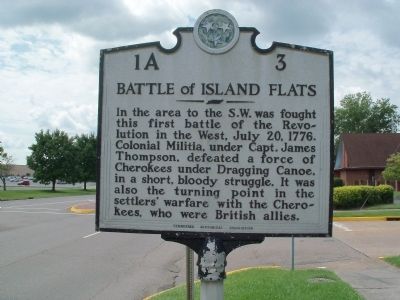
The Battle of Island Flats, also called the Battle of Eaton’s Station, occurred on July 20, 1776, just over two weeks after the Declaration of Independence. You’ve probably driven by the state historical markers along Memorial Boulevard near Robinson Middle School and another at the intersection of Memorial, Center, and Warpath (accurately named). Tennessee’s marker identifies Island Flats as “the first battle of the Revolution in the West.” It says that the colonial militia under Capt. James Thompson defeated a Cherokee force under Dragging Canoe in “a short bloody struggle,” and it was a turning point in the settlers’ warfare with the Cherokee, who were British allies.
That summer, Cherokee attacks swept across settlements in the Holston Valley as part of a wider frontier war intensified by the American Revolution. British officials saw frontier instability as a strategic advantage and encouraged Native resistance to settler expansion. For families living along the river and its tributaries, the consequences were immediate.
Cabins were burned. Fields were abandoned at the height of the growing season. Families fled toward fortified refuges, leaving behind tools, livestock, and crops. News traveled slowly, but fear spread quickly.
Island Flats (modern Kingsport) lay near Long Island and the Island Road, an important route through the valley that had carried settlers, traders, and longhunters westward for years. In 1776, that same corridor became an avenue of danger. Movement stalled as violence overtook the landscape.
Warnings spread quickly. Settlers rushed to nearby fortified sites. Eaton’s Station, located near Yancey’s Tavern—which still stands on Chestnut Ridge Road at Memorial Boulevard, opposite the entrance to East Lawn Cemetery—served as a mustering point where militia gathered in response to the alarm. Chestnut Ridge was sometimes called “Eaton’s Ridge,” a name that through common pronunciation over time became “Eden’s Ridge.”
Nearby fortified sites reflected the same reality confronting families at Island Flats. Shelby’s Station in present-day Bristol served as another refuge where settlers gathered for protection. Along with Looney’s Fort (near Sullivan Central Middle School) and Fort Patrick Henry, these sites suggest that defense in the Holston Valley depended on a scattered network of fortified places rather than a single stronghold.
The violence of July 1776 confirmed that the Revolutionary War had reached the frontier. Independence would be contested here not through formal battles alone, but through survival itself.
The attacks exposed the limits of scattered settlement and accelerated the push toward collective defense. Families clustered together for protection, sacrificing independence for security. Settlement patterns changed in response.
Yet the story does not end with flight. When immediate danger passed, settlers returned. Cabins were rebuilt. Fields were replanted. Communities adapted, learning to live with greater coordination and caution.
This experience complicates celebratory narratives of the Revolution. Independence did not arrive everywhere as a triumph. In the Holston Valley, it arrived as uncertainty, fear, and sacrifice.
But the determination to remain—to rebuild rather than abandon the land—proved decisive. The valley did not empty. It overcame.
As America reflects on its founding, Island Flats reminds us that the cost of independence was paid far beyond the halls of Congress, by ordinary families whose resilience anchored the frontier.
Next in the series: April 2026 | 4 of 12 — Before Countyhood: How Order Took Root in the Holston Valley
 Kingsport Spirit
Leave a comment