A while back, I was asked if I’d ever heard of zinc mines in Fall Branch.
I replied that I had seen some mining symbols on a map near Fall Branch, but that’s the extent of what I knew.
When researching the Hicks Block Building in Downtown Kingsport, I came across a 1916 article in the Kingsport Times that stated a group of Bristolians, including Dr. J.F. Hicks (who built the Hicks Block Building in 1916 in the emerging city of Kingsport) sold 12,000 acres in Fall Branch and Arcadia to Southern Zinc and Mining Co., which planned “one of the most extensive zinc operations in the United States.”
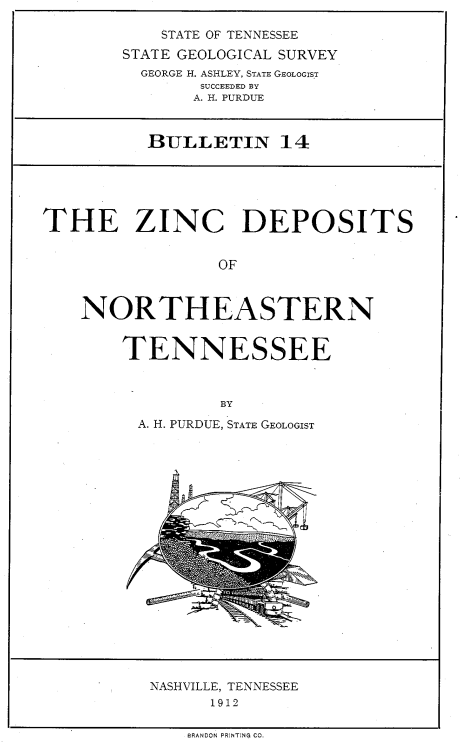
I did a little more digging and found a State Geological Survey produced by the State of Tennessee in 1912 with specific sections on Fall Branch and Jearoldstown.
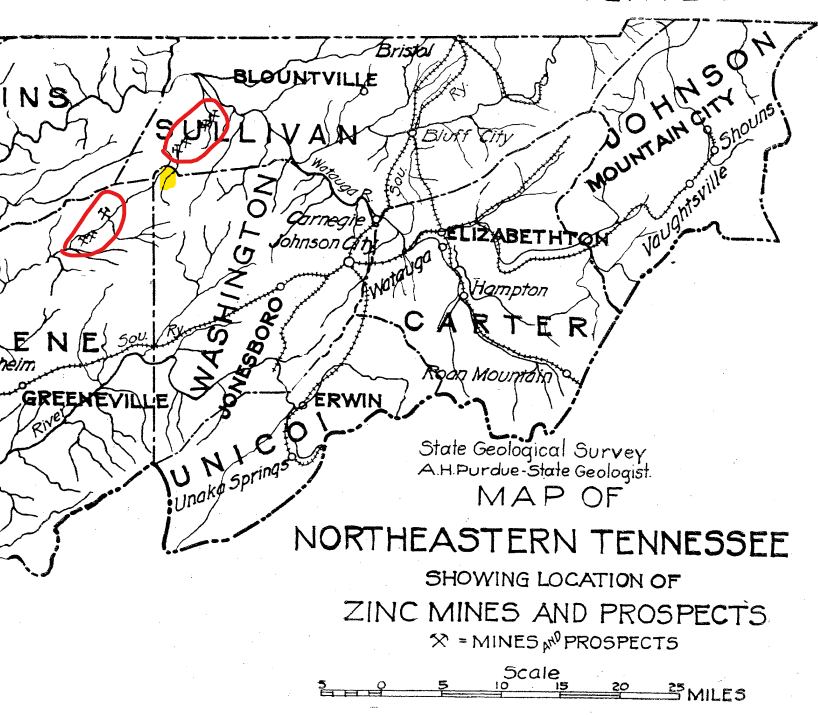
Inside was this 1912 map (below) showing zinc deposits (circled in red). For reference, Fall Branch is highlighted in yellow. Note that Kingsport isn’t shown on the map because it didn’t exist until five years later (1917). That’s hard to wrap my head around.
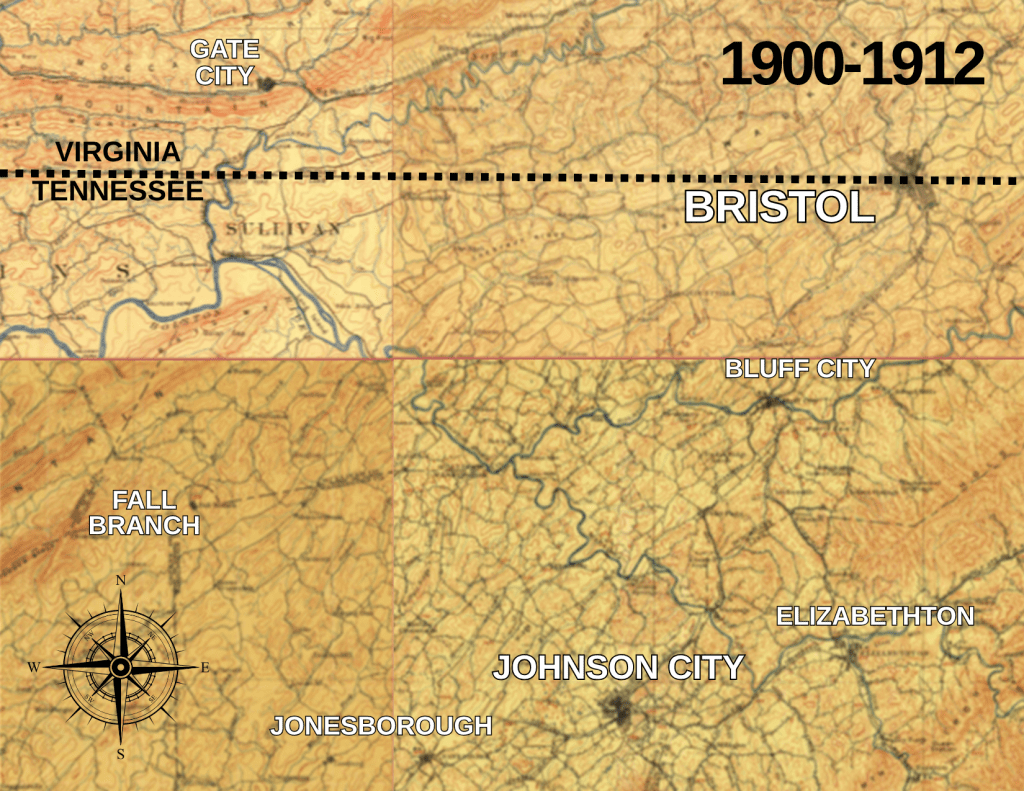
To put things in perspective, there wasn’t a “Tri-Cities” back then. Bristol was the heavyweight. Johnson City was nipping at its heels with the opening of a soldier’s home in 1901 (now the Veterans Administration Medical Center) and the East Tennessee State Normal School (now ETSU) accepting its first students in 1911. Gate City, Bluff City, and Elizabethton were substantial. Jonesborough and Fall Branch were noteworthy. And Kingsport is a large blank space.
That story is personal to me. My grandmother lived along the Holston River in Church Hill. She died in 1996 at 104. She attended the fledgling East Tennessee State Normal School (now ETSU) in 1912. I was blessed to speak with her often and pick her (very intelligent) brain.
I asked how she got to Johnson City. She said she caught the train in Church Hill to Gate City, then changed trains to Bristol, then again to Johnson City. I asked why she didn’t go through Kingsport. She said, “There wasn’t a Kingsport in 1912.”
As someone who served as city manager for Kingsport (55,000 souls), it’s hard to believe there was nothing here when my grandmother was in college.
For the Record
Early records and newspaper articles note that Fall Branch and Jearoldstown briefly stood on the edge of a mineral boom. Geologists, prospectors, and investors believed zinc-bearing ground might yield something much larger. Tennessee’s 1912 geological survey shows that these were not random rumors. They were recognized mineral localities in the upper Valley and Ridge, tied to the Knox dolomite and to a broader East Tennessee pattern of zinc occurrence.
The most vivid commercial snapshot comes from a May 25, 1916, Kingsport Times article titled “Zinc Developments at Fall Branch.” The paper reported that zinc developments in the Fall Branch region, extending into Virginia, had “taken definite form,” and that negotiations had been closed on more than 12,000 acres. The buyer was the Southern Zinc and Mining Company of New York, and among the Bristolians named as sellers were Dr. J. F. Hicks, Dr. J. A. Dickey, and H. E. Graves. The article also said Dr. John H. Banks of New York represented the purchasers and that W. B. Poling of Johnson City would direct operations at Fall Branch. In other words, this was not just local gossip around a prospect hole. It was a substantial land-and-mineral play backed by outside capital and organized management.
The 1912 survey helps explain why people took it seriously. The Fall Branch mine, on Fall Creek in Sullivan County, was described as lying in the upper part of the Knox dolomite, with a brecciated and fractured bed about seven and a half feet wide carrying sphalerite, the principal zinc ore. The survey noted that the ore extended for about 1,500 feet on the property and that an incline shaft and tunnel had already been driven. It also preserved a remarkable origin story: the zinc there was apparently discovered while prospecting for barite, another commercially useful mineral. By 1908–09, a plant with an engine, concentrator, rolls, tables, and dryer had been installed. Then the dream faltered. According to the survey, work was discontinued shortly after the mill was erected because of litigation.
Jearoldstown, though smaller and less dramatic, belonged to the same story. The 1912 bulletin described a prospect a quarter mile northeast of the community in Greene County, also in the upper Knox dolomite. There, two shafts had been sunk near an anticline. Surface evidence suggested brecciated, dolomitized limestone with yellow sphalerite, a little barite, and even reported lead ore. The survey added that barite was common in the vicinity and had been mined on a small scale as barite flour. Nearby Dobbins prospects showed smithsonite, another zinc mineral, alongside barite.
Who Owned the Properties?
The Fall Branch site mentions specific properties: Merrill (I presume a misspelling of the well-known Murrell or Morrell families there today), Cox, and Bowman. The Jearoldstown site mentions Dobbins.
What is Zinc’s Purpose?
In 1912, zinc would have been valuable chiefly for galvanizing iron and steel to resist rust, making brass and other alloys, chemical uses including zinc oxide and other compounds, and some electrical uses involving batteries.
Is Zinc Mined Today?
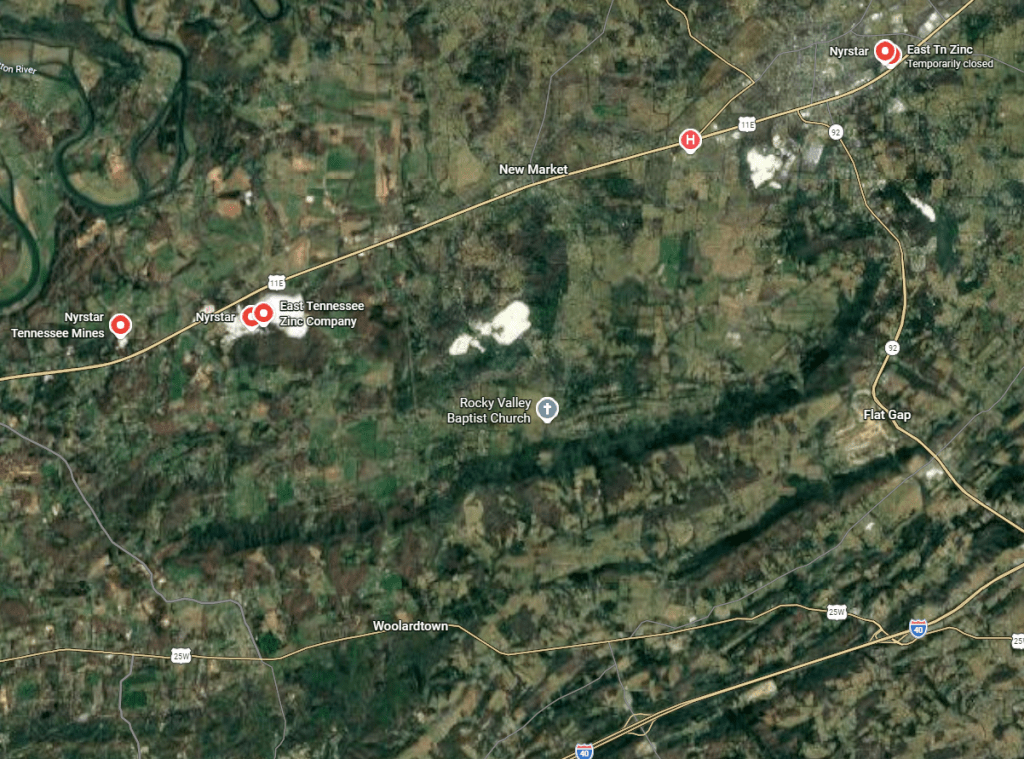
There are East Tennessee mines along the Holston River in Knox and Jefferson Counties (Mascot, New Market, and Jefferson City). They produce mainly zinc concentrate, not finished zinc metal, and that concentrate is sent on for smelting and refining. Today, zinc is used mostly to galvanize steel so it resists rust, and also in brass, alloys, die-cast parts, and other industrial products. Nyrstar is the international mining and metals company that has operated these Tennessee zinc assets, including the East Tennessee mines and the Clarksville smelter, while Korea Zinc is the South Korean metals company that, as of late 2025, proposed buying Nyrstar USA’s Tennessee operations and developing a larger integrated metals facility in Clarksville.
Conclusion
In the end, the zinc mines of Fall Branch and Jearoldstown became less a story of industrial success than of possibility and local landowners who briefly imagined that the ridges near Kingsport might become the next great mineral district of East Tennessee. The ore and ambition were real, and for a moment, the future seemed close at hand. But litigation, limited scale, and stronger competition from richer districts elsewhere left these prospects behind. What remains today is not a mining camp, but a trace memory in geological reports, old newspaper columns, and place-names—a reminder that not every frontier of promise becomes a lasting enterprise.

 Kingsport Spirit
Leave a comment