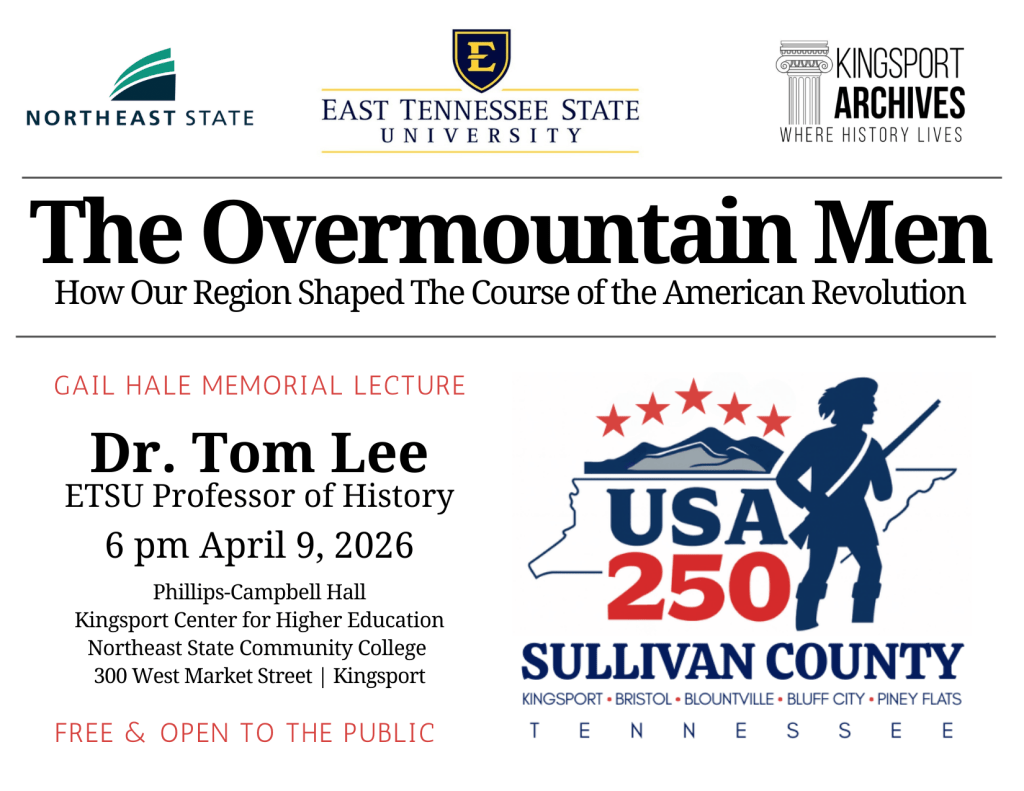
Mark your calendars for 6pm, April 9, at the Kingsport Center for Higher Education (invitation attached) as the Friends of Kingsport Archives and Sullivan 250 committee present “The Overmountain Men” in honor of America’s 250th birthday celebration.
Imagine living in our region before it was officially the United States of America.
In 1761, the Virginia militia — still subjects of the British crown — built Fort Robinson on the north bank of the Holston River, directly across from the Cherokee sacred Long Island (Great Island) in what would become Kingsport. Its purpose was to support Fort Loudoun (Loudon) farther downstream.
Before that time, the great river systems flowing west — the Holston, French Broad, and Tennessee — drained into what Europeans considered French Louisiana, tied to the Mississippi River and New Orleans.
That changed in 1763, when France ceded its mainland North American claims to Britain. Later that year, the Crown issued the Proclamation of 1763, discouraging settlement west of the Appalachian crest. In reality, that line was vague and difficult to enforce.
The temptation proved too great. A steady stream of pioneers — many of Scots-Irish and German descent — moved down the Great Valley of Virginia from Pennsylvania.
Fort Chiswell (modern Wytheville) became a fork in the road. Some turned south into the Carolina piedmont, while others pushed southwest toward the Holston frontier.
At the time, geography and jurisdiction were murky. Lands north of the Holston — including present-day Kingsport and Bristol — were generally considered Virginia, while settlements along the Watauga River (Sycamore Shoals/Elizabethton) were associated with North Carolina. Today, those rivers merge to form Boone Lake. The state line was not firmly settled until the early 1800s, leaving this area in a kind of boundary gray zone for a generation, resulting in the area being called, “The Squabble State.”
In 1775, the first shots of the American Revolution were fired in Massachusetts. On the frontier, the Transylvania Purchase transferred roughly 20 million acres claimed by Virginia and North Carolina (later Kentucky and Tennessee) to private investors who hoped to open lands west of the mountains.
By 1776, Patriots had built Fort Patrick Henry near the former Fort Robinson site, and frontier bases along the Holston — including the Long Island area — played a role in staging westward movement. Around this same period, Daniel Boone and his axmen blazed the Wilderness Road through Cumberland Gap.
By 1780, more than four years into the war, things were not going well for the Patriots. The British held major coastal cities like New York, Philadelphia, Savannah, and Charleston, and many Americans feared the cause might fail.
British officers sent a blunt warning to frontier settlements: submit to the Crown or face invasion and destruction.
Instead of backing down, frontiersmen from our region banded together. These volunteers became known as the Overmountain Men. They crossed the Appalachians and confronted Loyalist forces at Kings Mountain, just west of present-day Charlotte.
The result was a decisive Patriot victory. It electrified the struggling American cause and proved that citizen soldiers could defeat a professional army. Many historians see Kings Mountain as a turning point in the Revolution. Just one year later, in 1781, British General Lord Cornwallis surrendered at Yorktown — effectively ending the war.
The Overmountain Men were not professional soldiers. They were neighbors who shouldered their rifles, crossed the mountains, and stepped into history. Their victory at Kings Mountain didn’t just change the trajectory of a war — it proved that ordinary people, united by conviction, can alter the course of a nation. That legacy still echoes across these hills and rivers, reminding us how our region shaped the course of the American Revolution.
 Kingsport Spirit
Leave a comment