Rarely do we hear of Kingsport referred to as ‘ancient’. Instead, our Centennial Park downtown celebrates the city’s 100th anniversary in 2017; however, this article from a Knoxville newspaper was published in 1889. Kingsport was settled in 1761 and was first officially incorporated in 1822 as a riverport. The ‘model city’ we know today was incorporated in 1917. The riverport’s demise was linked to the rise of railroads, which were routed through Morristown, Greeneville, Jonesborough, Johnson City, and Bristol.
By 1889, a new railroad was underway, the 3C or C. C. & C., which stood for Charleston, Cincinnati, and Chicago. The Panic of 1893, a major national economic depression, devastated the railroad’s financial backing. This event directly led to its collapse. The railroad was placed into receivership (bankruptcy proceedings). Its assets were sold and reorganized into several smaller railroads, including the Clinchfield (officially the Carolina, Clinchfield & Ohio). The C.C. & C. managed substantial grading work before going bankrupt. However, little to no track was ever laid in the Kingsport area before the company collapsed. Today’s Riverbend Park is situated on or near the graded but unfinished rail bed of the old Charleston, Cincinnati & Chicago Railroad (C.C. & C.). Since the C.C. & C. hugged the river, much of it disappeared under Patrick Henry and Boone Lakes, built in 1952 and 1953, respectively. The Clinchfield, built 1905-1915, followed an alignment further from the South Holston River as it progressed towards Johnson City.
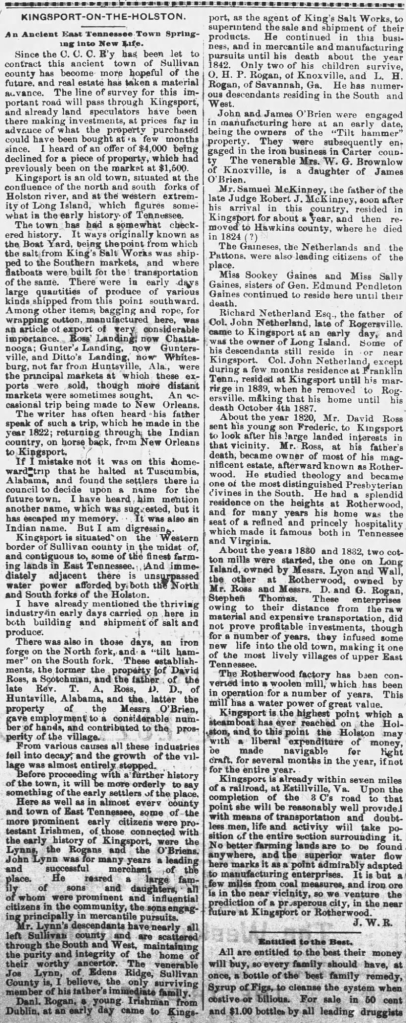
From the Knoxville Daily Tribune as transcribed by AI.
KINGSPORT-ON-THE-HOLSTON.
An Ancient East Tennessee Town Springing into New Life.
Since the C. C. & C. Ry has been let to contract, this ancient town of Sullivan County has become more hopeful of the future, and real estate has taken a material advance. The line of survey for this important road will pass through Kingsport, and already land speculators have been there making investments, at prices far in advance of what the property purchased could have been bought at a few months since. I heard of an offer of $4,000 being declined for a piece of property, which had previously been on the market at $1,500.
Kingsport is an old town, situated at the confluence of the north and south forks of Holston river, and at the western extremity of Long Island, which figures somewhat in the early history of Tennessee.
The town has had a somewhat checkered history. It was originally known as the Boat Yard, being the point from which the salt from King’s Salt Works was shipped to the Southern markets, and where flatboats were built for the transportation of the same. There were in early days large quantities of produce of various kinds shipped from this point southward. Among other items, bagging and rope, for wrapping cotton, manufactured here, was an article of export of very considerable importance. Ross’ Landing—now Chattanooga; Gunter’s Landing, now Guntersville, and Ditto’s Landing, now Whitesburg, not far from Huntsville, Ala., were the principal markets at which these exports were sold, though more distant markets were sometimes sought. An occasional trip being made to New Orleans. The writer has often heard his father speak of such a trip, which he made in the year 1822; returning through the Indian country, on horse back, from New Orleans to Kingsport.
If I mistake not it was on this homeward trip that he halted at Tuscumbia, in Alabama, and found the settlers there in council to decide upon a name for their future town. I have heard, in regard to another name, which was suggested, but it has escaped my memory. It was also an Indian name. But I am digressing.
Kingsport is situated on the western border of Sullivan County in the midst of, and contiguous to, some of the finest farming lands in East Tennessee. And immediately adjacent, there is unsurpassed waterpower afforded by both the North and South forks of the Holston.
I have already mentioned the thriving industry in early days carried on here in both building and shipment of salt and produce.
There was also in those days, an iron forge on the North fork, and a “tilt hammer” on the South fork. These establishments, the former the property of David Ross, a Scotchman, and the father of the late Rev. T. A. Ross, D. D., of Huntsville, Alabama, and the latter the property of the Messrs O’Brien, gave employment to a considerable number of hands, and contributed to the prosperity of the village.
From various causes all these industries fell into decay, and the growth of the village was almost entirely stopped.
Before proceeding with a further history of the town, it will be more orderly to say something of the early settlers of the place.
Here as well as in almost every village and town of East Tennessee, some of the more prominent early citizens were protestant Irishmen, of those connected with the early history of Kingsport, were the Lynns, the Rogans and the O’Briens. John Lynn was for many years a leading and successful merchant of the place. He reared a large family of sons and daughters, all of whom were prominent and influential citizens in the community, the sons engaging principally in mercantile pursuits.
Mr. Lynn’s descendants have nearly all left Sullivan County and are scattered through the South and West, maintaining the purity and integrity of character of their worthy ancestor. The venerable Jos. Lynn, of Eden’s Ridge, Sullivan County, is, I believe, the only surviving member of his father’s immediate family.
Danl. Rogan, a young Irishman from Dublin, at an early day came to Kingsport, as the agent of King’s Salt Works, to superintend the sale and shipment of their products. He continued in this business, and in mercantile and manufacturing pursuits until his death about the year 1842. Only two of his children survive, O. H. P. Rogan, of Knoxville, and L. H. Rogan, of Savannah, Ga. He has numerous descendants residing in the South and West.
John and James O’Brien were engaged in manufacturing here at an early date, being the owners of the “tilt hammer” property. They were subsequently engaged in the iron business in Carter County. The venerable Mrs. W. G. Brownlow of Knoxville is a daughter of James O’Brien.
(Note: she was the daughter-in-law of Governor William G. “Parson” Brownlow of Jonesborough, a fiery newspaper editor, Unionist, and Governor of Tennessee during Reconstruction (1865–1869), and U.S. Senator (1869-1875). Brownlow was considered a Radical Republican because he championed the most uncompromising Reconstruction policies in the South. As Tennessee’s postwar governor, he aggressively promoted Black suffrage, disenfranchised former Confederates, and used state militias to suppress resistance, including early activity by the Ku Klux Klan. He aligned closely with Radical Republicans in Congress, such as Thaddeus Stevens, who demanded equal rights for freedpeople and harsh measures against ex-Confederates. Brownlow’s administration was marked by forceful governance, earning him fierce critics for what many saw as dictatorial tactics, but also praise from supporters who viewed him as a defender of Union and civil rights during a volatile period.)
Mr. Samuel McKinney, the father of the late Judge Robert J. McKinney, soon after his arrival in this country, resided in Kingsport for about a year, and then removed to Hawkins county, where he died in 1824 (?)
The Gaineses, the Netherlands and the Pattons, were also leading citizens of the place.
Miss Sookey Gaines and Miss Sally Gaines, sisters of Gen. Edmund Pendleton Gaines continued to reside here until their death.
(Note: General Edmund Pendleton Gaines (1777–1849) was a distinguished U.S. Army officer who gained national fame for his service in the War of 1812, the Seminole Wars, and other frontier conflicts. Known for his defense of Fort Erie and his long military career, he was a prominent figure in early 19th-century America. His popularity led to numerous towns and counties being named in his honor, including Gainesville in Florida, Georgia, Texas, and other states, as well as Gainesboro, Tennessee.)
Richard Netherland Esq., the father of Col. John Netherland, late of Rogersville, came to Kingsport at an early day; and was the owner of Long Island. Some of his descendants still reside in or near Kingsport. Col. John Netherland, except during a few months residence at Franklin Tenn., resided at Kingsport until his marriage in 1839, when he removed to Rogersville, making that his home until his death October 28th 1887.
(Note: John Netherland, born in Kingsport in 1808 and later a longtime resident of Rogersville, was a prominent Tennessee lawyer, legislator, and political figure in the mid-19th century. The son of early Kingsport settler Richard Netherland, he served in both the Tennessee House and Senate and was appointed U.S. District Attorney for East Tennessee under President John Tyler. A gifted orator known for his moderate Unionist stance, Netherland ran as the Whig/Unionist candidate for governor in 1859, narrowly losing to Andrew Johnson. He also represented Tennessee at the Washington Peace Conference in 1861 in a last effort to avert the Civil War. He remained an influential voice in East Tennessee politics until his death in 1887.)
About the year 1820, Mr. David Ross sent his young son Frederic, to Kingsport to look after his large landed interests in that vicinity. Mr. Ross, at his father’s death, became owner of most of his magnificent estate, afterward known as Rotherwood. He studied theology and became one of the most distinguished Presbyterian divines in the South. He had a splendid residence on the bluff at Rotherwood, and for many years his home was the seat of a refined and princely hospitality which made it famous both in Tennessee and Virginia.
About the years 1880 and 1882, two cotton mills were started, the one on Long Island, owned by Messrs. Lyon and Wall, the other at Rotherwood, owned by Mr. Ross and Messrs. D. and G. Rogan, Stephen Thomas. These enterprises owing to their distance from the raw material and expensive transportation, did not prove profitable investments, though for a number of years, they infused some new life into the old town, making it one of the most lively villages of upper East Tennessee.
The Rotherwood factory has been converted into a woolen mill, which has been in operation for a number of years. This mill has a water power of great value.
Kingsport is the highest point which a steamboat has ever reached on the Holston. To this point the Holston may in liberal expenditure of money be made navigable for steamboat craft, for several months in the year, if not for the entire year.
Kingsport is already within seven miles of a railroad, at Estillville, Va. (Gate City). Upon the completion of the 3 C’s road to that point she will be reasonably well provided with means of transportation and doubtless men, life, and activity will take possession of the entire section surrounding it. No better farming lands are to be found anywhere, and the superior water flow here marks it as a point admirably adapted to manufacturing enterprises. It is but a few miles from coal measures, and iron ore is in the near vicinity, so we venture the prediction of a pre-resurrection in the near future at Kingsport or Rotherwood.
— J. W. R.

 Kingsport Spirit
Leave a comment