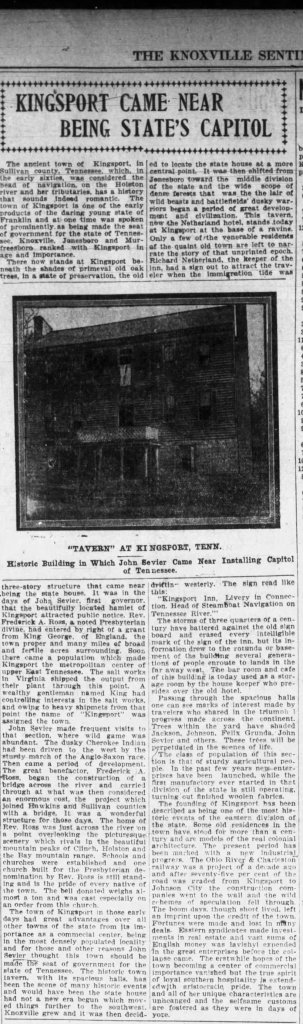
I didn’t write that headline. It came from an article published in the Knoxville Sentinel on September 14, 1901.
The “Tavern” it describes is what we know today as the Netherland Inn, a landmark that reminds us Kingsport’s history stretches back much farther than the commonly cited 1917 incorporation date. In fact, 1917 marks the second incorporation of the city. Kingsport’s roots go back to 1761, it was first incorporated in 1822, and only later re-incorporated in 1917.
Instead, the sequence of Tennessee’s state capitals unfolded as follows: Knoxville (1796–1812), Nashville (1812–1817), back to Knoxville (1817–1819), then Murfreesboro (1819–1826), and finally Nashville again from 1826 to the present. A unique footnote in this history is Kingston, which served as the capital for just one day in 1807 to fulfill a treaty obligation with the Cherokee.
I have found no scholarly evidence to substantiate this newspaper’s claim, yet it does highlight that Kingsport played a role—at least in local memory and tradition—in the broader conversations surrounding the foundations of Tennessee statehood.
Here is the transcription:
“The ancient town of Kingsport, in Sullivan County, Tenn., once considered as the site of Tennessee’s state capitol, is located on the historic Holston River, 14 miles from Bristol. Today Kingsport is one of the oldest towns of importance in the state.
During the early days of Tennessee history, Kingsport, with its fine water power and excellent drainage, was looked upon most prominently for the state of Tennessee’s capitol, because of the importance of the Holston River, its stage and wagon accommodations, and being the head of navigation.
The “Tavern” at Kingsport stood beneath the shades of primeval old oak trees, in a state of preservation, the old three-story structure that came near being the state house. It was here that John Sevier, first governor of the state, debated the locating of the capitol.
Kingsport, nestled midway between Bristol and Rogersville, is distant 17 miles from the Kentucky and Virginia line, and within easy access of trade, while farmers and manufacturers of Broad Shoals keep its population outlined for prosperity.
Kingsport, the place where John Sevier, Tennessee’s first governor, with a weary spirit, sat through the small hours of night planning and laying the political cornerstones that have made Tennessee famous, was prominent in the map of Tennessee politics before many of its contemporaries could boast the honor.
John Sevier made frequent visits to Kingsport, driving from his home at Marble Springs, over the old stage road. He always stopped at the Kingsport tavern. The “Tavern,” a frame building three stories, constructed of hewn timber and decorated Colonial in effect, began the construction of many pioneer buildings that dotted Tennessee in early days. A commodious inn, with a broad stairway, and wonderful winding rooms, the “Tavern” was considered a magnificent building in that period.
For more than 100 years the “Tavern” has stood. It was the gathering place of the pioneers of Tennessee. Within its spacious halls were enacted scenes that included many of the most historic episodes in the state’s annals.
In these halls were laid the plans that led to locating the state house at more central points. What has shifted from time to time was then an abiding place for many of the middle class citizens. Here Sevier came with the hope of obtaining that which the balance of the house had hesitated to ratify.
With Sevier, at the Kingsport tavern, came Andrew Jackson, James Robertson, and other early leaders. In those days of Tennessee’s infancy the tavern was a stopping place of men prominent in the political, social and religious life of the new state.
During the early days of Tennessee history, when the immigration tide was westwardly, the main road like today ran through Kingsport in lower connections. Head of steamboat navigation on the Holston River, it was considered then the most accessible town in Tennessee.
The storm of three quarters of a century has blistered against the old frame walls, but the timber has defied all attempts of decay. In the delightful formation of the mountain lies Kingsport, once one of the most important towns in Tennessee.
The “Tavern” has a history that makes it one of the landmarks of Tennessee, if not the United States, and is admired by Kingsport’s local keepers who treasure its traditions.
Within the broad and spacious halls were enacted scenes that include many of the hardships in the tumultuous times when the state of Tennessee was in its formative period. There often was depicted the strife of the pioneers with the Indians. These old walls have resounded with the yells of savages and the echoes of pioneers.
The “Tavern” is one of the few remaining old-time houses where the state’s governors rested from their journeys and where the brave men of Tennessee lived in the days of its beginning.
It stands as a monument to the men who blazed the way for the civilization of Tennessee. The old “Tavern” has been in continuous use until recent years, and many of the leading men of the state have rested within its walls.
As the pride of Kingsport it stands today, a relic of the past, a reminder of the early days of the commonwealth, and of the times when Kingsport almost became the state capital.”
 Kingsport Spirit
Leave a comment