Last week, I had the opportunity to hear Ben Harris’ presentation to the Kingsport Historical Society entitled “Loose Ends”-and it really cleared up some loose ends for me.

2025 is the 250th anniversary of the Daniel Boone Wilderness Trail, which came right through Kingsport. Ben did a great job peeling back the layers and explaining the details of the land transaction, legalities, and challenges.
He also explored the other early land grants that led to the formation of Northeast Tennessee—and the entire states of Tennessee and Kentucky, for that matter. Many with clues are hiding in plain sight to this day. For example, Chimney Top is a visible promontory that serves as the terminus for several grants that formed early county boundaries that still exist today.
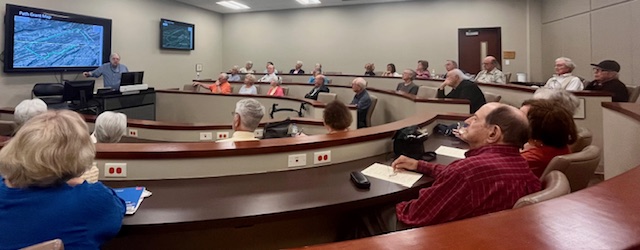
The lightbulb that Ben illuminated in me was the fact that all of this was happening on the eve of the American Revolution, which wasn’t a ‘big bang’, it evolved over several years. Life went on while the war was happening. And after the war, the new nation had to figure out how to govern itself.
Let’s start from the beginning. Before the U.S. was a sovereign nation, the North American continent was eyed by Great Britain, France, and Spain. In 1683, France claimed waters flowing to the Mississippi (which would include the Holston at Kingsport). That’s why names like “French Broad” appear on westward-flowing rivers in Asheville, NC. The nearby “Broad River” that flows through Columbia, SC, flowed toward the Atlantic, so it didn’t need territorial clarification. Coastal areas of Georgia, Florida, and Alabama were claimed by Spain. Beaufort, SC, was the point where all three claims converged.
In February 1763, France ceded all of its North American possessions east of the Mississippi River (including the Ohio Valley and Great Lakes region) to Great Britain. On October 7, 1763, the British Crown designated everything west of a line drawn along the crest of the Appalachian Mountains (roughly the Eastern Continental Divide) as an “Indian Reserve” under British sovereignty. Colonial settlement was forbidden there, but it remained Native lands administered by the British government.
That put today’s Northeast Tennessee and Southwest Virginia (west of the continental divide) in the crosshairs because British settlement had already begun two years before the proclamation declared it illegal, and the Edmund Pendleton land grant that included much of modern Kingsport was granted by Virginia’s governor circa 1750-1756.
November 19, 1761 – The British Fort Robinson was built at Long Island (Kingsport). During the Revolutionary War, it was captured and renamed Fort Patrick Henry.
October 7, 1763 – The British Crown prohibited settlement west of the crest of the Appalachian Mountains, which would include modern Kingsport, but settlers had already begun to encroach.
May 1, 1769 – Daniel Boone’s first exploration into Kentucky. Note it, too, comes after the prohibition of settlement by the British crown.
October 18, 1770 – Treaty of Lochaber established the conceptual boundary between British settlement and the Indian lands at six miles east of Long Island (Kingsport). This would be today’s Warriors Path State Park near Fall Creek bridge.
June 1, 1773 – Donelson’s Line brought the Lochaber Treaty’s concept to reality. It was first run on the ground by Colonel John Donelson (future father-in-law of Andrew Jackson) and Cherokee representatives in May 1771, but it did not gain formal, legal effect until it was incorporated into the Treaty of Augusta concluded at Augusta, Georgia on June 1, 1773, when the Cherokee chiefs officially acknowledged and ceded all lands south of that marked boundary to His Majesty. Donelson’s line had a couple of significant variations from the Lochaber Treaty. It included all lands east of the Kentucky River and extended the line south to the Holston River (because settlers were having difficulties identifying the 36-30 parallel).
The 36-30 parallel was the historic Royal division between the Virginia and Carolina colonies but imagine trying to establish a straight-line survey across the mountains, hills, and hollows along the border of today’s Tennessee and Kentucky. The boundary dispute wasn’t fully resolved until 1820, when the Jackson Purchase of Western Kentucky caused a notch in the state line to dip down into West Tennessee that can be still be seen on today’s maps. That’s the real 36-30 parallel. Imagine if it had been projected eastward to the Atlantic? Kingsport and Bristol would be entirely in Virginia today, and Clarksville, TN, would be in Kentucky.
Four key grants were consummated during the month of March of 1775 at Sycamore Shoals, modern day Elizabethton, which was for all intents and purposes the capital of the region.
March 10, 1775 – Daniel Boone set out to blaze the Wilderness Road to the Transylvania Purchase from the Long Island of the Holston (today’s Kingsport, TN). Yes, he jumped the gun by a week.
March 17, 1775 – The Great Grant Deed (Transylvania Purchase) sold lands in Kentucky, but dipped below the 36-30 parallel into the Nashville basin. That’s why Northeast Tennessee and Nashville were settled a few years before the rest of the state.
March 17, 1775 – The Path Grant Deed solved a gap in the Great Grant by providing a swath of land north of the Holston River including the Clinch River to reach the Powell River valley, which was the beginning of the Great Grant (Transylvania Purchase). Were it not for the Path, it would not be possible to travel to the Great Grant without passing or trespassing on Cherokee land. In the Hawkins County Office of the Registrar of Deeds, it is referred to as “The Indian Deed”.
March 19, 1775 – The Charles Robertson Grant included lands along the Watauga River in today’s Northeast Tennessee and the New River in today’s Northwest North Carolina, including the modern cities of Johnson City, Elizabethton, Mountain City, Boone, Banner Elk, West Jefferson, and Sparta. Charles Robertson was the older brother of James Robertson, who later became known as the “Father of Middle Tennessee”.
March 25, 1775 – The Jacob Brown Grant Deeds included lands along the Nolichucky River in today’s Jonesborough, Greeneville, and Erwin.
But less than a month later, the first shots were fired in the American Revolution.
April 19, 1775 – Battle of Lexington & Concord – first of the American Revolution
September 9, 1780 – British Major Patrick Ferguson’s formal proclamation—threatening to “march his army over the mountains, hang your leaders, and lay waste your country with fire and sword” was issued.
September 25, 1780 – the “Overmountain Men” mustered at Sycamore Shoals, and formally set out on the march over the Blue Ridge the next day. After crossing the mountains and linking up with allied militia, they arrived at Kings Mountain on October 7, 1780, in time to engage Major Ferguson’s Loyalists that afternoon
October 7, 1780 – The Colonial Militia, the “Overmountain Men”, won the Battle of King’s Mountain, widely considered the turning point of the American Revolution.
October 19, 1781 – Cornwallis surrenders after losing the Battle of Yorktown
September 3, 1783 – Signing of the Treaty of Paris, by which Great Britain formally recognized U.S. independence and ended the war.
May 16, 1785 – State of Franklin petitions for statehood, but North Carolina refuses to relinquish its claims. What would become the federal government was still in the early organizational stages and not prepared to add new states.
September 17, 1787 – After months of debate in Philadelphia, the final Constitution was signed by 39 delegates after the Constitutional Convention
June 21, 1788 – Under Article VII, nine of the thirteen states needed to ratify for it to take effect. On this date, New Hampshire became the ninth state, formally adopting the Constitution and bringing the new federal framework into being.
March 4, 1789 –The first Congress under the Constitution convened. This is generally treated as the date the Constitution became the supreme law of the land.
December 22, 1789 – North Carolina’s legislature votes to cede its trans-Appalachian western counties to the Confederation (later federal) government.
April 2, 1790 – Congress formally accepted that cession on April 2, 1790, creating what was organized a few weeks later (May 26, 1790) as the Territory South of the River Ohio (the Southwest Territory)
June 8, 1790 – President George Washington appointed William Blount as Governor of the Territory South of the River Ohio (the Southwest Territory), following his nomination the day before and Senate confirmation on June 8. Blount then took his oath of office on September 20, 1790.
1790 – Rocky Mount (the Cobb house at Piney Flats) served as the capital and governor’s headquarters of the Southwest Territory from its organization in 1790 until Governor William Blount relocated the seat of government to Knoxville in 1792
1792-1796 – Knoxville served as the capital of the Southwest Territory
March 14, 1791 – Vermont admitted as the 14th state
June 1, 1792 – Kentucky was admitted as the 15th state with Isaac Shelby as the first governor. Shelby was the son of Evan Shelby, founder of Shelby’s Fort, which was in modern Bristol.
September 10, 1794 – Blount College was chartered as the first non-sectarian institution west of the Appalachian Divide. It was chartered by the Territorial Assembly of the Southwest Territory and led by Rev. Samuel Carrick. It was later renamed “The University of Tennessee”, which explains why the university’s name is older than the state itself.
June 1, 1796 – Tennessee was admitted as the 16th state with John Sevier as the first governor.
I hope there’s another opportunity to hear Ben Harris’ presentation on this subject. It was enlightening to hear, and I appreciate all the hard work he put into the research.
Northeast Tennessee truly was America’s First Frontier.
 Kingsport Spirit
Leave a comment