The Move To Kingsport program was one of several initiatives launched following the 1999 Economic Summit. It was among five non-traditional economic strategies designed to help the city navigate significant downsizing in domestic manufacturing, a sector crucial to Kingsport’s industrial heritage. The other four strategies focused on higher education (notably a downtown campus), tourism (including sports and conventions), small business and entrepreneurship, and redevelopment and infill.
The economic consultant who facilitated the Summit warned that Kingsport risked becoming a rustbelt community, a statement that sent shockwaves through the audience. However, the city had a choice: to accept an inevitable decline or take action to shape a better future. Kingsport chose the latter and today it’s a very different place indeed.
Initially, the Move To Kingsport program targeted retirees, whose income and economic contributions were independent of local job availability. Their financial stability could sustain the consumer economy, including restaurants, retail, and service industries. Tennessee was already attracting retirees due to its lack of income and inheritance taxes, and Kingsport aimed to capture its share of this migration.
As a community that produced two Malcolm Baldrige National Quality Award winners (Eastman and Pal’s), Kingsport sought a measurable way to track success beyond anecdotal stories. The City of Kingsport’s water service, which serves a customer base roughly twice the city’s population, became the metric. New water connections were recorded, capturing previous out-of-state addresses to quantify migration.
Since this data reflects new service connections, it does not include mass-metered households such as apartments, retirement centers, mobile home parks, or other multi-unit developments. Thus, the numbers were not skewed by the temporary ebb and flow of multi-family movers.
Although Kingsport featured many beautiful worker cottages, historic homes, and midcentury neighborhoods, it became clear that the city needed to expand its inventory of new housing. A concerted effort began in 2006 when veteran city manager John Campbell returned to his hometown to conclude his career. Two significant developments emerged: Old Island on the east side and Edinburgh on the south side, which included the newly constructed John Adams Elementary School. Hundreds of additional lots were created throughout the city, waiting for new homes to be built.
However, just as these developments began, the 2008 economic recession struck. In its aftermath, mortgage lending became more stringent to prevent another crisis. Lenders increased income and credit verification, required larger down payments, and moved away from risky loans. Government regulations, such as the Dodd-Frank Act, imposed greater oversight and consumer protections, making borrowing safer but more difficult. New home construction slowed dramatically, and many newly planned subdivisions across the country sat with empty lots. The nation has yet to fully recover, leading to tight inventory, high demand, and rising prices nationwide, including in Kingsport.
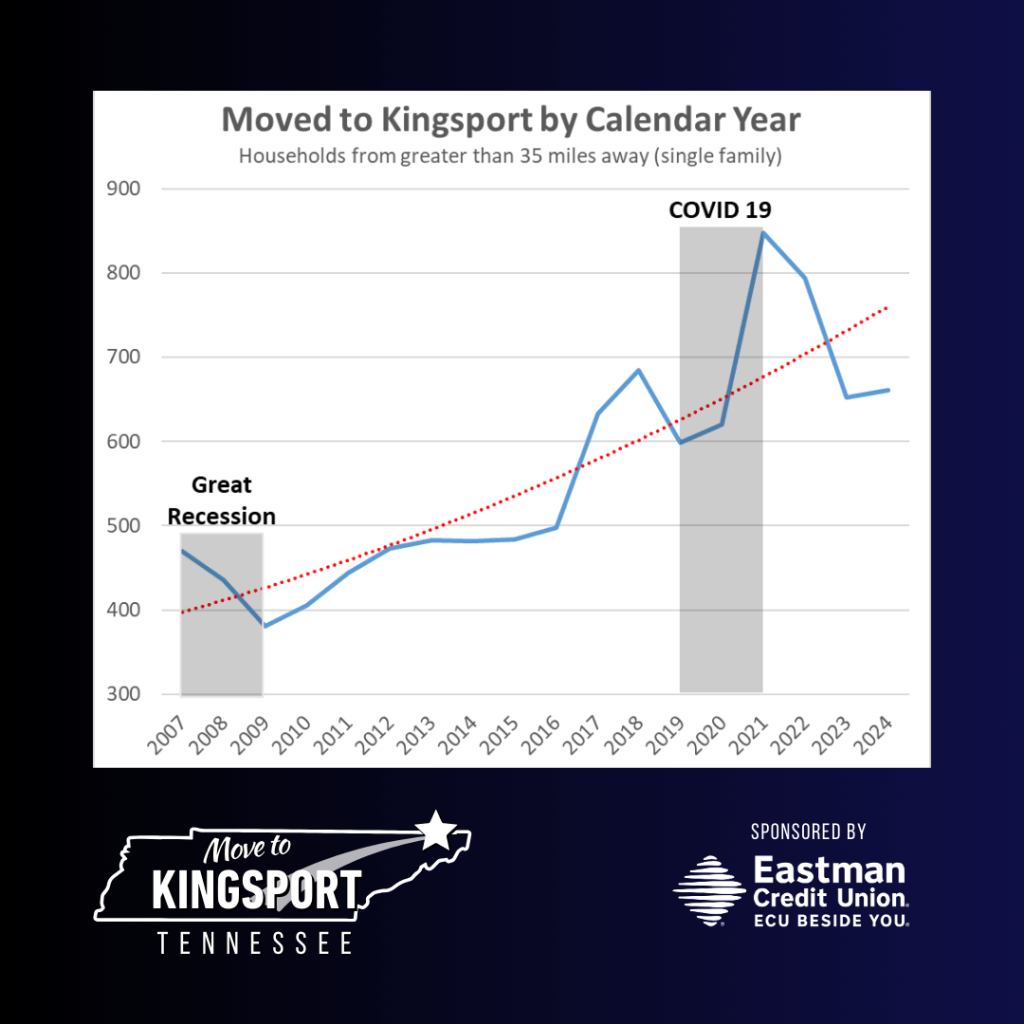
In 2007, an average of 39 families per month moved to Kingsport from beyond a 35-mile radius. By 2009, that number had dropped by 19% due to the recession but rebounded by 2012. By 2017, homebuilding surged, with a 27% increase in out-of-state newcomers over the previous year.
Like much of Tennessee, Kingsport experienced a significant influx of out-of-state residents during the post-COVID Great Migration. State policies, school and business disruptions, and affordability concerns drove many to leave expensive urban areas for locations offering more space and a better quality of life. By 2021, out-of-state migration had grown by 80% over pre-recession levels and 33% over 2019, continuing into 2022.
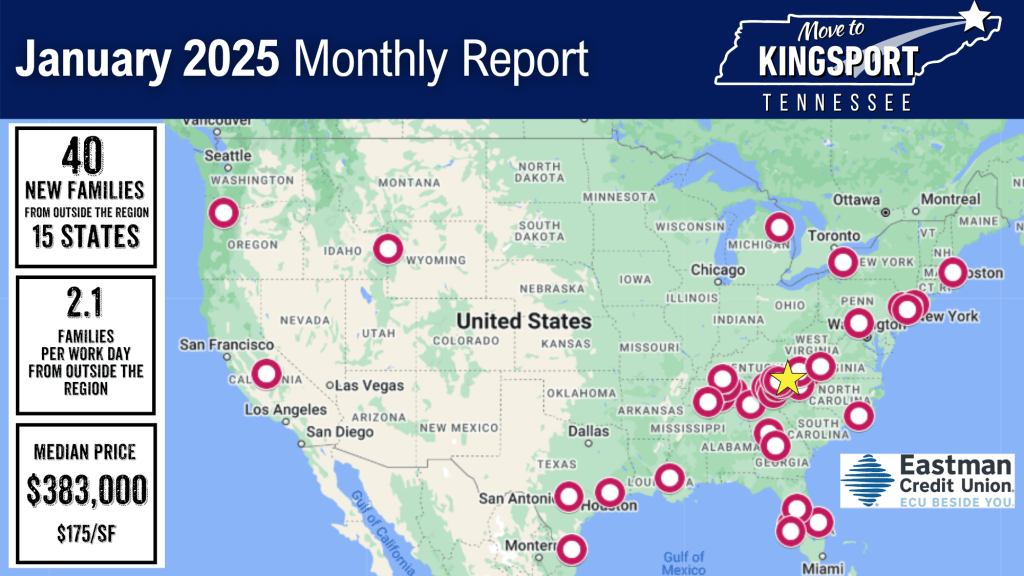
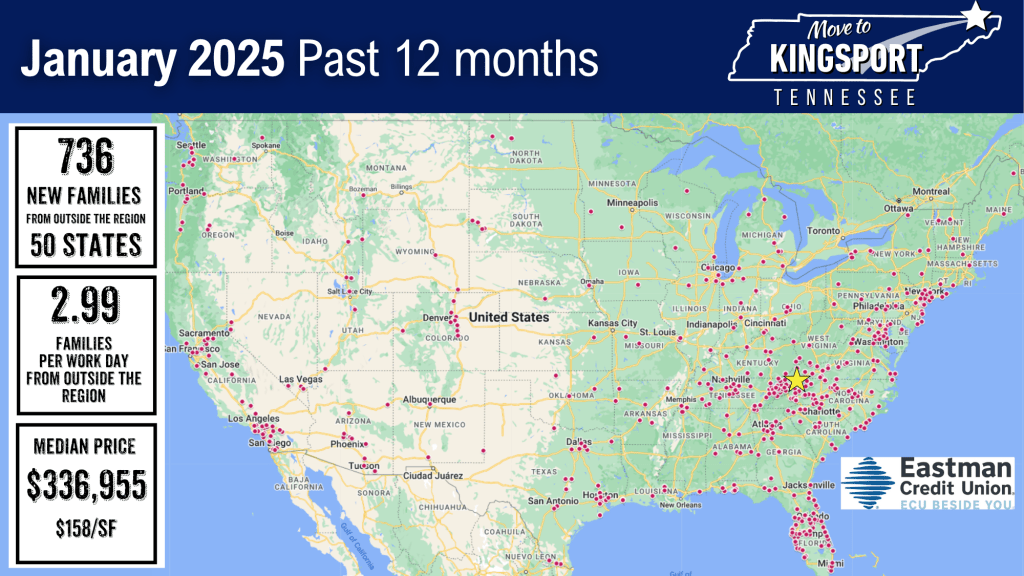
By 2023, out-of-state migration returned to pre-COVID levels but remained 39% higher than pre-recession figures, a trend that persisted into 2024. As 2025 begins, the trajectory remains uncertain. The first monthly report recorded 40 new families from 15 states, signaling a return to pre-recession levels, though a single month does not define a yearly trend.
Inventory remains tight across all price points in Kingsport, but the highly anticipated Brickyard project is set to introduce diverse new housing options downtown. Affordability remains a nationwide challenge, with home prices never fully returning to pre-recession levels, lending requirements still stringent, and interest rates staying higher than they were two decades ago. However, a key difference from pre-recession conditions is the substantial home equity growth that allows current homeowners to move up, cash out, or borrow against their assets.
Rising home prices have also reshaped the rental market, with more options now available in multi-family complexes, single-family homes, and urban lofts. Forward-thinking developers, such as those behind the Brickyard project, are integrating a mix of housing choices for both purchase and rental to meet diverse market demands.
Has the Move To Kingsport program been successful in its 25-year history?
The city has been on a residential growth trajectory not seen since the 1980s. Although deaths exceed births in all jurisdictions in Northeast Tennessee and Southwest Virginia, the number of out-of-state newcomers offset the natural decline by a reasonable margin. Kingsport’s not experiencing hypergrowth and its negative byproducts, nor is it shrinking like our neighbors to the north in Virginia, Kentucky, and beyond.
Kingsport successfully weathered national headwinds and is well-positioned for stable growth well into the future, all the while holding onto its community spirit, volunteerism, and sense of place.
That’s an enviable position indeed. And that’s what makes Kingsport unique.
Read more at:
2024: Kingsport Led the Region in Home Sales – Kingsport Spirit
Is Kingsport Growing or Dying? – Kingsport Spirit
Kingsport’s Next Big Opportunity: Who Will Build the Future? – Kingsport Spirit
ACT scores: Kingsport leads region in Class of 2024 – Kingsport Spirit
 Kingsport Spirit
Leave a comment