On a recent visit to the Kingsport Public Library, I came across a stack of books slated for removal. Most were duplicates of old census records for various Tennessee counties and surrounding states. Since these records are now readily available online, it makes sense that Kingsport wouldn’t need to store documents for counties in Middle Tennessee or out of state.
A few titles caught my eye, and I couldn’t resist rescuing them from the pile. One that stood out was Heads of Families at the First Census of the United States Taken in the Year 1790 – North Carolina.
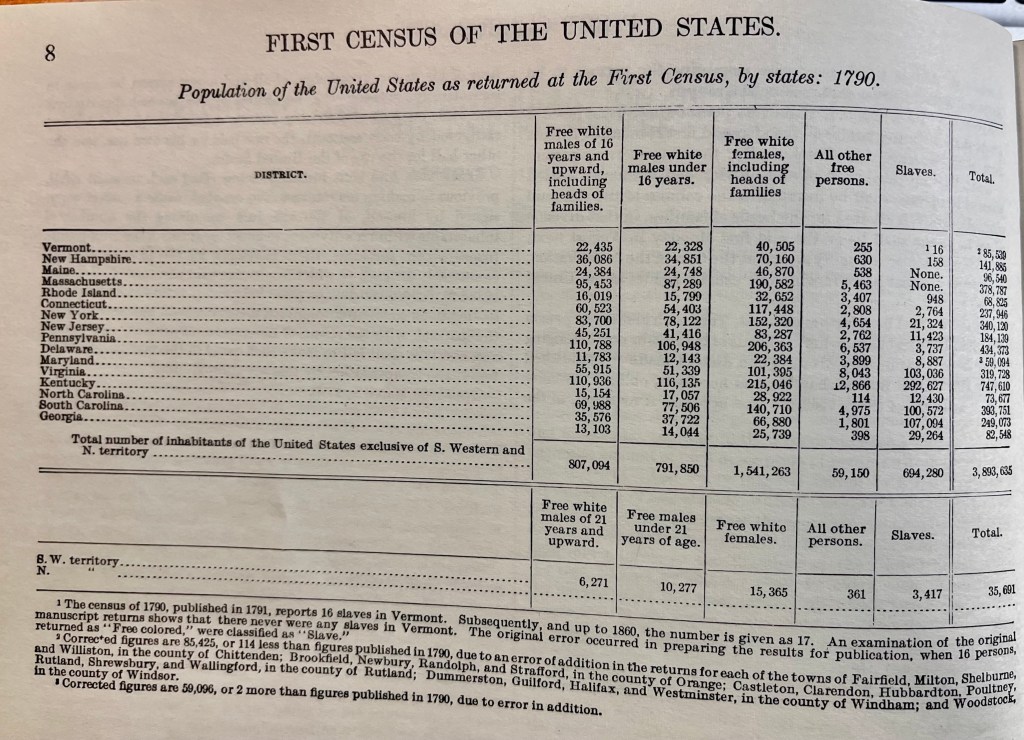
Since Sullivan County was part of North Carolina until Tennessee was established in 1796, I knew this book could offer insights into our area’s earliest settlers. But what truly stopped me in my tracks was a table listing the total population of each state in 1790—broken down into free whites, all other free persons, and slaves.
The numbers were staggering. Virginia was by far the most populous state, with 747,610 residents—39% of whom were enslaved. Perhaps that’s why so many of our early presidents hailed from there. Pennsylvania, the second most populous state, had 434,373 people, but only 1% were enslaved. Georgia, with just 82,548 residents, had a staggering 35% enslaved population.
That led me to wonder: which state has changed the most since 1790?
Fast forward to 2024, and Georgia’s population has exploded to 11,180,878—a growth of 13,445%. Who would ever have thought Atlanta would have the world’s busiest airport?!
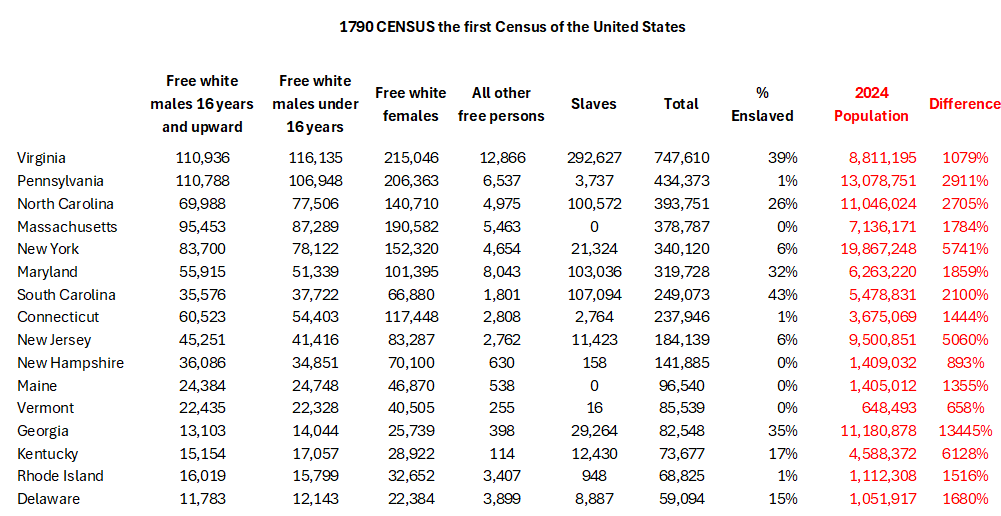
It’s no secret I’m a genealogy buff, but looking at these early population figures made something click for me. In 1790, the population of Delaware was roughly the same as Kingsport, and the population of Kentucky was similar to Johnson City!
When you trace history back far enough, you realize how connected we all are because we descend from a very small population base. It’s one thing to know that in theory, but seeing the numbers laid out in front of me made it feel real in a way I hadn’t quite grasped before.
I couldn’t help but reflect on how much has changed. Population shifts, migration patterns, and societal transformations have shaped the country in ways the people of 1790 could never have imagined. Yet, at our core, we are still connected by the same threads of history. Each name in that census represents a life, a family, and a story that contributed to the fabric of our nation. It’s a reminder that history isn’t just something in books—it’s alive in us, woven into who we are today.
 Kingsport Spirit
Leave a comment