First Families of Tennessee was established by the East Tennessee Historical Society (ETHS) in 1993 as a Tennessee Bicentennial project. Membership is open to anyone who can prove direct descent from a person or persons living in what is now Tennessee before or by statehood in 1796.
I began my First Families journey recently. My father’s family is from Southwest Virginia, and my mother’s family is from Northeast Tennessee. For reasons I can’t quite explain, I initially prioritized genealogical research on my father’s side. Maybe it was because it meant so much to him, whereas Mom was less interested in the topic. But 50% of my DNA comes from her side nonetheless.
I had a wonderful relationship with my maternal grandmother, Bessie Myers Burchfield. She died in 1996, just three months shy of her 104th birthday. I was 35. My maternal grandfather, Charles Blaine Burchfield, passed away when I was only three, so I didn’t get the chance to know him. Both of my grandparents were raised along the Holston River in Hawkins County, near Church Hill, Tennessee.

Mamaw Bessie came from a family that valued education. Her family was smart—brilliant, really. That’s how Mom’s side was wired. Dad’s side, on the other hand, was more about hard work and determination than books. The combination of the two has been a dynamic force in my life.
In those days, academics were seen as “nice” but not necessary for survival. I often wonder where Mamaw’s intelligence would have taken her had she been born a little later. Her brother, Roy Myers, became Superintendent of Hawkins County Schools and later served as the longtime treasurer of Carson-Newman College (now University). After finishing her farm chores, Mamaw loved to read anything she could get her hands on—books, newspapers, magazines. I know this because she told me. I had lunch with her multiple times per week during her later years.
Mamaw once told me that her father, James Myers, was from Piney Flats in Sullivan County. When I asked how he ended up in Hawkins County, she said, “He floated downriver.” I asked, “How did he get past the dam?” She laughed and said, “Honey, there wasn’t a dam back then.”
She also shared that she was part of the first class admitted to East Tennessee State University when it opened in 1911-1912. Just last month, I verified through the Registrar’s Office that she was indeed enrolled in the Spring Semester of 1912. I asked how she got to Johnson City, and she explained: “We ferried the river, caught a train in Church Hill to Gate City, Virginia, changed trains to Bristol, and then caught another train to Johnson City.” I still have the trunk she carried her belongings in for that journey. When I asked why she didn’t go through Kingsport, she replied, “Honey, there wasn’t a Kingsport back then.” Kingsport wasn’t incorporated until five years later. Today, more than 50,000 people live in that valley.
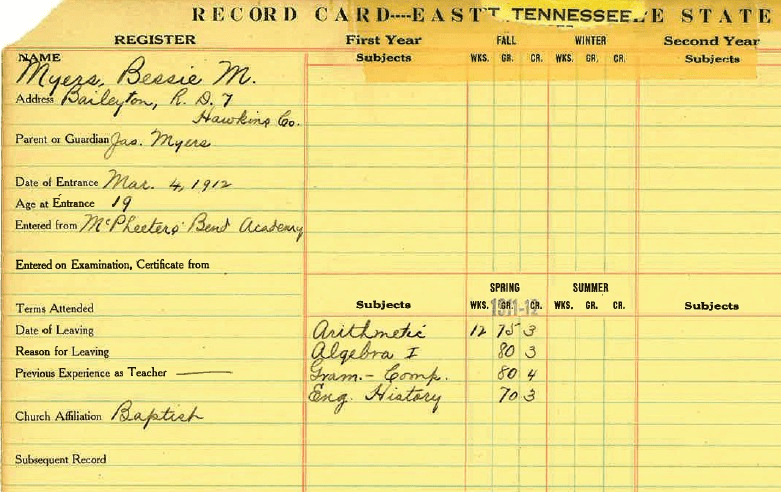
Mamaw Bessie often told me that her grandfather, Samuel Skelton, donated the land for McPheeters Bend School, which served the south side of the river. Crossing the river in those days was a real challenge. Fords and ferries existed before bridges were built. Interestingly, the ETSU address Mamaw used was Baileyton. It was easier to approach from Baileyton than to cross the river to Church Hill for mail.
I always knew Mamaw’s home place was on the river road leading to what is now Laurel Run Park—near the location where the movie The River, starring Mel Gibson and Sissy Spacek, was filmed. She would point out the house as we drove by and remind us, “Always remember where you came from.”

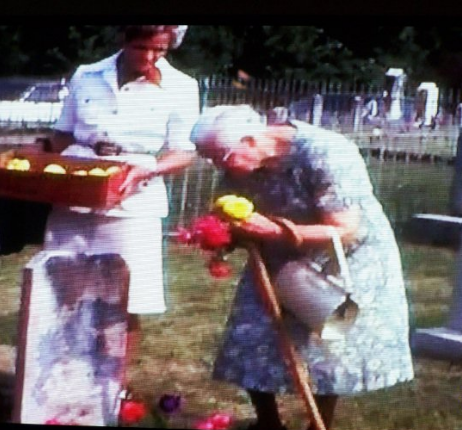
While studying old maps of the area, I noticed a place called “Curry’s Ford.” If you know Church Hill today, there’s an impressive farm called “The Smith Place” on Smith Place Drive. If you extend Smith Place Drive’s alignment across the river using Google Maps, you’ll find where Curry’s Ford once stood—right where my grandmother grew up. Just upstream was Solitude Bend, now Holston Defense. Not much Solitude there anymore.
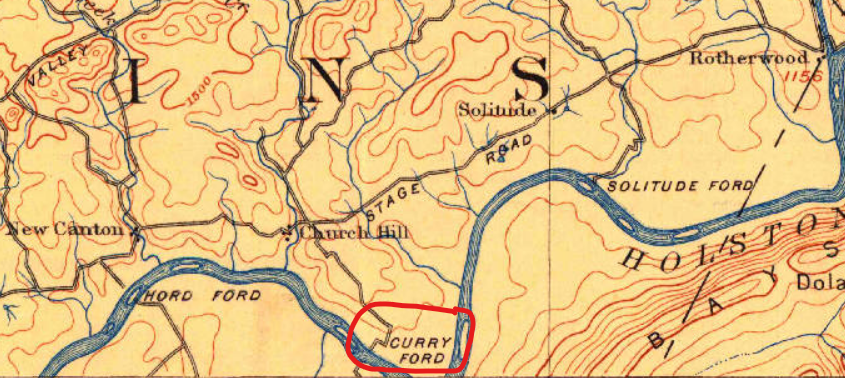
Now back in those days, places weren’t named for their marketing potential, they were named for specific reasons. So, Curry’s Ford must’ve meant there was a Curry family there. I began to look for Currys and their connection to the only other family name I knew from the area—Skelton.
It turns out that my 3rd great-grandmother, Anna Seawright Curry, married Ruben Skelton. That’s the connection. Another daughter married John McPheeters, and yet another married Archibald Simpson, still recognizable names to any Hawkins County genealogist.
The family endured tragedy. A waterborne pandemic known as “River Fever” struck in 1830, so severe that it was even mentioned in the Nashville newspaper. Five members of the Curry family died. The surviving sons left for Middle Tennessee or Kansas, which is why the Curry name is now uncommon in Hawkins County. The same is true for the McPheeters family.
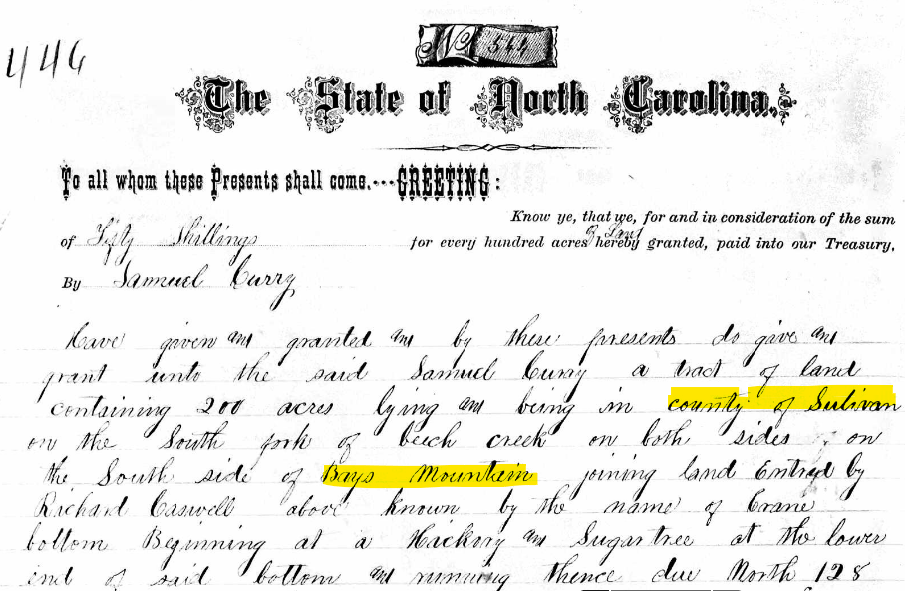
Land records from North Carolina show that Samuel Curry purchased 200 acres in 1790 for fifty shillings per acre. The record references Sullivan County but specifies that the land was to be registered in Hawkins County—six years before Tennessee became a state.
Samuel Curry’s will also caught my attention. It reads:
“It is my will that my sons should learn useful and profitable trades. Wherefore, I will that they be bound out to pious men to learn trades. It is my desire that James Lynn and Frederick A. Ross should have any of my children bound to them should they wish to do so. To put this my last Will & Testament in force and executed, I nominate and appoint my worthy friends Frederick A. Ross and James Lynn my Executors…”
Local historians will recognize Frederick Ross as the original owner of Rotherwood Mansion, just upstream from the Currys. James Lynn was connected to the family that operated Lynn’s Store in the Boat Yard—what we now call Kingsport.
Mind blown.
That’s my connection to First Families. My application has been submitted.
I often think of our state and country as permanent fixtures, but Tennessee is only 228 years old, and the United States just 248. By genealogical standards, that’s only 7-8 generations! If you want to explore your own connection to First Families, you can start your journey here.

 Kingsport Spirit
Leave a comment