Reflecting on the past year prompts us to delve into the underlying rationale behind the inception of the Move To Kingsport program, which began 24 years ago, predating the seismic shifts caused by the pandemic-driven “Great Relocation”. It was a proactive response by community leaders who foresaw our region grappling with a recurring issue seen in numerous American cities: a surging death rate surpassing the birth rate. This demographic imbalance, left unchecked, would precipitate population decline, adversely impact local businesses, and burden the provision of quality services, leading to higher costs or reduced amenities for residents. Similar challenges have plagued rustbelt areas in Michigan, Ohio, Pennsylvania, and upstate New York. Hence, the strategic recruitment of newcomers emerged as a vital tool to counter this gradual decline.
The pandemic triggered substantial shifts in national migration patterns, catalyzed by economic downturns, widespread business closures, and lingering inflation. This marked a trend unseen since the “Great Migration” from the South to the North before and after the Great Depression. Dubbed the “Great Relocation,” this phenomenon witnessed a swift influx into Southern states and rural areas from locales such as California. However, this sudden surge caught many communities off guard, resulting in negative perceptions and pushback. Accusations surfaced that newcomers were inflating local property prices and inciting bidding wars, an uncommon occurrence in Southern regions.
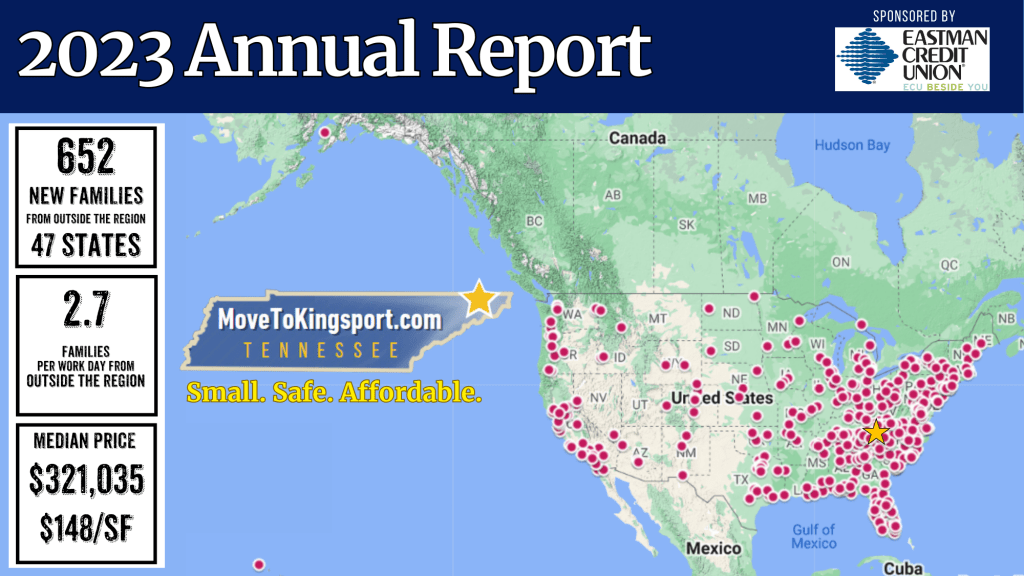
While newcomers often bore the brunt of blame, it’s crucial to acknowledge that nationwide inflation caused spikes in labor and material costs, consequently elevating house prices across the board. Many newcomers arrived with funds from selling higher-priced homes, enabling them to make swift purchases in regions where housing demand outstripped local supply.
Kingsport’s leadership vigilantly monitors this situation, actively advocating for new construction, largely in the moderate price range of $250,000-$350,000. Notably, in 2023, 50% of single-family home sales in Kingsport were under $250,000, with 26% falling within the $250,000-$350,000 bracket, while only 5% exceeded $550,000. Considering these factors, Kingsport’s housing market remains relatively affordable for both locals and out-of-state buyers.
Newcomers represent a small segment of Kingsport’s total population, positioning the Move To Kingsport program as a supplementary economic strategy. While not the primary catalyst, it holds significance in sustaining momentum and addressing population decline.
Recent Census data (2018-2022) indicates that out of Kingsport’s 54,696 residents, 14% relocated in the past 5 years—8.1% from the same county, 4% from elsewhere in Tennessee, and merely 2.1% from out-of-state. This demographic composition reflects a healthy balance, avoiding an overwhelming influx.
Sustainable growth is imperative for a city’s economic vitality, ideally requiring a 5%-10% population increase every decade. Excessive growth can strain infrastructure, intensify traffic, burden utilities, and overcrowd schools. Murfreesboro serves as an example of hypergrowth, tracking a staggering 31.5% increase by 2030 on top of its 40% growth from 2010-2020.
According to U.S. Census projections, Kingsport is slated to grow by 6.5% by 2030, a balanced trajectory. However, county data presents a more complex scenario, with Washington County anticipated to grow by 5%, Sullivan County by less than 1%, and Hawkins County expected to decline marginally. This emphasizes the continued importance of recruiting newcomers at this juncture.
Hope abounds for Kingsport’s future prospects. Both Kingsport and Johnson City earned recognition among the Top Emerging Markets by Realtor.com and the Wall Street Journal in 2023. SmartAsset.com’s analysis of 8.68 million tax returns from Americans earning >$200k highlighted Tennessee’s allure, ranking it #5 for inbound migration. The appeal lies in its tax-friendly environment, business-friendly policies, low cost of living, and high quality of life. Among 20 metros within a 4-hour drive, Kingsport-Bristol ranked #7 in positive employment growth, while Johnson City tied for #15. Kingsport stands as a “Sweet Spot,” maintaining a healthy pace of growth with a thriving business community, a convenient commercial airport, and excellent healthcare facilities—all without the drawbacks of gridlocked traffic, overcrowded schools, or high crime rates. Our growth rate is not too hot, not too cold, but just right, which makes it very desirable for many.
 Kingsport Spirit
Leave a comment