Recently, my son was traveling from Kingsport to Nashville for a business trip. To break up the monotony from time-to-time, he would call and say, “I just pulled off at this exit, tell me about <insert city name>.” In this case, it was Carthage, Tennessee.
I explained that Carthage was located on the Cumberland River which, like other rivers, was the main geographic feature that settlers followed into the wilderness. Finding a river meant the promise of broader waters–and eventually a port. Carthage was once a very important post on the Cumberland, but today its population is less than 3,000. As commerce shifted to rail and interstate highways, many early river cities, while still beautiful, lost their role of strategic importance.
Meanwhile, upstream at the head of navigation for the Tennessee River system, King’s Port was a critical juncture of the Holston River and the Wilderness Trail forged by Daniel Boone through Cumberland Gap. In the late 1700s, the Holston led directly into hostile Indian territory, so settlers looked for a more peaceful northern route. This took them slightly into Kentucky before coming back downstream on the Cumberland River into what is now Middle Tennessee. That’s why there is a huge gap in the early development of today’s Tennessee, temporarily skipping everything in between.
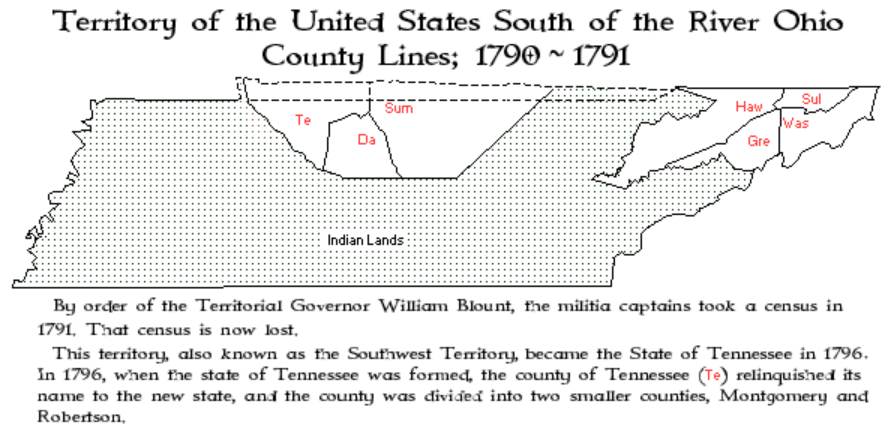
1790 was the post-revolutionary war period. John Sevier and the future Tennesseans had attempted to create a new state called Franklin, but the fledgling U.S. government was still in its formative years and had no protocol for admitting new states. Virginia willingly gave up its western lands for the formation of the new state of Kentucky, but North Carolina was unrelenting. After years of bickering, North Carolina realized it couldn’t effectively govern west of the Appalachians, so it formally ceded the land to the federal government. It was officially declared the “Territory South of the River Ohio” (commonly called the Southwest Territory) and a territorial governor, William Blount, was appointed to guide its pathway to statehood. The temporary capital was Rocky Mount located in Piney Flats, Sullivan County between today’s Bristol and Johnson City.
Along the Cumberland River, there were three counties: Sumner, Davidson, and Tennessee. When Tennessee achieved statehood in 1796, Tennessee County relinquished its name and became Robertson and Montgomery Counties.
Apparently, the early settlers were trying to gain favor with the territorial governor as several places settled at the time bore his name. For example, Blountville (county seat of Sullivan), Blount County (whose county seat, Maryville, is named after his wife), and Fort Blount (now Gainesboro) was a federal outpost on the Cumberland River) to name a few. Oh, and the “o” is silent, as in “blunt”.
The early pathways to settlement made for unexpected familial connections between today’s Northeast Tennessee and Middle Tennessee.
For example, Gainesboro, an important early post on the Cumberland River north of today’s Cookeville is named after Edmund Pendleton Gaines, the same family as Gaines-Preston Farm (Exchange Place) and the Pendleton Place neighborhood in Kingsport.
Another familial connection is Anthony Bledsoe. Bledsoe’s Fort is located along the Cumberland River in Castalian Springs (Sumner County). In 1779 Bledsoe became a surveyor with the commissioners of Virginia and North Carolina to establish the line between the western lands of those states. In 1780 he served as justice of the peace for the new county of Sullivan (NC, now TN), and in 1781 and 1782 was its state senator (for NC). He became a justice of the peace for new Davidson County (NC, now TN) in 1783, and in 1785-86 he represented the county in the state Senate (NC). When Sumner County (NC, now TN) was created in 1786, Bledsoe assumed the same duties there, becoming chairman of the county court in 1787. He was the first representative to the Virginia Legislature from Washington County (Bristol-Abingdon), commanded the troops at Long Island (Kingsport), and was in the 1776 Battle of Island Flats (Kingsport) before becoming one of the first justices of the peace in Davidson County (Nashville). He was also the first representative from Sumner County (TN) to the North Carolina legislature.

Another familial connection, closer to home personally, is Thomas Kilgore, which is my wife’s 3rd great granduncle. Thomas Kilgore was the first permanent European settler in Robertson County, TN (north of Nashville). He was a personal friend of James Robertson, father of Tennessee, and served alongside Anthony Bledsoe in surveying the boundary between Virginia and North Carolina (later Tennessee). He died in 1823 at the age of 108 after he became drenched and caught a chill during a trip to Gallatin, Tennessee. Kilgore was buried at Villines Cemetery in Cross Plains. In 2007, Kilgore Park, named for Thomas, opened in Cross Plains.
The earliest east-west settlement patterns in what is now Tennessee hugged the Cumberland River and stayed generally north, which is counter to the modern string of population centers along I-40, south of the Cumberland. In fact, unless you just know, you might not even realize the Cumberland River is there, generally paralleling I-40 before wandering north into Kentucky as its upper reaches are some of the most sparsely populated in the state. But in 1790, that region was clutch in Tennessee’s formative years.
The official outdoor drama of Tennessee, “Liberty: The Saga of Sycamore Shoals” does a great job explaining how our ancestors, who were seemingly everyday people, forged this new state we call home. It gives glimpses into their lives, their families, and their dreams for a brighter future.
Today, we can hop on I-40 and reach Nashville in a matter of hours. When we stop at bustling cities like Cookeville, we forget that early travel was much slower–and further north along the Cumberland River and the forts and trails leading to it.


 Kingsport Spirit
Leave a comment