In 1795 a portion of the Island Road was rerouted to pass through Blountville. The Great Road (Stage Road, Wagon Road) was actually a conglomerate of road systems and side trails, and not just one specific road. Blountville and Boat Yard (later Kingsport) became major stagecoach stops. The Great Road generally followed today’s Netherland Inn Road to West Sullivan Street, Watauga Street, East Center Street, and Memorial Boulevard to Orebank Road. It rejoined the Island Road about a mile east of the base of Eaton’s (later Eden’s, then Chestnut) Ridge where the road began the climb over the ridge. The court ordered that a bridge be built over Reedy Creek on the road to Gilbert Christian’s place, Kingsport’s first permanent settler. He assembled an 850-acre plantation at the mouth of Reedy Creek that spanned from Netherland Inn to today’s Church Circle, including lands on Long Island itself.
Source: Kingsport Heritage The Early Years 1700-1900 by Muriel Spoden and Shelia Steele Hunt, Sullivan County Historian.
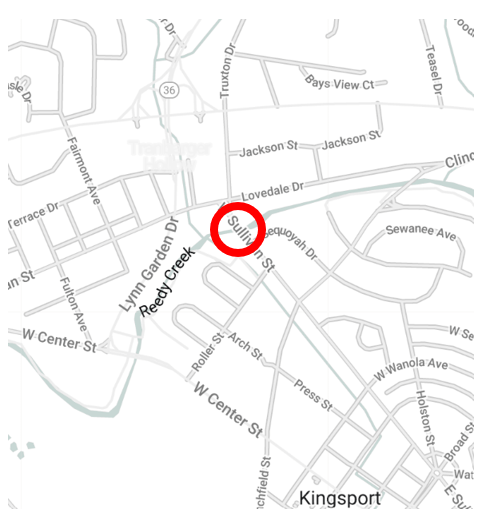
The bridge was located at the major intersection of the day–where the Great Stage Road (Netherland Inn Road / Sullivan Street), Reedy Creek Road (Bloomingdale Pike), and Scott County Road (Lynn Garden Drive) converged.
Today, Elizabethton is known for its charming, historic covered bridge. Kingsport might have been, too.
Most think of Kingsport as a modern city that’s just over 100 years of age, but it is actually one of the most historic places in Tennessee–it’s early settlement pre-dating statehood by 35 years.

 Kingsport Spirit
Leave a comment