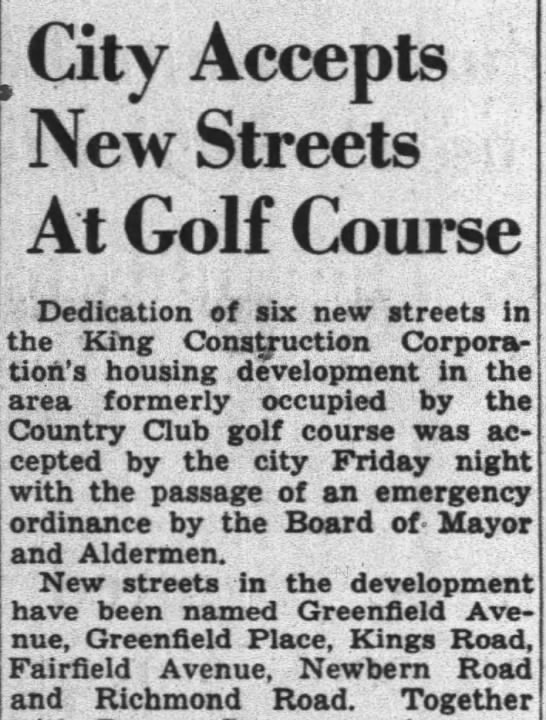
In 1947 (after World War II), there was a high demand for new housing in Kingsport. Enter King Construction Corporation (sometimes called King Development) headed by Glen Bruce. They developed Greenfields around six streets: Kings Road, Greenfield Avenue, Greenfield Place, Fairfield Avenue, Newbern Road, and Richmond Road. Wait, “Richmond Road”? But there isn’t a Richmond Road in Kingsport today. I wonder what happened?
First, let’s set the context.
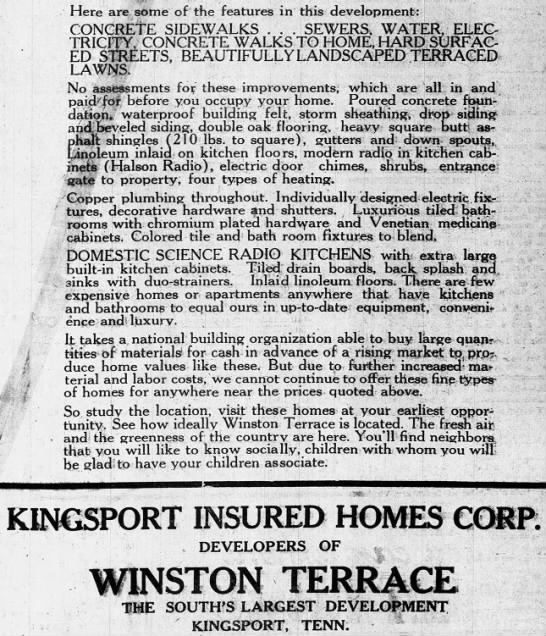
Ten years earlier, the 200-acre Kingsport Country Club was “forced out” (Kingsport Times, 1937). It was needed for housing and plans were made for the newly-formed Kingsport Insured Housing Corporation, headed by N.K. Winston and Arde Bulova of New York, to build up to 1000 new homes. It was marketed as “the South’s largest development” (Kingsport Times, 1937). But the world was on the verge of war and Kingsport’s defense industry needed housing—now. So, the plan for “Winston Terrace” shrank to include only the 1600 blocks of Carolina, Pineola, and Woodside (now East Sevier).
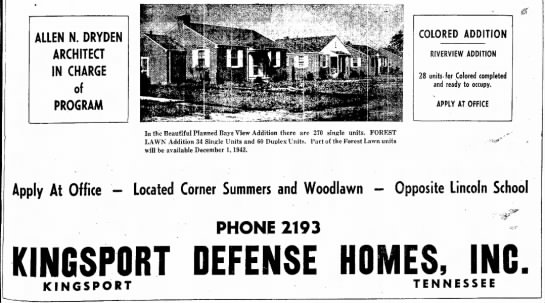
In 1943, Kingsport Defense Homes, Inc. took much of the former golf course for ‘speed brick’ homes on Morningside, Magnolia, Waverly, Garden, and the 1400-1500 blocks of Carolina, Pineola, and Woodside (East Sevier). They called it, “Bays View”. The homes could be built quickly to accommodate the swell of wartime housing demand being driven by the growth of Holston Army Ammunition Plant and other burgeoning industries.
After the war, the rest of the former golf course was eyed for housing as the soldiers returned and the baby boom began.
So if the transition from Borden Village to Bays View to Winston Terrace to Greenfields looks a little choppy, now you know why. Plans had to be modified during the war.
At the time, Eastman Road was the city limits. Greenfields on the west was inside, but the land that would later become Green Acres on the east side was outside the city.
Since the Greenfields side was built in 1948, families built and lived on Richmond Road for twelve years.
But when Hermitage Drive was built in 1960, it had many more homes than the Greenfields side.
Since the street was one alignment, the city changed the name to Hermitage Drive for both sides of Eastman Road.
Why they didn’t keep Richmond Road and extend the name is unknown. Maybe it was because the road didn’t lead to Richmond. Maybe it’s because Hermitage is synonymous with Tennessee.
Whatever the case, the mystery of Richmond Road is solved.

 Kingsport Spirit
Leave a comment